How, in the animal world, a daughter avoids mating with her father: Paternal 'voice' recognition
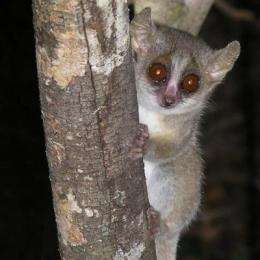
Paternal recognition – being able to identify males from your father's line – is important for the avoidance of inbreeding, and one way that mammals can do this is through recognizing the calls of paternal kin. This was thought to occur only in large-brained animals with complex social groups, but a new study published today in the open access journal BMC Ecology provides evidence in a tiny, solitary primate that challenges this theory.
The study, led by Sharon E Kessler, finds that the grey mouse lemur (Microcebus murinus) – a small-brained, solitary foraging mammal endemic to Madagascar – is able to recognize paternal relatives via vocalizations, thus providing evidence that this is not dependent upon having a large brain and a high social complexity, as previously suggested.
Because grey mouse lemurs are nocturnal solitary-foragers living in dense forests, vocal communication is important for regulating social interactions across distances where visibility is poor and communication via smell is limited. Though the mouse lemur shares sleeping sites with other mouse lemurs, it forages alone for fruit and insects. It is a particularly interesting species with which to study vocal paternal recognition because, in the wild, females remain in the same area of birth and cooperatively raise young with other female kin. Males do not co-nest with their mates or young and provide no paternal care, which limits opportunities for familiarity-based social interactions. Thus, vocalizations are likely to be important – particularly for avoiding inbreeding.
The research team from Arizona State University and the University of Veterinary Medicine Hannover in Germany found that two of the most frequent calls of the mouse lemur were the mate advertisement call and the alarm call. Using multi-parametric analyses of the call's acoustic parameters, they could see that both call types contained individual signatures. Through this, they discovered that only male grey mouse lemur advertisement calls, but not alarm calls, contained acoustic paternal signatures. Furthermore, females paid more attention to advertisement calls from unrelated males than from their fathers.
The findings from the study suggest that the discrimination between mate advertisement calls and alarm calls may be an important mechanism for inbreeding avoidance. This is likely to be highly important in the grey mouse lemur species because males are likely to remain in an area for several years and they can expand their ranges to more than twice that of the female's range, making it likely that adult males' ranges will overlap with those of their daughters from previous mating seasons.
The team also proposed that the mouse lemur's ultrasonic calls above the hearing range of owls could be an anti-predator strategy, especially since the species suffers from high predation.
Lead author Kessler commented, "Given that more complex forms of sociality with cohesive foraging groups are thought to have evolved from an ancestral solitary forager much like the mouse lemur, this suggests that the mechanisms for kin recognition like those seen here may be the foundation from which more complex forms of kin-based sociality evolved."
She continued, "Future analyses will determine which acoustic parameters make this kin recognition possible by artificially manipulating acoustic parameters in the calls and then using the modified calls in playback experiments."
More information: Paternal kin recognition in the high frequency / ultrasonic range in a solitary foraging mammal, Sharon E Kessler, Marina Scheumann, Leanne T Nash and Elke Zimmermann, BMC Ecology (in press)
Journal information: BMC Ecology
Provided by BioMed Central


