Made out of thin air: Fixation of CO2 through iridium catalyzed hydrosilylation
Oct 03, 2012

(Phys.org)—Carbon dioxide could be a useful alternative source of carbon for the chemical industry. It is inexpensive, is supplied in abundance by nature, and would help to reduce the consumption of fossil fuels. In addition, it would significantly improve the carbon footprint of fuels and chemical products. The largest barrier to this process is the high stability of the carbon dioxide molecule. In the journal Angewandte Chemie, Spanish researchers have now introduced a new process that traps carbon dioxide in the form of silyl formates, which are silicon-containing formic acid esters.

The of CO2 to formic acid (HCO2H) is an area of CO2 extraction that is being intensively researched. In the chemical industry, formic acid is used as a starting material for many products, with applications including agriculture, food technology, and the leather goods industry. Most interestingly, it could be used as a hydrogen- for fuel-cell-driven vehicles.

Although a number of catalytic processes for the production of formic acid from CO2 have been developed, none of them have been implemented industrially. The reaction is an equilibrium that significantly favors the . In order to hinder the constantly running reverse reaction, the formic acid must be trapped—in the form of salts, adducts, or derivatives—in order to remove it from the equilibrium.

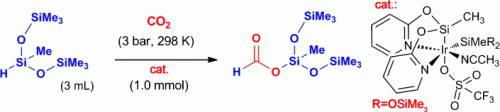
A team led by Francisco J. Fernández-Alvarez and Luis A. Oro at the University of Zaragoza has now developed a new catalyst that allows carbon dioxide to be converted and trapped as a silyl formate. These compounds can be used for the production of silicone polymers and as reactive intermediates in organic syntheses. It is also easily possible to release formic acid from the silyl formate.

The new reaction, which the researchers have been able to carry out on a gram scale, occurs under very mild reaction conditions. It is highly selective and delivers a high turnover, works without a solvent and produces no waste products. The carbon dioxide is reduced by heptamethyltrisiloxane. At the heart of the reaction lies a specially developed iridium catalyst that is formed in situ from an air- and water-stable precursor.

Explore further: Continuous hydrogenation of carbon dioxide to pure formic acid in supercritical CO2

More information: Luis A. Oro, Effective Fixation of CO2 by Iridium-Catalyzed Hydrosilylation. Angewandte Chemie International Edition. dx.doi.org/10.1002/anie.201206165

Related Stories

Modified microbes turn carbon dioxide to liquid fuel

Mar 29, 2012

Imagine being able to use electricity to power your car — even if it's not an electric vehicle. Researchers at the UCLA Henry Samueli School of Engineering and Applied Science have for the first time ...

New catalyst for safe, reversible hydrogen storage

Mar 18, 2012

(PhysOrg.com) -- Scientists at the Brookhaven National Laboratory and collaborators have developed a new catalyst that reversibly converts hydrogen gas and carbon dioxide to a liquid under very mild conditions. ...

Recommended for you

Unique method creates correct mirror image of molecule

May 22, 2013

Many molecules have a right and a left form, just like shoes. In pharmaceuticals, it is important that the correct form of the molecule is used. Researchers at the University of Gothenburg, Sweden, have been ...

New method for producing clean hydrogen

May 21, 2013

Duke University engineers have developed a novel method for producing clean hydrogen, which could prove essential to weaning society off of fossil fuels and their environmental implications.

Non-wetting fabric drains sweat

May 20, 2013

(Phys.org) —Waterproof fabrics that whisk away sweat could be the latest application of microfluidic technology developed by bioengineers at the University of California, Davis.

Beautiful 'flowers' self-assemble in a beaker

May 16, 2013

By simply manipulating chemical gradients in a beaker of fluid, materials scientists at Harvard have found that they can control the growth behavior of crystals to create precisely tailored structures—such ...

User comments : 11

Adjust slider to filter visible comments by rank

Display comments: newest first

daqman
5 / 5 (5) Oct 03, 2012
Widespread catalytic conversion of atmospheric CO2 into useful organic chemicals has been underway for some time. In particular the use of solar energy to facilitate the reaction has been very successful.

The infrastructure for such organic chemical production is readily visible in most countries of the world, they are called plants.

Couldn't resist.
nkalanaga
3 / 5 (1) Oct 03, 2012
True, but plants are optimized to produce more plants. It would be nice if we could do the same thing to produce other products. Also, plant photosynthesis is relatively inefficient by industrial standards do to the amount of energy required to maintain the plant itself. relatively little finished product (seeds, etc) is produced compared to the energy collected.

I did like your comment, though, and it is true.
dnatwork
5 / 5 (1) Oct 03, 2012
But no one will invest in plants because everyone knows that money doesn't grow on trees.

Seriously, though, the only way global warming will be addressed is if the people who have money now can make more money off of solving the problem than from making it worse.
Eikka
5 / 5 (2) Oct 03, 2012
Also, plant photosynthesis is relatively inefficient by industrial standards do to the amount of energy required to maintain the plant itself.


Same goes for solar panels, mind you.

The amount of energy required to sustain the industry that makes, installs and maintains the solar infrastructure is a huge part of the energy they produce, giving just 6-7 times more energy than the energy you spent.

Roland
1 / 5 (1) Oct 03, 2012
Wikipedia: "...one of the rarest elements in the Earth's crust, with annual production and consumption of only three tonnes."
Eventide
5 / 5 (1) Oct 03, 2012
Roland you right. I just wish you included the key word "iridium" in your post because it certainly is not abundant like silicon is. If they can develop an alternative to an iridium catalyst that is derived from abundant materials and can be retrofitted in all running cars and industrial plants and to suck CO2 from the atmosphere, now that will be worth reporting about and doing.
Chromodynamix
5 / 5 (1) Oct 04, 2012
Plenty of Iridium in asteroids as the dinosaurs will attest!
natello
1 / 5 (2) Oct 04, 2012
Couldn't resist.
You should wait, until we find a source of cheap iridium. Apparently, many scientific wannabes here are economical imbeciles. In such ignorant environment it's easy for scientists to make a comfortable life from research and proposals of unfeasible solutions.
antialias_physorg
5 / 5 (1) Oct 04, 2012
It seems this has to be explained to you over and over again. Science is not development, nor is it engineering. This is a site that reports (mainly) on science.

Science figures out what works. First you have to find out that you can do such a reaction at all.

The next step is development. Here's where you try to find ways to make the process cheaper and scaleable (in this case e.g. by finding replacements for iridium).

Then comes engineering where you optimize and actually scale the process up for widespread deployment.

Are these distinctions so hard to understand?
SteveL
not rated yet Oct 07, 2012
Widespread catalytic conversion of atmospheric CO2 into useful organic chemicals has been underway for some time. In particular the use of solar energy to facilitate the reaction has been very successful.

The infrastructure for such organic chemical production is readily visible in most countries of the world, they are called plants.

Couldn't resist.
Plants are not technically "catalytic". Sorry, couldn't resist.
SteveL
not rated yet Oct 07, 2012
But no one will invest in plants because everyone knows that money doesn't grow on trees.
People have been investing in plants for thousands of years.

More news stories

Chemists find new compounds to curb staph infection

(Phys.org) —In an age when microbial pathogens are growing increasingly resistant to the conventional antibiotics used to tamp down infection, a team of Wisconsin scientists has synthesized a potent new ...

New method for producing clean hydrogen

Duke University engineers have developed a novel method for producing clean hydrogen, which could prove essential to weaning society off of fossil fuels and their environmental implications.

Engineers pioneer flat spray-on optical lens

A University of British Columbia engineer and a team of U.S. researchers have made a breakthrough utilizing spray-on technology that could revolutionize the way optical lenses are made and used.

Russia evacuates drifting Arctic research station

Russia has ordered the urgent evacuation of the 16-strong crew of a drifting Arctic research station after ice floe that hosts the floating laboratory began to disintegrate, officials said Thursday.