Self-assembling polymeric copper catalyst greatly accelerates 'click reaction'
Oct 26, 2012
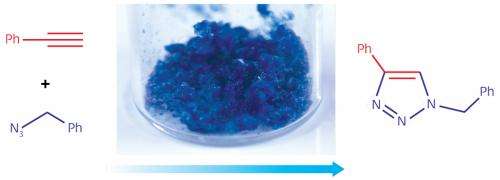
The blue copper catalyst drives the click reaction between an alkyne (left, red) and an azide (left, blue) to form a triazole (right). Credit: 2012 American Chemical Society

Few recently discovered chemical reactions have proven as powerful as the copper-catalysed Huisgen 1,3-dipolar cycloaddition between azides and alkynes—a transformation better known as a 'click reaction'. The process gets its nickname from the robust, reliable way that the azide and the alkyne organic functional groups 'click' together. From materials science to biochemical applications, this dependable method for joining molecules together has been exploited widely in the decade since its discovery. Now, Yoichi Yamada, Shaheen Sarkar and Yasuhiro Uozumi at the RIKEN Advanced Science Institute in Wako have developed a new form of heterogeneous copper catalyst that promises to make the click reaction more efficient than ever.

do not dissolve into the reaction mixture; they remain as a solid inside the reaction flask, offering a catalytic surface on which the reaction can take place. The key advantage of these catalysts is that they can easily be recaptured for re-use at the end of a reaction, often by simple filtration. Their disadvantage is that they are less intimately dispersed with the reactants than catalysts that dissolve, slowing the reaction.

The researchers overcame this disadvantage by embedding their copper within a self-assembled two-component polymer. The polymer backbone is made of a material called isopropylacrylamide, which has a hydrophobic sub-section and a hydrophilic sub-section. Overall, the material acts as an 'amphiphilic sponge': it readily draws in reactants and substrates regardless of their hydrophobicity, Yamada says.

The second polymer component is an imidazole, an electron-donating material that stabilizes and activates the copper to accelerate the click reaction. "The catalytic copper species within the sponge instantaneously react with substrates and reactant to give the products and to regenerate the catalyst," Yamada explains.

The material's performance is the best yet reported for a heterogeneous click catalyst, he adds. The best previous materials had turnover numbers below 1,000 before the catalyst would become deactivated, whereas the team's catalyst had a turnover number of 209,000. The catalyst's turnover frequency was also fast, turning into product at a rate of 6,740 conversions per hour.

The re-usable catalyst should find a host of applications, Yamada says. "The catalyst will be applied to the synthesis of pharmaceutical compounds and functional organic materials." The next step for the researchers is to incorporate the catalyst into a 'flow system', in which the is immobilized within a cartridge through which substrates and reagents are continually pumped, generating a continuous steady stream of product.

Explore further: Researchers develop superior fuel cell material

More information: Yamada, Y. M. A., Sarkar, S. M. & Uozumi, Y. Amphiphilic self-assembled polymeric copper catalyst to parts per million levels: click chemistry. Journal of the American Chemical Society 134, 9285–9290 (2012). dx.doi.org/10.1021/ja3036543

Related Stories

Longer-lasting chemical catalysts

Jan 13, 2012

Metal-based chemical catalysts have excellent green chemistry credentials—in principle at least. In theory, catalysts are reusable because they drive chemical reactions without being consumed. In reality, ...

Clicking synthetic and biological molecules together

Feb 19, 2008

Dutch researcher Joost Opsteen has developed a method to click polymers together in a controlled manner. Using this method, he can even attach proteins to nanoballs. For instance, this approach could be used to transport ...

A personality change for a catalyst

Mar 07, 2011

For more than 40 years, an ambition of catalysis science has been to persuade homogeneous catalysts to behave more like heterogeneous catalysts, while still maintaining their activity and exquisite selectivity. Professor ...

Click chemistry with copper -- a biocompatible version

Jul 18, 2011

Berkeley Lab researchers have found a way to make copper-catalyzed click chemistry biocompatible. By adding a ligand that minimizes the toxicity of copper but still allows it to catalyze the click chemistry ...

New Class of Catalyst Sports Shapely Selectivity

Mar 10, 2010

A new class of catalytic material has been studied by scientists at Pacific Northwest National Laboratory. Metal-organic frameworks (MOFs) display a unique three-dimensional structure that is highly selective ...

Researchers develop superior fuel cell material

Aug 24, 2012

Using a mixture of gold, copper and platinum nanoparticles, IBN researchers have developed a more powerful and longer lasting fuel cell material. This breakthrough was published recently in leading journal, ...

Recommended for you

Unique method creates correct mirror image of molecule

8 hours ago

Many molecules have a right and a left form, just like shoes. In pharmaceuticals, it is important that the correct form of the molecule is used. Researchers at the University of Gothenburg, Sweden, have been ...

New method for producing clean hydrogen

May 21, 2013

Duke University engineers have developed a novel method for producing clean hydrogen, which could prove essential to weaning society off of fossil fuels and their environmental implications.

Non-wetting fabric drains sweat

May 20, 2013

(Phys.org) —Waterproof fabrics that whisk away sweat could be the latest application of microfluidic technology developed by bioengineers at the University of California, Davis.

Beautiful 'flowers' self-assemble in a beaker

May 16, 2013

By simply manipulating chemical gradients in a beaker of fluid, materials scientists at Harvard have found that they can control the growth behavior of crystals to create precisely tailored structures—such ...

User comments : 0

More news stories

DNA damage: The dark side of respiration

(Phys.org) —Adventitious changes in cellular DNA can endanger the whole organism, as they may lead to life-threatening illnesses like cancer. Researchers at LMU now report how byproducts of respiration cause mispairing ...

NASA: Austin, calling Austin. 3-D pizzas to go

(Phys.org) —The idea of living with 3-D printed food is neither unthinkable nor new; designers and futurists have been looking to 3-D printing as food's next frontier. In 2012, there was news that the Thiel ...

Brain can be trained in compassion, study shows

Until now, little was scientifically known about the human potential to cultivate compassion—the emotional state of caring for people who are suffering in a way that motivates altruistic behavior.