US panel: China tech giants pose security threat (Update)
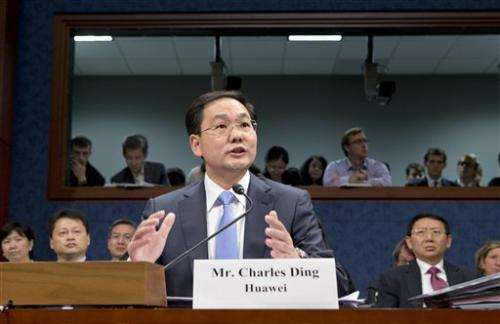
(AP)—American companies should avoid sourcing network equipment from China's two leading technology firms because they pose a national security threat to the United States, the House Intelligence Committee warned Monday.
The panel said in a report that U.S. regulators should block mergers and acquisitions in this country by Huawei Technologies Ltd. and ZTE Corp, among the world's leading suppliers of telecommunications gear and mobile phones.
Reflecting U.S. concern over cyber-attacks traced to China, the report also recommends that U.S. government computer systems not include any components from the two firms because that could pose an espionage risk.
"China is known to be the major perpetrator of cyber-espionage, and Huawei and ZTE failed to alleviate serious concerns throughout this important investigation. American businesses should use other vendors," the committee's chairman, Rep. Mike Rogers, R-Mich, told a news conference. He said the Chinese companies could not be trusted with access to computer networks that support everything from power grids to finance systems.
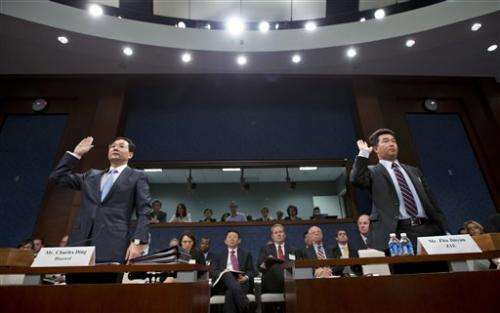
The recommendations are the result of a yearlong probe, including a congressional hearing last month in which senior Chinese executives of both companies denied posing a security threat and being under Beijing's influence.
Rogers said they are clearly tied to the Chinese government, and that allowing Huawei and ZTE to provide network equipment and services in America risks confidential consumer information and undermines core national security interests. He said the committee was not concerned about the sales of handsets that make up the bulk of their U.S. businesses, but rather network infrastructure where they have made fewer inroads.
William Plummer, vice president for external affairs for Huawei, said his company, a private entity founded by a former Chinese military engineer, was being victimized because of U.S. government concerns about China's government.
"Huawei is Huawei, Huawei is not China," he told reporters. "My company should not be held hostage to someone's political agenda."
Ahead of the report's release, China's foreign ministry said investment by telecommunications companies is mutually beneficial. "We hope the U.S. will do more to benefit the interests of the two countries, not the opposite," spokesman Hong Lei said at a regular briefing in Beijing Monday.
The panel's recommendations, however, will likely hamper Huawei and ZTE's ambitions to expand their businesses in America. Their products are used in scores of countries, including in the West.
The bipartisan report could also become fodder for a presidential campaign in which the candidates have been competing in their readiness to clamp down on Chinese trade violations. Republican Mitt Romney, in particular, has made it a key point to get tougher on China by designating it a currency manipulator and fighting abuses such as intellectual property theft.
Rogers said its release had nothing to do with politics, and was motivated by the need to alert U.S. companies of the risks. The committee's top Democrat, C.A. Dutch Ruppersberger, said U.S. companies should proceed with "their eyes wide open." He cited an estimate from the U.S. Cyber Command that more than $300 billion in U.S. trade secrets was stolen last year.
The committee says it received information from industry experts and current and former Huawei employees suggesting that Huawei, in particular, may be violating U.S. laws. The allegations include immigration violations and an alleged "pattern and practice" of Huawei using pirated software in its U.S. facilities.
Rogers said that information of alleged bribery by Huawei to gain a contract in the U.S. would be forwarded Tuesday to the FBI, and he was confident it would lead to an investigation. The committee also planned to forward information on allegations of "beaconing" from Huawei equipment to China—that is the unauthorized transfer of information from a computer network.
Huawei, founded in 1987 has grown rapidly to become the world's second largest supplier of telecommunications network gear, operating in more than 140 countries. ZTE Corp, which is partly state-owned, is the world's fourth largest mobile phone manufacturer, with 90,000 employees worldwide.
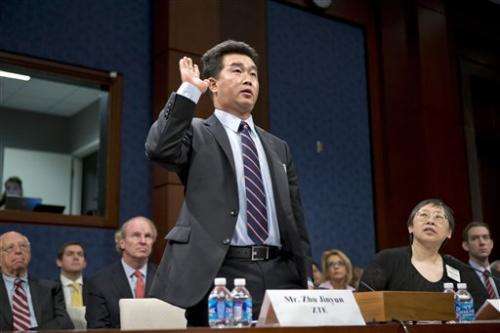
The report says the companies failed to provide responsive answers about their relationships and support by the Chinese government, and detailed information about their operations in the U.S. It says Huawei, in particular, failed to provide thorough information, including on its corporate structure, history, financial arrangements and management.
Plummer said it wasn't clear what Rogers was referring in the allegations of "beaconing." He said Huawei had provided "endless data" to the investigation, which he contended was not objective. He said its recommendations could create "market-distorting trade policy" and risk the tens of thousands of American jobs Huawei helps to support through procurement from U.S.-based suppliers that totaled $6.6 billion last year.
The recommendations "undermine competition, which undermines innovation which drives up the price of your broadband," he said.
ZTE said a Sept. 25 letter to the committee, released Monday, that China's government had never requested access to ZTE's equipment.
"Direct exclusion of one or two identifiable Chinese companies is an obvious unfair trade practice and, as a practical matter, would not provide meaningful security for US telecom infrastructure systems," the letter says.
In justifying its investigation, the committee contended that Chinese intelligence services, as well as private companies and other entities, often recruit those with direct access to corporate networks to steal trade secrets and other sensitive data.
It warned that malicious hardware or software implants in Chinese-manufactured telecommunications components and systems could allow Beijing to shut down or degrade critical national security systems in a time of a crisis.
Huawei denies being financed to undertake research and development for the Chinese military, but the committee says it has received internal Huawei documentation from former employees showing the company provides special network services to an entity alleged to be an elite cyber-warfare unit within the People's Liberation Army.
The intelligence committee recommended that the government's Committee on Foreign Investment in the United States, or CFIUS, bar mergers and acquisitions by both Huawei and ZTE. A multi-agency regulatory panel chaired by Treasury Secretary Timothy Geithner, CFIUS screens foreign investment proposals for potential national security threats.
Last year, Huawei had to unwind its purchase of a U.S. computer company, 3Leaf Systems, after it failed to win CFIUS approval. Still, Huawei employs 1,700 people in the U.S., and business is expanding. U.S. revenues rose to $1.3 billion in 2011, up from $765 million in 2010.
ZTE has also enjoyed growth in its sale of mobile devices, although in recent months it has faced allegations about banned sales of U.S.-sanctioned computer equipment to Iran. The FBI is probing reports that the company obstructed a U.S. government investigation into the sales.
Copyright 2012 The Associated Press. All rights reserved. This material may not be published, broadcast, rewritten or redistributed.


