NASA sees very strong wind shear battering Tropical Storm Gaemi
Oct 06, 2012
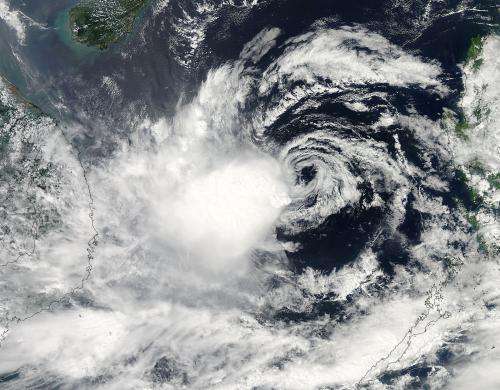
NASA's Aqua satellite passed over Tropical Storm Gaemi as it was approaching Vietnam (left) on Oct. 5, 2012 at 0550 UTC (1:50 a.m. EDT). The bulk of showers and thunderstorms are clearly to the southwest of the center. Credit: NASA/Goddard/MODIS Rapid Response Team

It is easy to see the effect of the strong northeasterly wind shear battering Tropical Storm Gaemi in satellite imagery from NASA. Visible imagery on Oct. 5 shows a large oval-shaped area of showers and thunderstorms associated with the storm, southwest of the exposed center of circulation.

NASA's Aqua satellite passed over Tropical Storm Gaemi as it was approaching Vietnam on Oct. 5, 2012 at 0550 UTC (1:50 a.m. EDT). A true-color image of the storm was captured by the Moderate Resolution Imaging Spectroradiometer (MODIS) instrument and shows bulk of showers and thunderstorms were clearly to the southwest of the center. The circulation center appears as a ring of concentric bands of clouds northeast of the large rounded area of clouds and showers associated with the storm.

On Tuesday, Oct. 5, 2012 at 1500 UTC (11 a.m. EDT), Tropical Storm Gaemi still had near 35 knots (40 mph/65 kph) as it did 24 hours before. It was located 425 nautical miles (489 miles/787 km)east of Hue, Vietnam near 14.7 North latitude and 117.7 East longitude. Gaemi has picked up speed and is moving to the west now at 11 knots (12.6 mph/20.3 kph).

Gaemi is forecast to make landfall south of Hue, Vietnam sometime on Oct. 6 after 11 a.m. EDT (1500 UTC). The Joint expects Gaemi to dissipate two days after landfall.

Explore further: NASA identifies where Tropical Storm Gaemi's power lies

add to favorites email to friend print save as pdf

Related Stories

NASA sees strong thunderstorms in Tropical Storm Gaemi

Oct 02, 2012

Infrared NASA satellite imagery revealed that the strongest thunderstorms within Tropical Storm Gaemi in the western North Pacific Ocean were located around the storm's center and in a band of thunderstorms ...

Recommended for you

Origins of human culture linked to rapid climate change

5 hours ago

Rapid climate change during the Middle Stone Age, between 80,000 and 40,000 years ago, during the Middle Stone Age, sparked surges in cultural innovation in early modern human populations, according to new research.

Bangladeshi, South Korean climbers die on Everest

11 hours ago

A climber from Bangladesh and another from South Korea have died on Mount Everest as hundreds flock to the world's highest peak during good weather, Nepalese tourism officials said Tuesday.

User comments : 0

More news stories

Climate change and wildfire: Synthesis of recent findings

Concerns continue to grow about the effects of climate change on fire. Wildfires are expected to increase 50 percent across the United States under a changing climate, over 100 percent in areas of the West by 2050 as projected ...

New method for producing clean hydrogen

Duke University engineers have developed a novel method for producing clean hydrogen, which could prove essential to weaning society off of fossil fuels and their environmental implications.