NASA watching Hurricane Paul, warnings up for Baja California
Oct 15, 2012
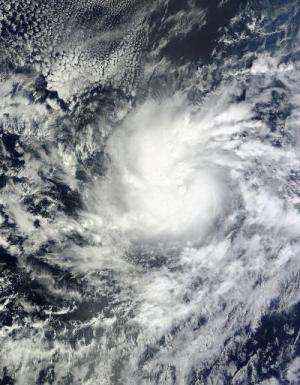
The MODIS instrument aboard NASA's Terra satellite captured this visible image of Paul on Oct. 13 at 18:25 UTC (2:25 p.m. EDT) just before it was a tropical storm off the west coast of Mexico. Paul has since strengthened into a hurricane. Credit: NASA Goddard MODIS Rapid Response Team

Tropical cyclones seem to love forming over weekends, Rafael formed over the weekend in the Atlantic, Anais in the Southern Indian Ocean and Hurricane Paul in the eastern Pacific Ocean. NASA's Terra satellite kept on top of Paul, however, and provided forecasters with a visible look at the newborn storm.

Paul formed on Oct. 13 at 5 p.m. EDT about 660 miles (1,065 km) south-southwest of the southern tip of Baja California, near 14.0 North and 113.6 West.

The Moderate Resolution Imaging Spectroradiometer (MODIS) instrument aboard NASA's captured a visible image of Paul on Oct. 13 at 18:25 UTC (2:25 p.m. EDT) just before it was officially designated a off the west coast of Mexico. The visible imagery showed powerful thunderstorms in a large, wide band wrapping around the storm from the north, around the western side and into the center from the southern quadrant. Paul has since strengthened into a hurricane.

On Monday, Oct. 15 at 11 a.m. EDT Paul strengthened into a hurricane and a Tropical Storm Warning was then posted for a part of the western coast of Baja California, Mexico.

A Tropical Storm Warning covers the west coast of the Baja Peninsula from Santa Fe northward to Puerto San Andresito, Mexico, and a Tropical Storm Watch is in effect from north of Puerto San Andresito to El Pocito.

Paul had near 90 mph (150 kph). It is located about 495 miles (800 km) southwest of the southern tip of Baja California, Mexico, near 17.3 North latitude and 114.7 West longitude. Paul is moving to the north at 13 mph (20 kph) and is expected to continue for a day or two before turning to the north-northwest and away from land.

The National Center expects Paul to bring dangerous surf and heavy rainfall to the Baja and tropical storm conditions by the afternoon hours on Oct. 16. Rainfall is expected between 2 and 4 inches with higher isolated totals.

Explore further: NASA sees brief life of Tropical Storm Olivia

add to favorites email to friend print save as pdf

Related Stories

NASA sees brief life of Tropical Storm Olivia

Oct 09, 2012

Tropical Storm Olivia was a three-day tropical cyclone in the eastern Pacific Ocean. It was born on Oct. 6 and faded to a remnant low pressure system on Oct. 9. NASA's Aqua satellite captured an image of ...

Satellite sees Miriam weaken to a tropical storm

Sep 26, 2012

Once a powerful hurricane, Miriam is now a tropical storm off the coast of Baja California, Mexico. Tropical Storm Miriam was seen in the Eastern Pacific Ocean by NOAA's GOES-15 satellite, and the visible ...

NASA sees Eastern Pacific storms power up and down

Sep 17, 2012

While Tropical Storm Kristy faded into a remnant low pressure area, Lane strengthened into a hurricane. NASA's Terra satellite caught a look at both storms when it passed overhead on Sept. 16 and showed a ...

Recommended for you

NASA's BARREL mission launches 20 balloons

10 hours ago

(Phys.org) —In Antarctica in January, 2013 – the summer at the South Pole – scientists released 20 balloons, each eight stories tall, into the air to help answer an enduring space weather question: ...

Power of US tornado dwarfs Hiroshima bomb

11 hours ago

Wind, humidity and rainfall combined precisely to create Monday's massive killer tornado in Oklahoma. The awesome amount of energy released dwarfed the power of the atomic bomb that leveled Hiroshima.

Origins of human culture linked to rapid climate change

18 hours ago

Rapid climate change during the Middle Stone Age, between 80,000 and 40,000 years ago, during the Middle Stone Age, sparked surges in cultural innovation in early modern human populations, according to new research.

User comments : 0

More news stories

Moore tornado a rarity, experts say

Tornados, among the most violent of atmospheric storms, rarely reach the size and brutality of the twister that swept through an Oklahoma City suburb on Monday, experts say.

Study says empathy plays a key role in moral judgments

Is it permissible to harm one to save many? Those who tend to say "yes" when faced with this classic dilemma are likely to be deficient in a specific kind of empathy, according to a report published in the scientific journal ...

Australia set to cull 10,000 wild horses

A controversial cull of up to 10,000 wild horses in Australia's harsh Outback reportedly began Wednesday in a bid to control the feral animals which officials say are destroying the land.