Moroccan desert meteorite delivers Martian secrets
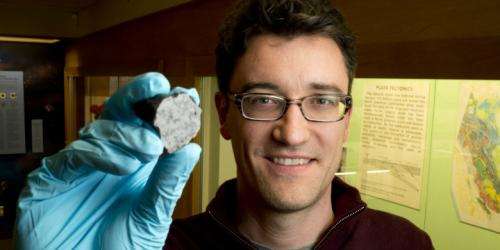
(Phys.org)—A meteorite that landed in the Moroccan desert 14 months ago is providing more information about Mars, the planet where it originated. University of Alberta researcher Chris Herd helped in the study of the Tissint meteorite, in which traces of Mars' unique atmosphere are trapped.
"Our team matched traces of gases found inside the Tissint meteorite with samples of Mars' atmosphere collected in 1976 by Viking, NASA's Mars lander mission," said Herd.
Herd explained that 600 million years ago the meteorite started out as a fairly typical volcanic rock on the surface of Mars when it was launched off the planet by the impact of an asteroid.
"At the instant of that impact with Mars, a shock wave shot through the rock," said Herd. "Cracks and fissures within the rock were sealed instantly by the heat, trapping components of Mars' atmosphere inside, and forming black, glassy spots."
The team estimates that for a period between 700,000 and one million years the rock floated through outer space until July, 2011 when it streaked through Earth's atmosphere landing in Morocco.
This is only the fifth time a Martian meteorite landing was witnessed. Herd says the fact that it was picked up just a few months after landing and was not subjected to weathering or contamination on this planet is the key reason why this meteorite is so important.
The Martian weathering involved water, which means water was present on the surface of Mars within the past few hundred million years. But Herd says this meteorite sample does not carry any evidence the water supported any life forms.
"Because the Martian rock was subject to such intense heat any water borne microbial life forms that may have existed deep within cracks of the rock would have been destroyed," said Herd.
Curiosity, NASA's current Mars Rover mission is moving around the Red Planet searching for more information on the history of Mars.
The team's study makes a return mission to Mars that will bring rocks back to Earth all the more crucial, "Martian rocks delivered to Earth by a space craft would provide the best opportunity to see if life was ever clinging to the surface of Mars."
More information: The research paper published online Oct. 11 in the journal Science.
"Tissint Martian Meteorite: A Fresh Look at the Interior, Surface and Atmosphere of Mars," by H. Chennaoui Aoudjehane, Science, 2012.
Journal information: Science
Provided by University of Alberta


