Mars soil sample delivered for analysis inside rover
Oct 18, 2012
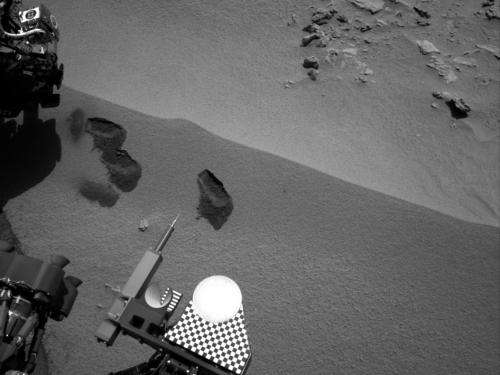
Three bite marks left in the Martian ground by the scoop on the robotic arm of NASA's Mars rover Curiosity are visible in this image taken by the rover's right Navigation Camera during the mission's 69th Martian day, or sol (Oct. 15, 2012). Image credit: NASA/JPL-Caltech

(Phys.org)—NASA's Mars rover Curiosity has ingested its first solid sample into an analytical instrument inside the rover, a capability at the core of the two-year mission.

The rover's Chemistry and (CheMin) instrument is analyzing this sample to determine what minerals it contains.

"We are crossing a significant threshold for this mission by using CheMin on its first sample," said Curiosity's project scientist, John Grotzinger of the California Institute of Technology in Pasadena. "This instrument gives us a more definitive mineral-identifying method than ever before used on Mars: X-ray diffraction. Confidently identifying minerals is important because minerals record the under which they form."

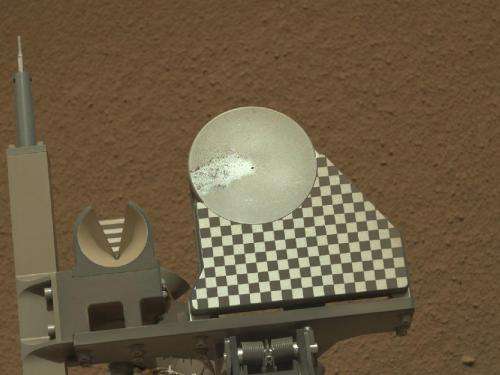
The robotic arm on NASA's Mars rover Curiosity delivered a sample of Martian soil to the rover's observation tray for the first time during the mission's 70th Martian day, or sol (Oct. 16, 2012). Image credit: NASA/JPL-Caltech/MSSS

The sample is a sieved portion—about as much material as in a baby aspirin—from the third scoop collected by Curiosity as a windblown patch of dusty sand called "Rocknest." The rover's robotic arm delivered the sample to CheMin's opened inlet funnel on the rover's deck on Oct. 17.

The previous day, the rover shook the scooped material inside sample-processing chambers to scrub internal surfaces of any residue carried from Earth. One earlier scoopful was also used for cleaning. Additional repetitions of this cleaning method will be used before delivery of a future sample to the rover's other internal analytic instrument, the Analysis at Mars investigation, which studies samples' chemistry.
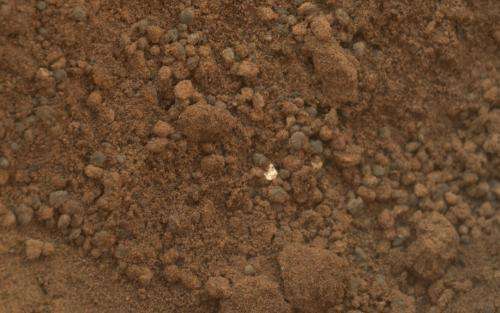
This image shows part of the small pit or bite created when NASA's Mars rover Curiosity collected its second scoop of Martian soil at a sandy patch called "Rocknest." Image credit: NASA/JPL-Caltech/MSSS

Various small bits of light-toned material on the ground at Rocknest have affected the rover's activities in the past several days. One piece about half an inch (1.3 centimeters) long was noticed on Oct. 7. The rover team postponed use of the for two days while investigating this object, and assessed it to be debris from the spacecraft.

Images taken after Curiosity collected its second scoop of Rocknest material on Oct. 12 showed smaller bits of light-toned material in the hole dug by the scooping action. This led to discarding that scoopful rather than using it to scrub the processing mechanisms. Scientists assess these smaller, bright particles to be native Martian material, not from the spacecraft.

"We plan to learn more both about the spacecraft material and about the smaller, bright particles," said Curiosity Project Manager Richard Cook of 's Jet Propulsion Laboratory, Pasadena. "We will finish determining whether the spacecraft material warrants concern during future operations. The native Mars particles become fodder for the mission's scientific studies."

During a two-year prime mission, researchers are using 's 10 instruments to assess whether the study area has ever offered environmental conditions favorable for microbial life.

Explore further: Curiosity rover's second scoop discarded, third scoop commanded

Related Stories

Curiosity preparing for second scoop

Oct 15, 2012

On Sol 65 (Oct. 11, 2012) of the Mars Science Laboratory mission, NASA's Mars rover Curiosity completed several activities in preparation for collecting its second scoop of soil. Like the first scoop, the ne ...

Recommended for you

NASA head views progress on asteroid lasso mission

12 hours ago

Surrounded by engineers, NASA chief Charles Bolden inspected a prototype spacecraft engine that could power an audacious mission to lasso an asteroid and tow it closer to Earth for astronauts to explore.

Ecuador satellite collides with Russian space junk

12 hours ago

A small Ecuadoran satellite collided in orbit with the remains of a Russian rocket, but it is too soon to know how much damage it might have sustained, Quito's space agency said Thursday.

Forecast for Titan: Wild weather could be ahead

May 22, 2013

(Phys.org) —Saturn's moon Titan might be in for some wild weather as it heads into its spring and summer, if two new models are correct. Scientists think that as the seasons change in Titan's northern hemisphere, ...

SDO observes mid-level solar flare

May 22, 2013

UPDATE 16:30 p.m. EDT: The M7-class flare was also associated with a coronal mass ejection or CME, another solar phenomenon that can send billions of tons of particles into space. While this CME was not Ea ...

User comments : 7

Adjust slider to filter visible comments by rank

Display comments: newest first

hemitite
3.3 / 5 (7) Oct 18, 2012
My working hypothesis it that the small light colored object is actually a children's aspirin tablet.
gwrede
5 / 5 (2) Oct 19, 2012
The "sand" in the picture looks damp. Now, I don't actually believe it to be soaked with water, but it would be nice if some article explained what makes it look damp.
Claudius
3 / 5 (2) Oct 19, 2012
It will be interesting to see what the bits are made of. They can analyze them, can't they?
ValeriaT
5 / 5 (1) Oct 19, 2012
The "sand" in the picture looks damp. Now, I don't actually believe it to be soaked with water, but it would be nice if some article explained what makes it look damp.
Yep, I noticed it too. Maybe it's electrostatic effect.
BloodSpill
5 / 5 (1) Oct 19, 2012
With a crappy excuse for an atmosphere, would solar radiation cause more static attraction between sands on the surface of Mars?
I know dust from the Moon is famous for sticking to everything and getting everywhere. Is it an ionisation effect?
NotAsleep
5 / 5 (1) Oct 19, 2012
I think moon dust sticks more because it is (relatively) sharp from lack of weathering
EBENEZR
5 / 5 (1) Oct 19, 2012
I think moon dust sticks more because it is (relatively) sharp from lack of weathering


True, whereas Martian duststorms can envelope the planet and last a long time. Not saying this means there won't be any (as you say) "relatively" sharp particles, but it certainly suggests something else at play. I believe ice particles play a role (http://www.space....ky.html"]Mars Dirt Surprisingly Sticky - Space.com[/URL]), seeing how easily ice cubes stick to one's fingers.

More news stories

A hidden population of exotic neutron stars

(Phys.org) —Magnetars – the dense remains of dead stars that erupt sporadically with bursts of high-energy radiation - are some of the most extreme objects known in the Universe. A major campaign using ...

Hubble reveals the ring nebula's true shape

(Phys.org) —The Ring Nebula's distinctive shape makes it a popular illustration for astronomy books. But new observations by NASA's Hubble Space Telescope of the glowing gas shroud around an old, dying, ...

Century-old science helps confirm global warming

(Phys.org) —Ocean measurements taken more than 135 years ago during the scientific expedition of HMS Challenger have provided further confirmation of human-produced global warming over the past century.

Controlling mood through the motions of mitochondria

(Medical Xpress)—Regulating the distribution of power in neurons is done by a system that makes the national electric grid look simple by comparison. Each neuron has several thousand mitochondria confined ...

A quantum simulator for magnetic materials

Physicists understand perfectly well why a fridge magnet sticks to certain metallic surfaces. But there are more exotic forms of magnetism whose properties remain unclear, despite decades of intense research. ...