Less is more when choosing between groups of assorted items
Oct 03, 2012
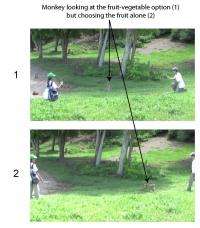
A monkey chooses between groups of objects. Credit: PLoS ONE 7(10): e46240.doi:10.1371/journal.pone.0046240

When making decisions about the value of an assortment of different objects, people approximate an average overall value, which though frequently useful can lead to apparently irrational decision-making. A new study published Oct 3 in PLOS ONE by Jerald Kralik and colleagues at Dartmouth College shows for the first time that non-human primates also make similar 'irrational' choices based on approximation.

In the study, researchers found that preferred a highly-valued food item (a fruit) alone to the identical item paired with a food of positive but lower value (fruit and a vegetable).

The researchers suggest that this behavior is similar to what has been seen in previous studies with humans, where participants rated a 24-piece dinnerware set more highly than one with the same 24 pieces, plus 16 more pieces of which nine were broken.

According to the authors, decision-making processes in humans and other primates have evolved towards reducing the complexity in choices between large groups of assorted items, which may result in such irrational choices.

"People often judge a group—-of valuables, of foods, of other people—-by its average rather than by the sum of its parts. Our study shows that monkeys appear to do the same thing, which suggests that both monkeys and people inherited a particular way of simplifying the world around us, making choices easier, sometimes at the expense of ''" says Kralik.

Explore further: Seeing certain foods prompts kids to eat healthier

More information: Kralik JD, Xu ER, Knight EJ, Khan SA, Levine WJ (2012) When Less Is More: Evolutionary Origins of the Affect Heuristic. PLoS ONE 7(10): e46240.doi:10.1371/journal.pone.0046240

add to favorites email to friend print save as pdf

Related Stories

Seeing certain foods prompts kids to eat healthier

Jul 25, 2012

(Medical Xpress) -- Just because healthful foods are available in school cafeterias doesn't mean children are going to eat them, but in some cases, the very presence of such foods as whole fruit may actually prompt kids to ...

Great apes make sophisticated decisions

Dec 29, 2011

Chimpanzees, orangutans, gorillas and bonobos make more sophisticated decisions than was previously thought. Great apes weigh their chances of success, based on what they know and the likelihood to succeed when guessing, ...

Monkeys choose variety for variety's sake

Mar 15, 2010

Given a choice between spending a token to get their absolute favorite food or spending it to have a choice from a buffet of options, capuchin monkeys will opt for variety.

Recommended for you

City-life changes blackbird personalities, study shows

4 hours ago

The origins of a young animal might have a significant impact on its behavior later on in life. Researchers at the Max Planck Institute for Ornithology in Radolfzell, Germany, have been able to demonstrate ...

Origins of 'The Hoff' crab revealed (w/ Video)

4 hours ago

The history of a new type of crab, nicknamed 'The Hoff' because of its hairy chest, which lives around hydrothermal vents deep beneath the Southern Ocean and Indian Ocean, has been revealed for the first ...

Personality test finds some mouse lemurs shy, others bold

9 hours ago

Anyone who has ever owned a pet will tell you that it has a unique personality. Yet only in the last 10 years has the study of animal personality started to gain ground with behavioral ecologists, said Jennifer ...

Lonely bees make better guests

16 hours ago

Solitary bees are twice as likely to pollinate the flowers they visit as their more sociable counterparts, according to a new study.

User comments : 0

More news stories

Origins of 'The Hoff' crab revealed (w/ Video)

The history of a new type of crab, nicknamed 'The Hoff' because of its hairy chest, which lives around hydrothermal vents deep beneath the Southern Ocean and Indian Ocean, has been revealed for the first ...

3D printing tiny batteries

(Phys.org) —3D printing can now be used to print lithium-ion microbatteries the size of a grain of sand. The printed microbatteries could supply electricity to tiny devices in fields from medicine to communications, ...