Food vs. fuel: Is there surplus land for bioenergy?

Oct 18, 2012
There is biofuel production from rapeseed oil. Credit: André Künzelmann/UFZ

An interdisciplinary team of 11 scientists from seven European countries and the USA have discussed the concept to utilize so called surplus land for the production of feedstock for bioenergy. They identified environmental, economic and social constraints but also options for efficient use of surplus land for bioenergy. The study provides a scientific background in support of a reassessment of land available for bioenergy feedstock production. Their findings were published in the open access journal BioRisk.

Increasing demand for bioenergy is generating land-use conflicts which are currently discussed in the food vs. fuel controversy and the debate about indirect land-use change. Concepts for solving those conflicts suggest a of food/feed and bioenergy producing areas. It is suggested to continue producing food/feed on established agricultural land while growing dedicated energy crops on so called "surplus" land.

Confusion in the applicability of those concepts is however caused by ambiguity in the definition and characterization of surplus land as well as by uncertainties in assessments of land availability, both on the national and the global scale, and of the potential yields of bioenergy crops when grown on surplus land.
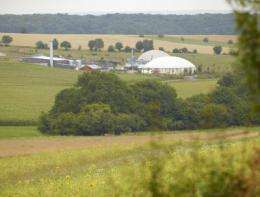
This is a bioenergy plant in Jühnde with CHP. Credit: André Künzelmann/UFZ

'We still have limited understanding of how much land is truly surplus and suitable for production' said Dr Dauber, the lead author of the study, 'because constraints arising from environmental and socio-economic implications of bioenergy development in those areas are often not accounted for in assessments of land availability'.

The authors suggest a thorough reassessment of for bioenergy production by clarifying the terminology of surplus land and taking both constraints and options for efficient and sustainable bioenergy-land use into account. Policy recommendations for resolving conflicting land-use demands are provided.

In Dr Daubers opinion, 'factoring in the constraints, combined with creativity in utilizing the options provided by the novel cropping systems, would lead to a more sustainable and efficient development of the sector'.

Explore further: Century-old science helps confirm global warming

More information: Dauber J, Brown C, Fernando AL, Finnan J, Krasuska E, Ponitka J, Styles D, Thrän D, Van Groenigen KJ, Weih M, Zah R (2012): Bioenergy from "surplus" land: environmental and socio-economic implications. BioRisk 7: 5-50. doi: 10.3897/biorisk.7.3036

add to favorites email to friend print save as pdf

Related Stories

Agave fuels global excitement as a bioenergy crop

Jan 26, 2011

Scientists found that in 14 independent studies, the yields of two Agave species greatly exceeded the yields of other biofuel feedstocks, such as corn, soybean, sorghum, and wheat. Additionally, even more productive Agave ...

Miscanthus adapts

Jun 06, 2011

An article in the current issue of Global Change Biology Bioenergy finds that natural populations of Miscanthus are promising candidates as second-generation energy sources because they have genetic variation that may in ...

Report suggests biomass energy won't harm food production

Dec 02, 2011

(PhysOrg.com) -- Biomass could cover 20% of the global energy supply without harming production of food, a new report released in the United Kingdom says. Reviewing over 90 international studies, the report was produced by ...

Switchgrass as bioenergy feedstock

Dec 09, 2011

Scientists examined current knowledge about the potential contributions of bioenergy production from switchgrass to limit greenhouse gas emissions. Their findings, published in GCB Bioenergy, conclude that the use of swi ...

Abandoned farmlands are key to sustainable bioenergy

Jun 23, 2008

Biofuels can be a sustainable part of the world's energy future, especially if bioenergy agriculture is developed on currently abandoned or degraded agricultural lands, report scientists from the Carnegie Institution and ...

Recommended for you

Century-old science helps confirm global warming

4 hours ago

(Phys.org) —Ocean measurements taken more than 135 years ago during the scientific expedition of HMS Challenger have provided further confirmation of human-produced global warming over the past century.

Be prepared for weather extremes

6 hours ago

Unsettled weather is an Iowa mainstay, and so is Inside's annual reminder of the university's severe weather safety and preparedness guidelines—for storms, extreme heat, flooding and more.

US House sends message on Keystone pipeline

7 hours ago

US lawmakers agreed to a bill that would speed construction of a Canada-US oil pipeline and circumvent the need for President Barack Obama's approval for the $5 billion project.

New EU climate policy unlikely before 2015: Poland

7 hours ago

The European Union is unlikely to hammer out its new policy on global warming ahead of a global climate deal that could be clinched in 2015, Poland's environment minister said Wednesday.

User comments : 1

Adjust slider to filter visible comments by rank

Display comments: newest first

jerryd
not rated yet Oct 18, 2012
Cattle feed, the largest use, drought is the reason for higher food prices as our US ethanol comes from increased yields and farm land and we have a good amount more that can be used if needed.

While this might not be ture in other countries, it is here. Food shortages are political as there is plenty.

More news stories

A hidden population of exotic neutron stars

(Phys.org) —Magnetars – the dense remains of dead stars that erupt sporadically with bursts of high-energy radiation - are some of the most extreme objects known in the Universe. A major campaign using ...

Russia evacuates drifting Arctic research station

Russia has ordered the urgent evacuation of the 16-strong crew of a drifting Arctic research station after ice floe that hosts the floating laboratory began to disintegrate, officials said Thursday.

Century-old science helps confirm global warming

(Phys.org) —Ocean measurements taken more than 135 years ago during the scientific expedition of HMS Challenger have provided further confirmation of human-produced global warming over the past century.

Amazon expands Kindle tablet sale to 170 countries

Online retail titan Amazon announced Thursday it is expanding sales of its Kindle tablet computers to "over 170 countries and territories around the world," and its Appstore in nearly 200 countries.

Google to add Galapagos Islands to Street View

Few have explored the remote volcanic islands of the Galapagos archipelago, an otherworldly landscape inhabited by the world's largest tortoises and other fantastical creatures that inspired Charles Darwin's theory of evolution.