A European-wide network for systematic GMO impact assessment
Oct 17, 2012
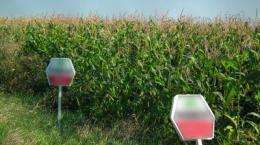
This is a GMO maize field between Timisoara and Sannicolau Mare in Romania. The plains of the Banat is used for agriculture for centuries -- for several years in the Romanian part for field trials with GMO plants. (The signs were obscured for privacy.) Credit: Tilo Arnhold/UFZ

The authors of this paper propose a framework for a European-wide network for systematic GMO impact assessment. This network aims at improving the regulatory system by enhancing and harmonizing the environmental risk assessment process and post-market environmental monitoring of GM crops in the EU.

In Europe there are many concerns about adverse environmental effects of , and the opinions on the outcomes of environmental risk assessments (ERA) differ largely. GM crop safety testing and introduction studies among the regulatory system are insufficiently developed. Therefore the proposed framework aims at improving the .

Specific elements of the network are a) methodologies for both indicator and field site selection for GM crop ERA and PMEM, b) an EU-wide typology of agro-environments, c) a pan-European field testing network using GM crops, d) specific hypotheses on GM crop effects, and e) state-of-the art sampling, statistics and modelling approaches. Involving actors from various sectors the network will address public concerns and create confidence in the ENSyGMO results , write a team of scientists in the open access journal BioRisk.

Explore further: Flanders Institute for Biotechnology exceptionally sceptical about the Seralini research

More information: Graef F, Römbke J, Binimelis R, Myhr AI, Hilbeck A, Breckling B, Dalgaard T, Stachow U, Catacora-Vargas G, Bøhn T, Quist D, Darvas B, Dudel G, Oehen B, Meyer H, Henle K, Wynne B, Metzger MJ, Knäbe S, Settele J, Székács A, Wurbs A, Bernard J, Murphy-Bokern D, Buiatti M, Giovannetti M, Debeljak M, Andersen E, Paetz A, Dzeroski S, Tappeser B, van Gestel CAM, Wosniok W, Séralini G-E, Aslaksen I, Pesch R, Maly S, Werner A (2012): A framework for a European network for a systematic environmental impact assessment of genetically modified organisms (GMO). BioRisk 7: 73-97. doi: 10.3897/biorisk.7.1969
www.pensoft.net/journals/biorisk/article/1969/abstract/a-framework-for-a-european-network-for-a-systematic-environmental-impact-assessment-of-genetically-modified-organisms-gm

add to favorites email to friend print save as pdf

Related Stories

Bioluminescent technology for easy tracking of GMO

Apr 30, 2012

It is important to be able to monitor genetically modified (GM) crops, not only in the field but also during the food processing chain. New research published in BioMed Central's open access journal BMC Biotechnology shows ...

France asks EU to suspend GM crop authorisation

Feb 20, 2012

France's ecology ministry said Monday it had asked European regulators to suspend authorisation for the use of genetically modified MON 810 maize crops from US company Monsanto based on new studies.

What farmers think about GM crops

Feb 24, 2008

Farmers are upbeat about genetically modified crops, according to new research funded by the Economic and Social Research Council (ESRC).

EU agrees to allow traces of GM crops in EU animal feed

Feb 22, 2011

Crops containing tiny traces of genetically modified produce will be allowed to enter the European food chain for the first time under plans approved by EU governments Tuesday and attacked by environmental ...

Recommended for you

Fast new, one-step genetic engineering technology

7 hours ago

A new, streamlined approach to genetic engineering drastically reduces the time and effort needed to insert new genes into bacteria, the workhorses of biotechnology, scientists are reporting. Published in ...

100K Pathogen Genome Project maps first genomes

7 hours ago

(Phys.org) —Striking a blow at foodborne diseases, the 100K Pathogen Genome Project at the University of California, Davis, today announced that it has sequenced the genomes of its first 10 infectious microorganisms, including ...

New DNA cattle test beefs up dairy and meat quality

7 hours ago

(Phys.org) —A genomics technique developed at Cornell to improve corn can now be used to improve the quality of milk and meat, according to research published online May 17 in the journal PLOS ONE.

Strawberry fields forever and fungus-free

8 hours ago

(Phys.org) —Strawberries are one of the most economically important berry crops in the world, and a high value export crop for the Australian horticultural industry.For the first time, researchers at The ...

User comments : 0

More news stories

Coral reefs 'ruled by earthquakes and volcanoes'

(Phys.org) —Titanic forces in the Earth's crust explain why the abundance and richness of corals varies dramatically across the vast expanse of the Indian and Pacific Oceans, a world-first study from the ...

NASA: Austin, calling Austin. 3-D pizzas to go

(Phys.org) —The idea of living with 3-D printed food is neither unthinkable nor new; designers and futurists have been looking to 3-D printing as food's next frontier. In 2012, there was news that the Thiel ...