Coral reefs and food security: Study shows nations at risk
Oct 17, 2012
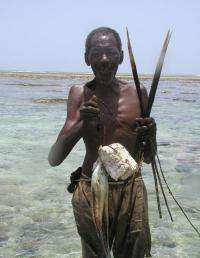
A new study shows nations most vulnerable to coral reef loss from a food- security perspective. Local fisherman shows off his catch of octopus in Kenya. Credit: Tim McClanahan/WCS

A new study co-authored by the Wildlife Conservation Society identifies countries most vulnerable to declining coral reef fisheries from a food-security perspective while providing a framework to plan for alternative protein sources needed to replace declining fisheries.

The study looked at 27 countries around the world and found two common characteristics: nations with low incomes that lack the ability to adapt to alternative protein sources; and middle-income nations with higher adaptive capacity but higher sensitivity to climate change. According to the analysis, Indonesia and Liberia were the most vulnerable countries to fisheries declines from a perspective, while Malaysia and Sri Lanka were the least vulnerable.

The study, which appears in the November issue of the journal and Policy, is authored by Sara Hughes, Annie Yau, Lisa Max, Nada Petrovic, Frank Davenport, and Michael Marshall of the University of California; Tim McClanahan of the Wildlife Conservation Society; Edward Allison of ; and Josh Cinner of James Cook University.

The authors say the results of the study should be a wake-up call for nations to begin enacting policies to promote alternative protein sources, either through land-based means such as growing beans and poultry farming, or increased aquaculture. Coral reef fisheries are expected to decline with climate change and other human caused disturbances.

"The study identifies countries where climate change is likely to be felt first by threatening people that depend on fisheries," said the study's co-author Tim McClanahan of the . "These countries are priorities for developing adaptation actions before the undermine their ability to feed themselves. Some countries will be stressed by climate yet have enough capacity to make the adaptation, while others will not. Making them realize this early will save considerable human suffering in the future."

Explore further: Source of life running out: water scientists

add to favorites email to friend print save as pdf

Related Stories

'Super reefs' fend off climate change, study says

Apr 23, 2009

The Wildlife Conservation Society announced today a study showing that some coral reefs off East Africa are unusually resilient to climate change due to improved fisheries management and a combination of geophysical factors. ...

Study IDs new marine protected areas in Madagascar

Feb 24, 2012

A new study by the University of California, Berkeley, Wildlife Conservation Society, and others uses a new scientific methodology for establishing marine protected areas in Madagascar that offers a "diversified ...

One solution to global overfishing found

Mar 19, 2012

A study by the Wildlife Conservation Society, the ARC Centre for Excellence for Coral Reef Studies, and other groups on more than 40 coral reefs in the Indian and Pacific Oceans indicates that "co-management"—a ...

Recommended for you

Source of life running out: water scientists

15 hours ago

The majority of people on Earth people will face severe water shortages within a generation or two if pollution and waste continues unabated, scientists warned at a conference in Bonn Friday.

Century-old science helps confirm global warming

May 23, 2013

(Phys.org) —Ocean measurements taken more than 135 years ago during the scientific expedition of HMS Challenger have provided further confirmation of human-produced global warming over the past century.

User comments : 0

More news stories

Galaxies fed by funnels of fuel

(Phys.org) —Computer simulations of galaxies growing over billions of years have revealed a likely scenario for how they feed: a cosmic version of swirly straws.

Dark, massive asteroid to fly by Earth on May 31

It's 1.7 miles long. Its surface is covered in a sticky black substance similar to the gunk at the bottom of a barbecue. If it impacted Earth it would probably result in global extinction. Good thing it is ...

Source of life running out: water scientists

The majority of people on Earth people will face severe water shortages within a generation or two if pollution and waste continues unabated, scientists warned at a conference in Bonn Friday.

Google eyes emerging markets networks

Google has become deeply involved in a series of projects to build and operate wireless networks in emerging markets including sub-Saharan Africa and Southeast Asia, a report said Friday.