Water splitting: Ultrahigh resolution data reveals reaction mechanisms
Sep 21, 2012
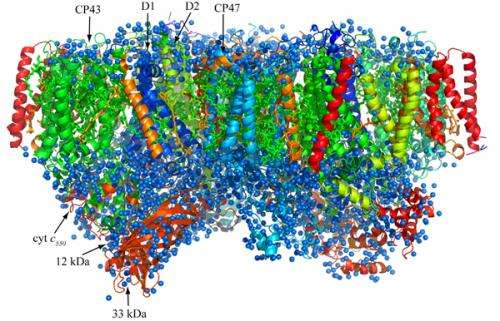
Overall structure of photosystem II.

Oxygenic photosynthetic organisms utilize energy from the sun to split water into protons, electrons and oxygen—products vital to life on earth. The process takes place through light-induced electron transfer reactions in a membrane protein complex photosystem II, but so far the resolution of structural studies on the protein complex has been too limited to ascertain the mechanism of these reactions in detail.

Now Jian-Ren Shen at Okayama University in collaboration with researchers at Osaka City University in Japan has solved the structure of the photosystem II complex at an unprecedented resolution. They improved the quality of the photosystem II crystals significantly, and obtained X-ray with a resolution of 1.9 Å.

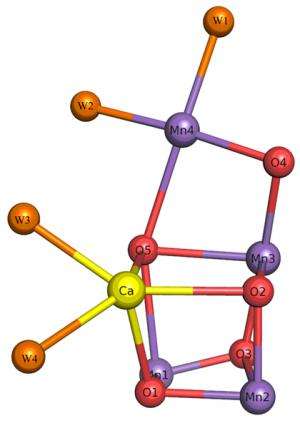
Structure of the chair-shaped oxygen-evolving complex.

Their studies revealed the detailed structures of and a number of cofactors involved in light absorption, energy transfer, and electron transfer reactions in this protein complex. The most significant finding of their work is elucidation of the detailed structure of the Mn4CaO5 cluster, which catalyses the light-induced water-splitting reaction. The cluster is shaped like a distorted chair and the distances between atoms in the structure provide insights into the role of oxygen and nearby water molecules in dioxygen formation. As they pointed out, "This provides a basis for unravelling the mechanism of water splitting and O–O bond formation, one of nature's most fascinating and important reactions." Their studies are considered extremely helpful for that aims to derive clean energy from the sun light efficiently, which may provide an ultimate solution for the energy and environmental problems that we face.

Explore further: Scientists unlock some key secrets of photosynthesis

More information: Yasufumi Umena, et al. Crystal structure of oxygen-evolving photosystem II at a resolution of 1.9 Å. Nature 473, 55-61 (2011). DOI: 10.1038/nature09913

add to favorites email to friend print save as pdf

Related Stories

Scientists unlock some key secrets of photosynthesis

Jul 02, 2012

New research led by chemists in the Baruch '60 Center for Biochemical Solar Energy Research at Rensselaer Polytechnic Institute is seeking to detail the individual steps of highly efficient reactions that ...

Recommended for you

New method for producing clean hydrogen

1 hour ago

Duke University engineers have developed a novel method for producing clean hydrogen, which could prove essential to weaning society off of fossil fuels and their environmental implications.

Non-wetting fabric drains sweat

May 20, 2013

(Phys.org) —Waterproof fabrics that whisk away sweat could be the latest application of microfluidic technology developed by bioengineers at the University of California, Davis.

Beautiful 'flowers' self-assemble in a beaker

May 16, 2013

By simply manipulating chemical gradients in a beaker of fluid, materials scientists at Harvard have found that they can control the growth behavior of crystals to create precisely tailored structures—such ...

User comments : 0

More news stories

New method for producing clean hydrogen

Duke University engineers have developed a novel method for producing clean hydrogen, which could prove essential to weaning society off of fossil fuels and their environmental implications.

Non-wetting fabric drains sweat

(Phys.org) —Waterproof fabrics that whisk away sweat could be the latest application of microfluidic technology developed by bioengineers at the University of California, Davis.

Protein study suggests drug side effects are inevitable

A new study of both computer-created and natural proteins suggests that the number of unique pockets – sites where small molecule pharmaceutical compounds can bind to proteins – is surprisingly small, meaning drug side ...

Beautiful 'flowers' self-assemble in a beaker

By simply manipulating chemical gradients in a beaker of fluid, materials scientists at Harvard have found that they can control the growth behavior of crystals to create precisely tailored structures—such ...