Plants cry for help when an attack can be expected
Sep 07, 2012
Credit: Nina Fatouros

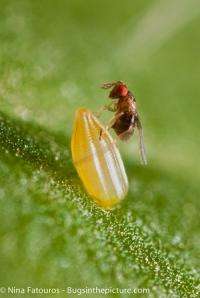
Eggs of insect pests deposited on plants trigger the production of scents by plants that affect different plant community members probably helping the plant to get rid of the pest before it becomes harmful.

These results are reported the journal by researchers, of the Laboratory of Entomology of Wageningen University and the Netherlands Institute of Ecology (NIOO-KNAW).

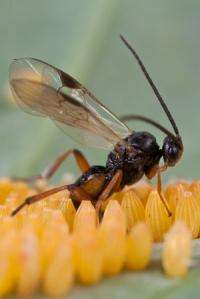
The research team, led by Nina Fatouros, tested how parasitic wasps, natural enemies of a common cabbage pest, the large cabbage white butterfly, and gravid butterfly females respond to black mustard, a cabbage relative, emitting scents during the initial phase of herbivore attack, when eggs are laid.
Credit: Nina Fatouros

They show that butterfly egg deposition triggers highly specific chemical and structural changes in the plant that attract different attacking either butterfly eggs or caterpillars but repel egg-laying butterflies. However, egg deposition by a less common pest, the cabbage moth, does not trigger such changes.

A specific plant response to butterfly egg deposition might help the plant defending itself before actual damage by hatching caterpillars starts.

Explore further: Parasitic wasps remember better if reward is greater

More information: Plant Volatiles Induced by Herbivore Egg Deposition Affect Insects of Different Trophic Levels, Plos ONE, August 2012, Volume 7, Issue 8, e43607

add to favorites email to friend print save as pdf

Related Stories

'Cry for help' gene identified in plants

Jan 18, 2006

A genetic mechanism that enables corn plants to "cry for help" and attract beneficial insects has been clarified by scientists from the University of Neuchâtel, Switzerland and the Max Planck Institute for ...

Parasitic wasps remember better if reward is greater

Aug 22, 2012

Two parasitic wasp species show similar memory consolidation patterns in response to rewards of different quality, providing evidence that the reward value affects the type of memory that is consolidated. ...

Insects that deter predators produce fewer offspring

Jan 25, 2011

Scientists studied the defences used by caterpillars that transform into large white butterflies, called Pieris brassicae. The insects regurgitate semi-digested cabbage leaves to make them smell and taste unpleasant to predators. ...

Recommended for you

Lovelorn frogs bag closest crooner

May 20, 2013

What lures a lady frog to her lover? Good looks, the sound of his voice, the size of his pad or none of the above? After weighing up their options, female strawberry poison frogs (Oophaga pumilio) bag th ...

Honeybees trained in Croatia to find land mines

May 19, 2013

(AP)—Mirjana Filipovic is still haunted by the land mine blast that killed her boyfriend and blew off her left leg while on a fishing trip nearly a decade ago. It happened in a field that was supposedly ...

User comments : 0

More news stories

New immune system discovered

(Medical Xpress)—A research team, led by Jeremy Barr, a biology post-doctoral fellow, unveils a new immune system that protects humans and animals from infection.

Lab sets a new record for creating heralded photons

(Phys.org) —Entanglement, by general consensus of physicists, is the weirdest part of quantum science. To say that two particles, A and B, are entangled means that they are actually two parts of an inseparable ...