NASA sees a western weakness in Tropical Storm Miriam
Sep 27, 2012
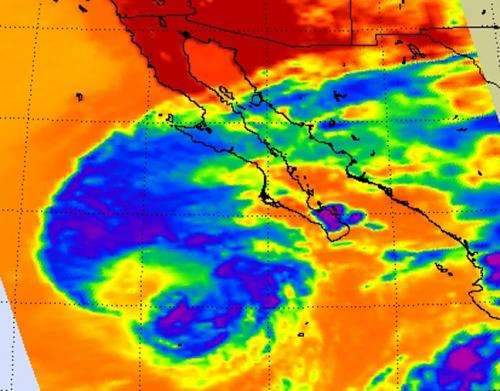
This infrared image was created from AIRS data of Tropical Storm Miriam on Sept. 26 at 2047 UTC off the coast of Baja California. Strongest thunderstorms with very cold cloud top temperatures appear in purple surrounding north, east and south of the center of circulation. Credit: Credit: NASA JPL/Ed Olsen

NASA infrared satellite imagery showed Tropical Storm Miriam had strong convection and thunderstorm activity in all quadrants of the storm on Sept. 26, except the western quadrant. That activity waned dramatically in 24 hours because of strong wind shear and cooler sea surface temperatures.

The Atmospheric Infrared Sounder (AIRS) instrument that flies aboard NASA's Aqua satellite captured infrared data on Tropical Storm Miriam on Sept. 26 at 2047 UTC, when it was off the coast of Baja California. Strongest thunderstorms with very cold cloud top temperatures appear to surround north, east and south of the center of circulation. By Sept. 27, only the northern quadrant of the storm appeared to have those strong thunderstorms.

Miriam appears to be weakening quickly because of strong and cooler waters.

At 11 a.m. EDT on Sept. 27, Miriam's had decreased to near 40 mph (65 kmh) and further weakening is expected. The National Hurricane Center noted that Miriam could become a remnant low later today or tomorrow, Sept. 28.

The center of Tropical Storm Miriam was located near latitude 22.2 north and longitude 116.3 west. Miriam is moving northwest near 6 mph (9 kmh) and is expected to turn west.

Regardless of the weakening condition of the storm, Miriam is still generating dangerous ocean swells along the south and west coasts of the southern and central Baja peninsula today but those will begin to gradually subside by Sept. 28.

Explore further: Satellite sees Miriam weaken to a tropical storm

add to favorites email to friend print save as pdf

Related Stories

Satellite sees Miriam weaken to a tropical storm

Sep 26, 2012

Once a powerful hurricane, Miriam is now a tropical storm off the coast of Baja California, Mexico. Tropical Storm Miriam was seen in the Eastern Pacific Ocean by NOAA's GOES-15 satellite, and the visible ...

NASA sees wind shear battering Tropical Storm Nadine

Sep 13, 2012

Tropical Storm Nadine is struggling against wind shear and some dry air. Infrared satellite imagery from NASA showed that Nadine's most powerful thunderstorms were being pushed east of the center.

NASA sees the short life of Tropical Depression John

Sep 04, 2012

Tropical Storm John had about one day of fame in the Eastern Pacific. Born Tropical Depression 10, it intensified into Tropical Storm John on Sept. 2 at 5 a.m. EDT and maintained maximum sustained winds of ...

Recommended for you

Russia evacuates drifting Arctic research station

6 hours ago

Russia has ordered the urgent evacuation of the 16-strong crew of a drifting Arctic research station after ice floe that hosts the floating laboratory began to disintegrate, officials said Thursday.

Bacterium from Canadian High Arctic and life on Mars

8 hours ago

(Phys.org) —The temperature in the permafrost on Ellesmere Island in the Canadian high Arctic is nearly as cold as that of the surface of Mars. So the recent discovery by a McGill University led team of ...

User comments : 0

More news stories

Hubble reveals the ring nebula's true shape

(Phys.org) —The Ring Nebula's distinctive shape makes it a popular illustration for astronomy books. But new observations by NASA's Hubble Space Telescope of the glowing gas shroud around an old, dying, ...

NASA head views progress on asteroid lasso mission

Surrounded by engineers, NASA chief Charles Bolden inspected a prototype spacecraft engine that could power an audacious mission to lasso an asteroid and tow it closer to Earth for astronauts to explore.

A hidden population of exotic neutron stars

(Phys.org) —Magnetars – the dense remains of dead stars that erupt sporadically with bursts of high-energy radiation - are some of the most extreme objects known in the Universe. A major campaign using ...