NASA sees the short life of Tropical Depression John
Sep 04, 2012
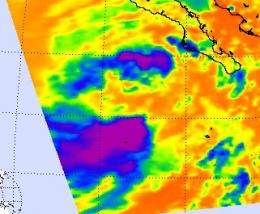
NASA's Aqua satellite flew over John on Sept. 3 at 2041 UTC (4:41 p.m. EDT) during its brief time as a tropical storm and noticed the strongest convection (purple) and coldest cloud top temperatures seemed to be limited to the northeastern and southwestern quadrants of the storm. Credit: NASA JPL, Ed Olsen

Tropical Storm John had about one day of fame in the Eastern Pacific. Born Tropical Depression 10, it intensified into Tropical Storm John on Sept. 2 at 5 a.m. EDT and maintained maximum sustained winds of 40 mph (65 kmh) until it weakened back into a depression on Monday, Sept. 3 at 11 p.m. EDT.

NASA's Aqua satellite flew over John on Sept. 3 at 2041 UTC (4:41 p.m. EDT) during its brief time as a tropical storm and noticed (rising air that forms thunderstorms that make up the storm) and coldest cloud top temperatures seemed to be limited to the northeastern and southwestern quadrants of the storm. As John continued to move north into cooler waters the convection tapered off, and the development of strong diminished.

By Tuesday, September 04, 2012 at 2 a.m. EDT, there was no sign of strong convection in John and the storm had become "a swirl of low- to mid-level clouds," according to the National Hurricane Center.

At 11 a.m. EDT today, John's were near 35 mph (55 kmh) and the storm is weakening. It was centered about 420 miles (620 km) west of the southernmost tip of Baja California, near 23.5 North and 116.5 West. John was moving to the northwest near 14 mph (22 kmh) and is expected to keep moving in that general direction while slowing over the cooler waters.

John's fame is fleeting as the tropical depression is expected to become a remnant area of low pressure later today, Sept. 4.

Explore further: Satellite sees two tropical cyclones chase Tropical Storm Daniel

add to favorites email to friend print save as pdf

Related Stories

NASA watches Tropical Storm Florence develop and weaken

Aug 06, 2012

The sixth tropical storm of the Atlantic Ocean hurricane season formed over the past weekend, and NASA kept an on its progression. Tropical Storm Florence was born in the eastern Atlantic and weakened when ...

Recommended for you

Origins of human culture linked to rapid climate change

6 hours ago

Rapid climate change during the Middle Stone Age, between 80,000 and 40,000 years ago, during the Middle Stone Age, sparked surges in cultural innovation in early modern human populations, according to new research.

Bangladeshi, South Korean climbers die on Everest

12 hours ago

A climber from Bangladesh and another from South Korea have died on Mount Everest as hundreds flock to the world's highest peak during good weather, Nepalese tourism officials said Tuesday.

User comments : 0

More news stories

Reducing caloric intake delays nerve cell loss

Activating an enzyme known to play a role in the anti-aging benefits of calorie restriction delays the loss of brain cells and preserves cognitive function in mice, according to a study published in the May ...

CDC says high number of public pools contain microbes

(HealthDay)—Three-quarters of public schools in the metro Atlanta area contain microbes, including bacteria indicating the presence of fecal matter, according to research published in the May 17 issue of ...