NASA's GRAIL moon twins begin extended mission science
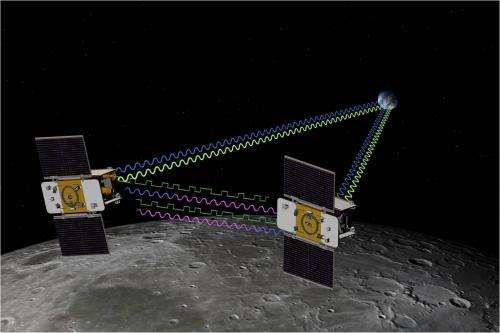
(Phys.org)—NASA's twin, lunar-orbiting Gravity Recovery and Interior Laboratory (GRAIL) spacecraft began data collection for the start of the mission's extended operations.
At 9:28 a.m. PDT (12:28 p.m. EDT) yesterday, while the two spacecraft were 19 miles (30 kilometers) above the moon's Ocean of Storms, the Lunar Gravity Ranging System—the mission's sole science instrument aboard both GRAIL twins—was energized.
"The data collected during GRAIL's primary mission team are currently being analyzed and hold the promise of producing a gravity field map of extraordinary quality and resolution," said Maria Zuber, principal investigator for GRAIL from the Massachusetts Institute of Technology in Cambridge. "Mapping at a substantially lower altitude during the extended mission, and getting an even more intimate glimpse of our nearest celestial neighbor, provides the unique opportunity to globally map the shallow crust of a planetary body beyond Earth."
The science phase of GRAIL's extended mission runs from Aug. 30 to Dec. 3. Its goals are to take an even closer look at the moon's gravity field, deriving the gravitational influence of surface and subsurface features as small as simple craters, mountains and rilles. To achieve this unprecedented resolution, GRAIL mission planners are halving the operating altitude - flying at the lowest altitude that can be safely maintained.
During the prime mission, which stretched from March 1 to May 29, the two GRAIL spacecraft, named Ebb and Flow, orbited at an average altitude of 34 miles (55 kilometers). The average orbital altitude during extended mission will be 14 miles (23 kilometers), which places the GRAIL twins within five miles (eight kilometers) of some of the moon's higher surface features.
"Ebb and Flow, and our mission operations team, are both doing great, which is certainly notable considering all the milestones and challenges they have experienced," said David Lehman, GRAIL project manager from NASA's Jet Propulsion Laboratory in Pasadena, Calif. "The twins have endured the lunar eclipse of June 4, 2012, and 26 rocket burns since arriving in lunar orbit at the beginning of the year. Down here in our control room, with all the planning and mission operations we have been doing, it feels as though we've been riding right along with them. Of course, they have the better view."
Science data are collected when the Lunar Gravity Ranging System transmit radio signals between the two spacecraft, precisely defining the rate of change of distance between Ebb and Flow. The distance between the twins change slightly as they fly over areas of greater and lesser gravity caused by visible features, such as mountains and craters, and by masses hidden beneath the lunar surface.
Mission scientists calculated that even as the last data were downlinked, four of the mission's six principal science measurement goals had already been achieved. The objective of the GRAIL mission is to generate the most accurate gravity map of the moon and from that derive the internal structure and evolution of Earth's natural satellite.
Provided by NASA


