Lowell's Large Monolithic Imager sees first light on the Discovery Channel Telescope
Sep 21, 2012
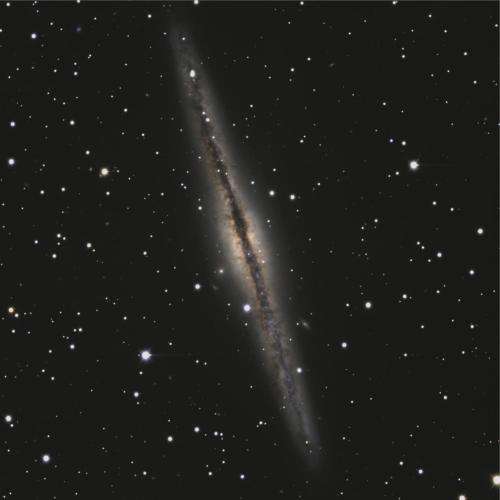
Galaxy NGC 891 as imaged by the Large Monolithic Imager (Lowell Observatory)

(Phys.org)—The Large Monolithic Imager (LMI), a camera built at Lowell Observatory and funded by the National Science Foundation (NSF), recently took a set of first-light images on Lowell's 4.3-m Discovery Channel Telescope (DCT). At the heart of the LMI is the largest charge-coupled device (CCD) that can be built using current fabrication techniques and the first of its kind to be made by e2v. The 36-megapixel CCD's active surface is 3.7 inches on a side. The LMI's ability to provide much more accurate measurements of the faint light around galaxies separates it from cameras that use a mosaic of CCDs to produce images.

The attached first-light image is of NGC 891, an edge-on about 30 million light-years away in the Andromeda constellation. The image was obtained by Lowell's Phil Massey, Ted Dunham, and Mike Sweaton, and then turned into a beautiful color composite by Kathryn Neugent. The exposure consisted of 10×1 min (B), 5×1 min (V), and 6×1 min (R), all unguided.

In the coming months, astronomers from Lowell and its DCT institutional partners—Boston University, the University of Maryland, and the University of Toledo—will be getting many more images like this as the Telescope's commissioning continues.

Explore further: Hubble sees the needle galaxy, edge-on and up close

Provided by Lowell Observatory

4.5 /5 (2 votes)
add to favorites email to friend print save as pdf

Related Stories

U. of Ariz. has telescope work contract

Aug 02, 2006

(AP) -- The University of Arizona will get $3 million for polishing the 4.3-meter mirror of a new $40 million telescope partially funded by the owners of the Discovery Channel.

Hubble spies edge-on beauty

May 21, 2012

(Phys.org) -- Visible in the constellation of Andromeda, NGC 891 is located approximately 30 million light-years away from Earth. The NASA/ESA Hubble Space Telescope turned its powerful wide field Advanced ...

Hubble sees the needle galaxy, edge-on and up close

Jul 16, 2012

(Phys.org) -- This image snapped by the NASA/ESA Hubble Space Telescope reveals an exquisitely detailed view of part of the disc of the spiral galaxy NGC 4565. This bright galaxy is one of the most famous ...

Hubble spies a spiral galaxy edge-on

Apr 02, 2012

(PhysOrg.com) -- The NASA/ESA Hubble Space Telescope has spotted the "UFO Galaxy." NGC 2683 is a spiral galaxy seen almost edge-on, giving it the shape of a classic science fiction spaceship. This is why the ...

A galaxy blooming with new stars

Dec 15, 2011

(PhysOrg.com) -- The VLT Survey Telescope (VST) has captured the beauty of the nearby spiral galaxy NGC 253. The new portrait is probably the most detailed wide-field view of this object and its surroundings ...

Recommended for you

Fragile mega-galaxy is missing link in history of cosmos

16 hours ago

Two hungry young galaxies that collided 11 billion years ago are rapidly forming a massive galaxy about 10 times the size of the Milky Way, according to UC Irvine-led research published Wednesday in the journal ...

Galaxy's Ring of Fire

May 18, 2013

Johnny Cash may have preferred this galaxy's burning ring of fire to the one he sang about falling into in his popular song. The "starburst ring" seen at center in red and yellow hues is not the product of ...

User comments : 0

More news stories

Forecast for Titan: Wild weather could be ahead

(Phys.org) —Saturn's moon Titan might be in for some wild weather as it heads into its spring and summer, if two new models are correct. Scientists think that as the seasons change in Titan's northern hemisphere, ...

Scientists announce Top 10 New Species from 2012

An amazing glow-in-the-dark cockroach, a harp-shaped carnivorous sponge and the smallest vertebrate on Earth are just three of the newly discovered top 10 species selected by the International Institute for ...

Theorists weigh in on where to hunt dark matter

(Phys.org) —Now that it looks like the hunt for the Higgs boson is over, particles of dark matter are at the top of the physics "Most Wanted" list. Dozens of experiments have been searching for them, but ...