Coral study provides clues to reef damage in Madagascar
Sep 05, 2012
Coral study provides clues to reef damage in Madagascar
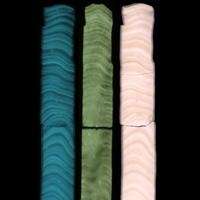
Coral cores--These drill samples show luminescence under UV light, x-ray and normal light (l-r). The bands in the samples on the left and right correspond, and indicate massive discharges of organic matter from rivers taken up by the corals.

(Phys.org)—A group of international researchers, including one from UWA Oceans Institute, has used coral sampling to assess the impact of river run-offs in a bay in north-eastern Madagascar.

The research was carried out in a bay favoured by whales to rear their calves, in effect, making it a 'whale kindergarten'.

"The aim of the study was to test if we can use coral cores to assess the impact of various small mountain rivers on adjacent coral reefs in Antongil Bay, the largest bay on the island of Madagascar in the west Indian Ocean," said Dr Jens Zinke, of UWA Oceans Institute.

"The bay is significant because every year up to 300 come into this bay between June to October to raise their young and protect them from predators."

As part of the study, researchers drilled coral samples from the reef in the bay. By exposing the coral samples to various lights, luminescent bands - in effect, similar to the of a tree - provided a long-term record of river run-off reaching the coral reefs in Madagascar.

"For instance, the corals closest to the river plume at Nosy Mangabe island reserve showed clear signs of disease and distorted growth patterns," Dr Zinke said.

"Nevertheless, these reefs were adapted to sediment discharge for hundreds of years and survived several cyclone induced mass erosion events in the past."

The research findings will be used to help guide on the island and the management of its marine parks.

"With these results, we can inform conservation managers on the best choice of marine parks and the likelihood of adverse impacts on and fisheries caused by high levels of in reefs outside the bay near highly deforested plains," Dr Zinke said.

The study, Spatial linkages between proxies of terrestrial run-off across a large embayment in Madagascar, is published in the journal Biogeosciences.

Explore further: Ancient coral reefs at risk from deforestation and land use practices

More information: doi:10.5194/bg-9-3063-2012

add to favorites email to friend print save as pdf

Related Stories

New study predicts where corals can thrive

Apr 16, 2008

The Wildlife Conservation Society (WCS) and the International Institute for Geo-Information Science and Earth have developed a new scientific model that accurately maps where coral reefs are in the most trouble and identifies ...

Recommended for you

Century-old science helps confirm global warming

4 hours ago

(Phys.org) —Ocean measurements taken more than 135 years ago during the scientific expedition of HMS Challenger have provided further confirmation of human-produced global warming over the past century.

Be prepared for weather extremes

6 hours ago

Unsettled weather is an Iowa mainstay, and so is Inside's annual reminder of the university's severe weather safety and preparedness guidelines—for storms, extreme heat, flooding and more.

US House sends message on Keystone pipeline

7 hours ago

US lawmakers agreed to a bill that would speed construction of a Canada-US oil pipeline and circumvent the need for President Barack Obama's approval for the $5 billion project.

New EU climate policy unlikely before 2015: Poland

7 hours ago

The European Union is unlikely to hammer out its new policy on global warming ahead of a global climate deal that could be clinched in 2015, Poland's environment minister said Wednesday.

User comments : 0

More news stories

A hidden population of exotic neutron stars

(Phys.org) —Magnetars – the dense remains of dead stars that erupt sporadically with bursts of high-energy radiation - are some of the most extreme objects known in the Universe. A major campaign using ...

Russia evacuates drifting Arctic research station

Russia has ordered the urgent evacuation of the 16-strong crew of a drifting Arctic research station after ice floe that hosts the floating laboratory began to disintegrate, officials said Thursday.

Century-old science helps confirm global warming

(Phys.org) —Ocean measurements taken more than 135 years ago during the scientific expedition of HMS Challenger have provided further confirmation of human-produced global warming over the past century.

Bacterium from Canadian High Arctic and life on Mars

(Phys.org) —The temperature in the permafrost on Ellesmere Island in the Canadian high Arctic is nearly as cold as that of the surface of Mars. So the recent discovery by a McGill University led team of ...

Review: Google music plan solid, serendipitous

Google's new music service offers a lot of eye candy to go with the tunes. The song selection of around 18 million tracks is comparable to popular services such as Spotify and Rhapsody, and a myriad of playlists ...