Cavenauts return to Earth
Sep 21, 2012
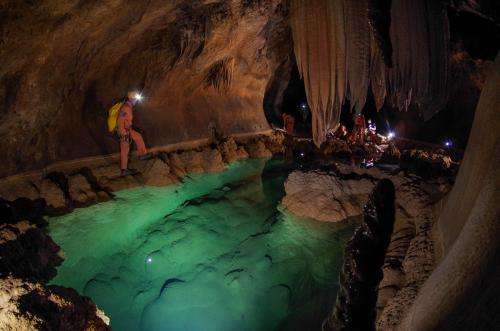
Cave wonderland.

The international team of astronauts taking part in ESA's caving adventure have returned to Earth after spending six days underground. The voyage to the surface of our planet took them five hours from basecamp.

gives astronauts a taste of working as a safe and effective team during long spaceflights. In particular, they can hone their leadership and group skills while working in a typical multicultural team found on the International Space Station.

Course designer Loredana Bessone explains the similarities of caving and working in space: "The 'cavenauts' have to adapt to a completely new environment. Working and living underground is both physically and mentally demanding."

This video is not supported by your browser at this time.

Space protocols were used in the course: "Cavewalking is similar to a . You have to pay continuous attention to the correct use of tools and safety protocols, to the progression path and to obstacles, which correspond to No Touch Zones and Keep Out Zones on the Space Station."

CAVES is the first behavioural course to involve astronauts from all partners of the . Astronauts from USA, Japan, Canada, Russia and Denmark participated this year.

Apart from exploring and surveying parts of the caves, the astronauts also conducted speleological research: cave meteorology, geology, biology and microbiology.
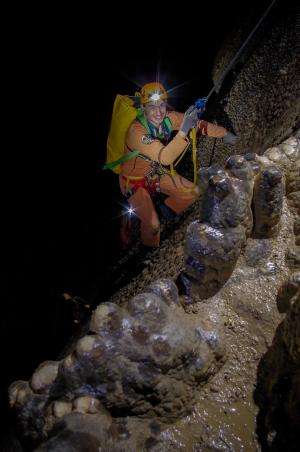
Nikolai ascending to the surface.

They set traps and collected of underground life, which have now been forwarded to specialists for further analysis.

This year the astronauts explored further than the CAVES 2011 team and discovered what astronaut Mike Fincke described as an underground "wonderland."

ESA astronaut Andreas Mogensen is very positive about the course: "CAVES is perhaps the most physically demanding that I have taken part in, and perhaps also the most rewarding.

"To complete the training, our crew had to work together effectively and efficiently as a team, which we did.

"All in all, it was a fantastic and unique experience."

Explore further: Astronauts going underground

add to favorites email to friend print save as pdf

Related Stories

Astronauts going underground

Sep 12, 2012

ESA's CAVES training programme began its second phase last Friday as six astronauts ventured into the Sardinian caves in Italy that are their home this week. CAVES mimics elements of spaceflight to prepare ...

Cave crew returns to Earth

Oct 24, 2011

Take five astronauts and instead of sending them into space take them underground. ESA’s CAVES venture prepares astronauts to work in an international team under real exploration conditions. The latest ...

Tim gets his feet wet

Apr 18, 2012

ESA astronaut Timothy Peake will soon dive to the bottom of the sea to learn more about exploring space. A permanent underwater base almost 20 m below the waves off the coast of Florida will be Tim’s ...

Learn to dock ATV the astronaut way

Apr 11, 2012

Do you have what it takes to be an astronaut? ESA is making actual astronaut training available on your computer and tablet, so you can see for yourself.

Recommended for you

Super-hurricane-force winds on Venus are getting stronger

20 hours ago

(Phys.org) —As the closest planet to Earth, Venus is a relatively easy object to observe. However, many mysteries remain, not least the super-rotation of Venus' atmosphere, which enables high altitude winds ...

ExoMars 2016 set to complete construction

Jun 18, 2013

ESA's mission to Mars in 2016 has entered the final stage of construction with the signature of a contract today with Thales Alenia Space at the Paris Air & Space Show.

Australian team maps Moon's hidden craters

Jun 18, 2013

Australian scientists Tuesday said they had identified a possible 280 additional craters on the Moon, a finding they said could shed light on the history of the Earth's natural satellite.

User comments : 0

More news stories

Siberian caves warn of permafrost meltdown

Climate records captured in Siberian caves suggest 1.5 degrees of warming is enough to trigger thawing of permafrost, according to a paper to be given at the Geological Society of London on 27 June.

Multiview 3-D photography made simple

Computational photography is the use of clever light-gathering tricks and sophisticated algorithms to extract more information from the visual environment than traditional cameras can.