Body heat, fermentation drive new drug-delivery 'micropump'
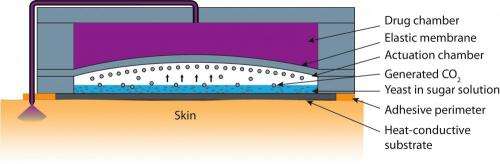
(Phys.org)—Researchers have created a new type of miniature pump activated by body heat that could be used in drug-delivery patches powered by fermentation.
The micropump contains bakers yeast and sugar in a small chamber. When water is added and the patch is placed on the skin, the body heat and the added water causes the yeast and sugar to ferment, generating a small amount of carbon dioxide gas. The gas pushes against a membrane and has been shown to continually pump for several hours, said Babak Ziaie, a Purdue University professor of electrical and computer engineering and biomedical engineering.
Such miniature pumps could make possible drug-delivery patches that use arrays of "microneedles" to deliver a wider range of medications than now possible with conventional patches. Unlike many other micropumps under development or in commercial use, the new technology requires no batteries, said Ziaie, who is working with doctoral student Manuel Ochoa.
"This just needs yeast, sugar, water and your own body heat," Ziaie said.
The robustness of yeast allows for long shelf life, and the design is ideal for mass production, Ochoa said.
"It would be easy to fabricate because it's just a few layers of polymers sandwiched together and bonded," he said.
Findings were detailed in a research paper published online in August in the journal Lab on a Chip. The paper was written by Ochoa and Ziaie, and the research is based at Purdue's Birck Nanotechnology Center in the university's Discovery Park.
The "the microorganism-powered thermopneumatic pump" is made out of layers of a rubberlike polymer, called polydimethylsiloxane, which is used commercially for diaphragms in pumps. The prototype is 1.5 centimeters long.
Current "transdermal" patches are limited to delivering drugs that, like nicotine, are made of small hydrophobic molecules that can be absorbed through the skin, Ziaie said.
"Many drugs, including those for treating cancer and autoimmune disorders cannot be delivered with patches because they are large molecules that won't go through the skin," he said. "Although transdermal drug delivery via microneedle arrays has long been identified as a viable and promising method for delivering large hydrophilic molecules across the skin, a suitable pump has been hard to develop."
Patches that used arrays of tiny microneedles could deliver a multitude of drugs, and the needles do not cause pain because they barely penetrate the skin, Ziaie said. The patches require a pump to push the drugs through the narrow needles, which have a diameter of about 20 microns, or roughly one-fourth as wide as a human hair.
Most pumps proposed for drug-delivery applications rely on an on-board power source, which is bulky, costly and requires complex power-management circuits to conserve battery life. "Our approach is much more simple," Ziaie said. "It could be a disposable transdermal pump. You just inject water into the patch and place it on your skin. After it's used up, you would through it away."
Researchers have filed an application for a provisional patent on the device.
More information: A fermentation-powered thermopneumatic pump for biomedical applications, Lab on a Chip, 2012.
ABSTRACT
We present a microorganism-powered thermopneumatic pump that utilizes temperature-dependent slow-kinetics gas (carbon dioxide) generating fermentation of yeast as a pressure source. The pump consists of stacked layers of polydimethylsiloxane (PDMS) and a silicon substrate that form a drug reservoir, and a yeast-solution-filled working chamber. The pump operates by the displacement of a drug due to the generation of gas produced via yeast fermentation carried out at skin temperatures. The robustness of yeast allows for long shelf life under extreme environmental conditions (50 °C, >250 MPa, 5-8% humidity). The generation of carbon dioxide is a linear function of time for a given temperature, thus allowing for a controlled volume displacement. A polymeric prototype (dimensions 15 mm x 15 mm x 10 mm) with a slow flow rate of <0.23 mL min-1 and maximum backpressure of 5.86 kPa capable of continuously pumping for over two hours is presented and characterized.
Journal information: Lab on a Chip
Provided by Purdue University


