'Bed of nails' material for clean surfaces
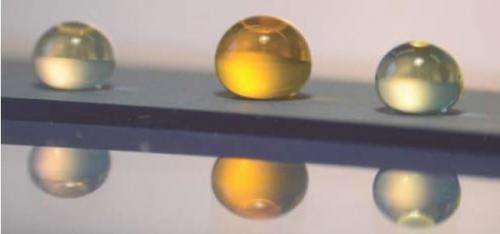
(Phys.org)—Scientists at the University of Twente's MESA+ Institute for Nanotechnology have developed a new material that is not only extremely water-repellent but also extremely oil-repellent. It contains minuscule pillars which retain droplets. What makes the material unique is that the droplets stay on top even when they evaporate (slowly getting smaller). This opens the way to such things as smartphone screens that really cannot get dirty. The study appears today in the scientific journal Soft Matter.
Water-repellent surfaces can be used as a coating for windows, obviating the need to clean them ever again. These surfaces have an orderly arrangement of tiny pillars less than one-hundredth of a millimetre high (similar to a bed of nails but on an extremely small scale). Water droplets stay on the tips of the pillars, retaining the shape of perfectly round tiny pearls. As a result they can roll off the surface like marbles, taking all the dirt with them.
Nanotechnologists at the University of Twente have now managed to create a silicon surface that retains not only water droplets but also oil droplets like tiny pearls (see illustration). What makes the material unique is that the droplets remain in place even when they evaporate (get smaller).
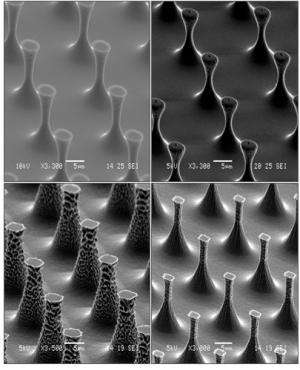
With existing materials, evaporating droplets drop down between the pillars onto the surface after a while, changing in shape to hemispheres which can no longer simply roll off the surface. The surface can therefore still get dirty. By modifying the edges and the roughness of the minuscule pillars the UT scientists have managed to create a surface on which the droplets do not drop down even when they evaporate but stay neatly on top.
Clean smartphone screens
Surfaces that repel both water and oil are currently used among other things as a dirt-resistant coating on smartphones screens. In practice the screens still get dirty, however, showing e.g. greasy fingerprints. The material developed by the UT scientists brings screens that really never get dirty a lot closer.
More information: The study appears today in the scientific journal Soft Matter.
Journal information: Soft Matter
Provided by University of Twente


