UBC researchers seek to engage students in STEM careers with science outreach toolkit
Aug 30, 2012
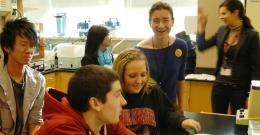
This shows University of British Columbia researcher Joanne Fox with students during a genomics field trip program hosted at the Michael Smith Laboratories. Credit: Michael Smith Laboratories, UBC

Outreach programs that offer a taste of real-world science and pair secondary students with enthusiastic young researchers are key to promoting careers in science and technology, according to University of British Columbia researchers.

In a paper published this week in PLoS , UBC researchers document their work on the Genomics Field Trip Program hosted at the Michael Smith Laboratories (MSL). Joanne Fox, Jennifer McQueen and Jody Wright outline the benefits of research-based field trips, offering a blueprint for designing science outreach programs.

"Genomics is important because will deal with challenging questions and they need to be informed and science-literate," says Fox, a faculty member at the Michael Smith Laboratories.. "For example, they may have their personal and they may have to decide who has access to that information."

The Genomics Field Trip program encourages exploration of the sciences through a full day genomics experience which takes place at the MSL laboratories. Program instructors are typically UBC graduate students who benefit from the experience by developing their ability to communicate scientific ideas to the general public. They also develop skills in lesson design and delivery, allowing them to enhance their instructional skills, something that does not always occur in teaching assistantship positions.

Fox hopes the success of the Genomics Field Trip Program will inspire other institutions to develop similar programs. The recommendations included in her paper can be used as a blueprint for science programs and an online genomics toolkit provides valuable information for lesson plans.

"This type of program helps graduate students remember why science is so exciting, and in turn inspires the next generation of scientists," Fox explains.

Explore further: Experimental learning paying off

More information: www.ploscompbiol.org/article/info:doi/10.1371/journal.pcbi.1002636

add to favorites email to friend print save as pdf

Related Stories

Women in science? Universities don't make the grade

Sep 29, 2011

Despite years of trying to improve the number of women undergraduates in science and engineering, a new study shows most universities are failing. Not only are women lagging behind their male classmates, efforts to close ...

Scientists seek to increase science literacy

Jul 18, 2011

A scientist at the University of Alaska Fairbanks and colleague at Emory University are seeking to persuade the National Science Foundation to reevaluate its decision to cancel a program that has placed 10,000 science graduate ...

Experimental learning paying off

Aug 20, 2012

Through the use of the Online Health Program Planner, a tool created by Public Health Ontario, a soon-to-be-implemented peer nutrition education program by and for university students looks to help enhance critical thinking ...

Recommended for you

US scientist not involved in classified research: witnesses

May 17, 2013

Colleagues of a US scientist found hanged in Singapore last year told a coroner's inquiry Friday he was not involved in projects with military applications and was never asked to compromise any country's national security.

Bonaparte family letter to return to France

May 16, 2013

(Phys.org) —A handwritten letter dated April 27, 1792, signed by Joseph Bonaparte and referring to a skirmish in Corsica involving Napoleon, the writer's then 22-year-old brother, will be returned to its ...

New research method aims to unlock academia's biggest problem

May 16, 2013

Scientists at Keele University have found a solution to one of life's great mysteries: Why people often fail to see the answer to a problem when the solution is right in front of them. The researchers have created a new method, ...

User comments : 0

More news stories

Evolution of lying

(Phys.org) —Ultimately, our ability to convincingly lie to each other may have evolved as a direct result of our cooperative nature.

Heat-related deaths in Manhattan projected to rise

Residents of Manhattan will not just sweat harder from rising temperatures in the future, says a new study; many may die. Researchers say deaths linked to warming climate may rise some 20 percent by the 2020s, ...

Kinks and curves at the nanoscale

One of the basic principles of nanotechnology is that when you make things extremely small—one nanometer is about five atoms wide, 100,000 times smaller than the diameter of a human hair—they are going ...