Tropical Storm Ernesto was an unwelcome visitor in St. Lucia
Aug 03, 2012
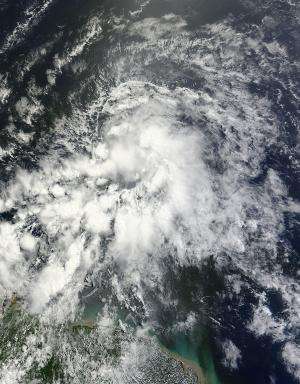
On Aug. 2 at 10:20 a.m. NASA's Terra satellite captured this stunning visible image of Tropical Storm approaching the Lesser Antilles. The image showed the highest, strongest thunderstorms on the eastern side of the storm from north to south. Credit: Credit: NASA Goddard MODIS Rapid Response Team

The fifth Atlantic Ocean tropical depression strengthened into Tropical Storm Ernesto on Thursday, August 2 at 5 p.m. EDT and tracked over St. Lucia early on August 3. NASA's Terra satellite captured an image of Ernesto from space as it approached the island.

On August 2, 2012 at 1420 UTC (10:20 a.m. EDT) the Moderate Resolution Imaging Spectroradiometer (MODIS)instrument onboard NASA's captured a stunning of Tropical Storm Ernesto as it was approaching the Lesser Antilles. The image showed the highest, strongest thunderstorms from the northern to the eastern and southern quadrants of the storm. Some thunderstorms were so high in the troposphere that they were casting shadows on the lower surrounding tops.

On August 3 at 8 a.m. EDT, Ernesto's were near 45 mph (75 kmh). The National Hurricane Center (NHC) reported a wind gust in Saint Lucia during the morning of August 3. During the 7 a.m. EDT hour, Ernesto's center moved over or near Saint Lucia, according to the NHC. By 8 a.m. EDT, Ernesto had moved 40 miles (65 km) away from Saint Lucia, to the west-southwest. Ernesto was near 13.5 North and 61.5 West, and speeding to the west at 24 mph (39 kmh).
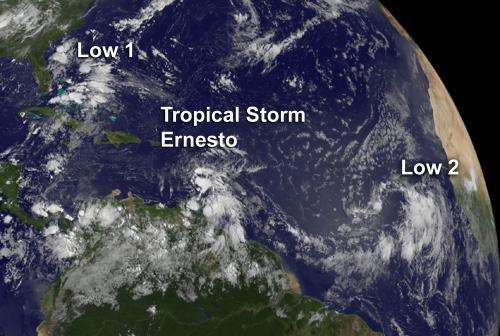
NOAA's GOES-13 satellite captured an image of the tropical Atlantic Ocean on Aug. 3 at 7:45 a.m. EDT with three tropical systems. The visible image shows Tropical Storm Ernesto in the eastern Caribbean Sea, a low pressure area (Low 1) near Florida's southeastern coast with a 10 percent chance of development, and a low pressure area in the eastern Atlantic (Low 2), about 175 miles south of the Cape Verde Islands that has a 30 percent chance of development over the weekend. The image was created by NASA's GOES Project, located at NASA's Goddard Space Flight Center in Greenbelt, Md. Credit: NASA GOES Project

As a result of Ernesto's speeding, the government of Trinidad has discontinued the tropical storm watch for Grenada and its dependencies. However, a Tropical Storm Warning is in effect for Dominica, St. Lucia, Martinique and Guadeloupe.

The NHC expects Ernesto to continue speeding westward through the eastern Caribbean Sea near the same rate of speed over the next day or two.

Explore further: NASA catches birth of Tropical Storm Chris by the tail

add to favorites email to friend print save as pdf

Related Stories

NASA catches birth of Tropical Storm Chris by the tail

Jun 21, 2012

Several hundred miles from Newfoundland, the third tropical storm of the Atlantic Hurricane Season was born on June 19, and NASA's Aqua satellite captured an image just before it reached tropical storm strength, ...

Recommended for you

Strong earthquake at exceptional depth

May 24, 2013

This morning at 05:45 CEST, the earth trembled beneath the Okhotsk Sea in the Pacific Northwest. The quake, with a magnitude of 8.2, took place at an exceptional depth of 605 kilometers. Because of the great ...

Marine forecasting on the horizon for Indian Ocean Rim

May 24, 2013

Nearly all of the member countries of the Indian Ocean Rim Association for Regional Cooperation (IOR-ARC) will attend the week-long workshop to further cooperation and understanding on international ocean ...

Russia evacuates drifting Arctic research station

May 23, 2013

Russia has ordered the urgent evacuation of the 16-strong crew of a drifting Arctic research station after ice floe that hosts the floating laboratory began to disintegrate, officials said Thursday.

User comments : 0

More news stories

Galaxies fed by funnels of fuel

(Phys.org) —Computer simulations of galaxies growing over billions of years have revealed a likely scenario for how they feed: a cosmic version of swirly straws.

Century-old science helps confirm global warming

(Phys.org) —Ocean measurements taken more than 135 years ago during the scientific expedition of HMS Challenger have provided further confirmation of human-produced global warming over the past century.