Designing tiny molecules that glow in water to shed light on biological processes
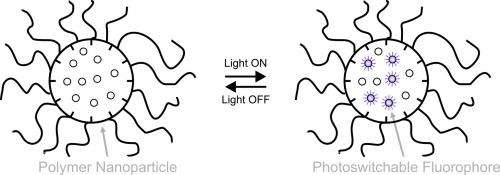
University of Miami scientists have developed a way to switch fluorescent molecules on and off within aqueous environments, by strategically trapping the molecules inside water-soluble particles and controlling them with ultraviolet light. The new system can be used to develop better fluorescent probes for biomedical research.
Previous studies have used water-soluble particles to bring organic molecules into water. What is novel about this system is the use of a photoswitching mechanism in combination with these particles.
The findings published online by Chemistry-A European Journal, describe the creation of a fluorescent photoswitchable system that is more efficient than current technologies, says Francisco Raymo, professor of chemistry at the UM College of Arts and Sciences and principal investigator of this study.
"Finding a way to switch fluorescence inside cells is one of the main challenges in the development of fluorescent probes for bioimaging applications," Raymo says. "Our fluorescent switches can be operated in water efficiently, offering the opportunity to image biological samples with resolution at the nanometer level."
Fluorescent molecules are not water soluble; therefore Raymo and his team created their system by embedding fluorescent molecules in synthetic water-soluble nanoparticles called polymers that serve as transport vehicles into living cells. Once inside the cell, the fluorescence of the molecules trapped within the nanoparticles can be turned on and off under optical control.
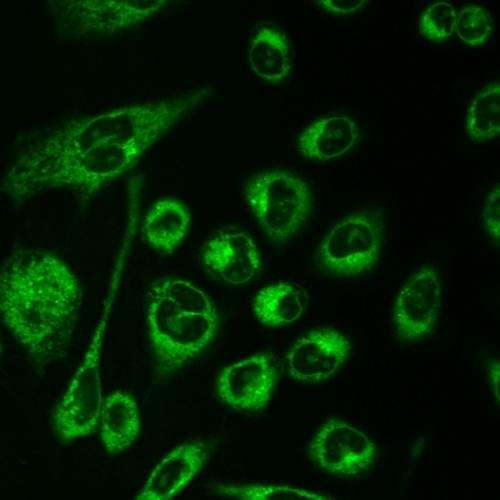
"The polymers can preserve the properties of the fluorescent molecules and at the same time assist the transfer of the molecules into water," Raymo says. "It's a bit like having a fish in a bowl, so the fish can carry on with its activities in the bowl and the whole bowl can be transferred into a different environment."
The new system is faster and more stable than current methods. The fluorescent molecules glow when exposed simultaneously to ultraviolet and visible light and revert back to their original non-luminous state in less than 10 microseconds after the ultraviolet light is removed.
By using engineered synthetic molecules, the new system is able to overcome the natural wear down process that organic molecules are subject to when exposed to ultraviolet light.
"The system can be switched back and forth between the fluorescent and non-fluorescent states for hundreds of cycles, without sign of degradation," Raymo says.
The surface of the system can be customize to help it attach to specific molecules of interests, thus allowing researchers to visualize structures and activity within cells, in real time, with a resolution that would otherwise be impossible to achieve.
Provided by University of Miami


