New technique improves rendering of smoke, dust and participating media
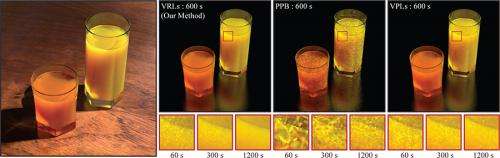
Computer graphic artists often struggle to render smoke and dust in a way that makes a scene look realistic, but researchers at Disney Research, Zürich, Karlsruhe Technical Institute in Germany, and the University of Montreal in Canada have developed a new and efficient way to simulate how light is absorbed and scattered in such scenes.
"Our technique could be used to simulate anything from vast cloudscapes, to everyday 'solid' objects such as a glass of orange juice, a piece of fruit or virtually any organic substance," said Dr. Wojciech Jarosz of Disney Research Zürich, who led the research team.
The team's new virtual ray lights technique will be presented Aug. 7 in the "Light Rays" session at this year's international SIGGRAPH conference, which focuses on the latest and greatest advances in Computer Graphics and Interactive Techniques, at the Los Angeles Convention Center.
Beneath the surface, this new approach leverages another Disney Research technology — photon beams, also developed by a team lead by Jarosz — which challenged the traditional views on how to simulate light in scenes with smoke, dust or other "participating media."
Normally, realistic rendering techniques simulate light using a set of particles (virtual "photons") that bounce off of walls and objects, depositing tiny bits of light-energy along their trip. It's this light-energy that's collected to form the final simulated image. But Disney researchers have found that it's much more efficient to use long and thin beams of light, instead of tiny photon particles, as a building block for generating images. This photon beams approach was presented at last year's SIGGRAPH conference in Vancouver and was also used to create magical wispy effects for Disney's Tangled. Since then Disney researchers have been hard at work to make the technique even better.
This latest work in the photon beams family looks at how photon beams contribute to so-called secondary lighting events in participating media: namely, when light enters a smoky or dusty room, the light particles actually hit and bounce off of the smoke or dust. This special game of ping-pong happens in reality at the speed of light, and the newly proposed technique investigates how entire beams of light are ping-ponged around the dust and smoke clouds in a room, or the pulp inside a glass of orange juice.
With this new technique computer graphics experts can simulate more realistic participating media effects, which occur more commonly than one would expect in the real-world: participating media effects account for the way we observe clouds, the appearance of fruit juices and milk, the haze in smoggy cities, and even the subtle dimming of distant objects on an otherwise clear day. The amount to which these effects can contribute to a final rendered image varies from tiny shifts to major rifts, but even the most subtle of changes to the appearance of a virtual scene, when executed correctly, can help convince otherwise oblivious audience members that what they are seeing is "real."
The virtual ray lights technique was also designed to be flexible, and the researchers hope it will find its way into many different areas of the computer animation and special effects industry. Virtual ray lights were designed to be progressive, meaning that they can very quickly generate a preview-quality result while converging to a final result as time goes by. On the one hand, this allows skilled technical artists at feature-film studios to quickly get feedback about their lighting setups and designs, as opposed to making changes and grabbing a coffee before being able to tell if their design changes are helpful or not. This rapid-feedback property reduces iteration time, allowing artists to focus on the end-goal instead of wrestling with the lighting tool. Another benefit of the progressive nature of the new technique is that users can choose between quality and performance, which is ideal for game developers who don't care so much about being 100 percent realistic but instead want their scenes to "just look great."
Finally, the virtual ray lights project is a shining example of Disney's commitment to bringing together the brightest experts from across industrial and academic research settings in order to push the limits of the state-of-the-art. This project was undertaken by four researchers in three countries across two continents: Jan Novák, an intern at Disney Research in Zürich and full-time PhD student at Karlsruhe Institute of Technology, worked alongside Wojciech Jarosz, a research scientist and head of the Rendering Group at Disney Research Zürich, Derek Nowrouzezahrai, a Disney Research post-doc and now assistant professor at the University of Montreal, and Carsten Dachsbacher, the head of the Computer Graphics Group at Karlsruhe Institute of Technology.
More information: The paper is available on the project's website at http://zurich.disneyresearch.com/~wjarosz/publications/novak12vrls.html.
Provided by Disney Research


