Strawberry extract protects against UVA rays
Aug 03, 2012
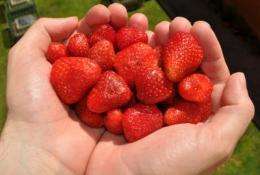
The experiment shows that strawberry extract added to skin cell cultures acts as a protector against UVA rays. Credit: SINC

An experiment has shown that strawberry extract added to skin cell cultures acts as a protector against ultraviolet radiation as well as increasing its viability and reducing damage to DNA. Developed by a team of Italian and Spanish researchers, the study opens the door to the creation of photoprotective cream made from strawberries.

"We have verified the protecting effect of strawberry extract against damage to skins cells caused by UVA rays," as explained to SINC by Maurizio Battino, researcher at the Università Politecnica delle Marche in Italy and lead author of the jointly Spanish and Italian study. The results are published in the Journal of Agricultural Food Chemistry.

The team prepared human skin (fibroblasts) and added strawberry extract in different concentrations (0.05, 0.25 and 0.5 mg/ml), the only exception being the control extract. Using ultraviolet light, the samples were then exposed to a dose "equivalent to 90 minutes of midday summer sun in the French Riviera."

Data confirm that the extract, especially at a concentration of 0.5 mg/ml, displays photoprotective properties in those fibroblasts exposed to UVA radiation, it increases cell survival and and decreases damage in the when compared with control cells.

"These aspects are of great importance as they provide protection for cell lines subject to conditions that can provoke cancer and other skin-related inflammatory and degenerative illnesses," outlines Battino.

The researcher recognises that this is the "first step in determining the beneficial effects of strawberries in our diet or as a possible compound source for 'food integrators' or cosmetics for instance."

The redness of anthocyanins

But what molecules give strawberries their photoprotective properties? Scientists suspect that it could be the anthocyanins, which are pigments that give leaves, flowers and fruits their red colour. Analyses have confirmed that extracts are rich in such substances.

"These compounds have important anti-inflammatory, antioxidant and anti-tumour properties and are capable of modulating enzymatic processes," explains another of the authors, Sara Tulipani from the University of Barcelona. She adds that "we have not yet found a direct relationship between their presence and photoprotective properties."

"At the moment the results act as the basis for future studies evaluating the 'bioavailability' and 'bioactivity' of anthocyanins in the dermis and epidermis layers of the human skin, whether by adding them to formulations for external use or by ingesting the fruit itself," states Tulipani.

Also made up of researchers from the Universities of Salamanca and Granada, in its previous works the team had already demonstrated that strawberries (Fragaria x ananassa) strengthen the red bloods and protect the stomach from the effects of alcohol.

Explore further: Protein study suggests drug side effects are inevitable

More information: Francesca Giampieri, Josè M. Alvarez-Suarez, Sara Tulipani, Ana M. Gonzàles-Paramàs, Celestino Santos-Buelga, Stefano Bompadre, JoséL. Quiles, Bruno Mezzetti, Maurizio Battino. "Photoprotective Potential of Strawberry (Fragaria × ananassa) Extract against UV-A Irradiation Damage on Human Fibroblasts". Journal of Agricultural Food Chemistry 60 (9): 2322-7, 2012.

add to favorites email to friend print save as pdf

Related Stories

Strawberries protect the stomach from alcohol

Oct 25, 2011

In an experiment on rats, European researchers have proved that eating strawberries reduces the harm that alcohol can cause to the stomach mucous membrane. Published in the open access journal Plos One, the st ...

Grapes protect against ultraviolet radiation

Jul 29, 2011

Some compounds found in grapes help to protect skin cells from the sun's ultraviolet radiation, according to a study by researchers from the University of Barcelona and the CSIC (Spanish National Research Council). The study ...

Purple pigments and obesity

Feb 11, 2008

Scientists in Arkansas are reporting new evidence that natural pigments responsible for the beautiful blue/purple/reddish color of certain fruits and vegetables may help prevent obesity. Their animal study, ...

Poplar tree leaf bud extract could fight skin aging

Jun 08, 2011

Antioxidants are popular anti-aging ingredients in skin creams, and now scientists are reporting a new source of these healthful substances — leaf buds of poplar trees. Their study appears in the ACS' Journal of Agricultural an ...

Recommended for you

Protein study suggests drug side effects are inevitable

18 hours ago

A new study of both computer-created and natural proteins suggests that the number of unique pockets – sites where small molecule pharmaceutical compounds can bind to proteins – is surprisingly small, meaning drug side ...

Attacking MRSA with metals from antibacterial clays

May 17, 2013

In the race to protect society from infectious microbes, the bugs are outrunning us. The need for new therapeutic agents is acute, given the emergence of novel pathogens as well as old foes bearing heightened antibiotic resistance.

Keeping fruit, vegetables and cut flowers fresh longer

May 15, 2013

New technology offers the promise of reducing billions of dollars of losses that occur each year from the silent, invisible killer of fruits, vegetables and cut flowers—a gas whose effects are familiar to everyone who has ...

Why don't beetles freeze in the winter?

May 14, 2013

For 37 years, Queen's University Biochemistry professor Peter Davies has been unraveling the mystery of why some organisms including insects and fish don't freeze in the winter. His research into insect antifreeze protein ...

User comments : 0

More news stories

Protein study suggests drug side effects are inevitable

A new study of both computer-created and natural proteins suggests that the number of unique pockets – sites where small molecule pharmaceutical compounds can bind to proteins – is surprisingly small, meaning drug side ...

Non-wetting fabric drains sweat

(Phys.org) —Waterproof fabrics that whisk away sweat could be the latest application of microfluidic technology developed by bioengineers at the University of California, Davis.

Beautiful 'flowers' self-assemble in a beaker

By simply manipulating chemical gradients in a beaker of fluid, materials scientists at Harvard have found that they can control the growth behavior of crystals to create precisely tailored structures—such ...

Attacking MRSA with metals from antibacterial clays

In the race to protect society from infectious microbes, the bugs are outrunning us. The need for new therapeutic agents is acute, given the emergence of novel pathogens as well as old foes bearing heightened antibiotic resistance.

Study shows where scene context happens in our brain

In a remote fishing community in Venezuela, a lone fisherman sits on a cliff overlooking the southern Caribbean Sea. This man –– the lookout –– is responsible for directing his comrades on the water, ...

Green conversion of heat to electricity

Soon, it will be possible to produce electricity from heat over 30 degrees emitted from a waste incinerator, refinery, or data processor. The start-up Osmoblue has just confirmed the feasibility of this new ...

New rice contamination reported in China

Authorities are investigating rice mills in southern China following tests that found almost half of the staple grain in one of the country's largest cities was contaminated with a toxic metal.