Watching a train of storminess in the tropical Atlantic ocean
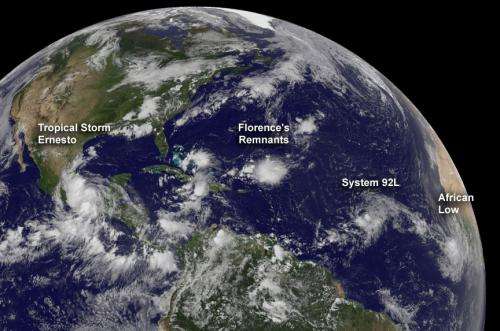
(Phys.org) -- This NOAA GOES-13 satellite image from 1745 UTC (1:45 p.m. EDT) today, August 9 shows some very active tropics. In the Atlantic Basin there are four areas that forecasters are watching.
NASA's GOES Project, located at NASA Goddard Space Flight Center in Greenbelt, Md. created a "full-disk" image of the Atlantic Ocean today, using data from NOAA's GOES-13 satellite. The image showed a "train" of low pressure areas in the tropical Atlantic Ocean.
Farthest west lies Tropical Storm Ernesto. At 10 a.m. EDT on August 9, the National Hurricane Center noted that Ernesto's center was located very close to the coast, or already on land, near 18.2 North and 94.3 West. Ernesto's maximum sustained winds were near 60 mph (95 kmh) with higher gusts, but as Ernesto moves inland it is expected to weaken. Ernesto is moving west near 10 mph (17 kmh) and will move over southern Mexico over the next two days.
The remnants of Tropical Storm Florence is next in the train of low pressure areas in the Atlantic. Those remnants are producing an area of disorganized showers and thunderstorms several hundred miles north-northeast of the Northern Leeward Islands. The National Hurricane Center gives this low just a 10 percent chance of organizing in the next couple of days.
Although System 92L follows that low, and is located about 1,000 miles west of the southern Cape Verde Islands looks ripe for development into the next tropical storm. It is actually located halfway between the Cape Verde Islands and The Lesser Antilles. Upper-level winds appear conducive for a tropical depression to form later today or tonight, according to the National Hurricane Center, who gives this system a high chance of becoming a tropical cyclone during the next 48 hours.
The final "car" in that train of low pressure areas is coming off the African coast. A tropical wave accompanied by an area of low pressure is approaching the west coast of Africa. The low has minimal shower and thunderstorm activity, but has a chance for some development. The National Hurricane Center gives it a 20 percent chance for becoming a tropical depression in the next couple of days.
Given that train of storms, it appears that chances are increasing that we'll soon see another tropical storm in the Atlantic.
Provided by NASA


