Parasitic wasps remember better if reward is greater
Aug 22, 2012
Kruidhof HM, Pashalidou FG, Fatouros NE, Figueroa IA, Vet LEM, et al. (2012) Reward Value Determines Memory Consolidation in Parasitic Wasps. Credit: PLoS ONE 7(8): e39615. doi:10.1371/journal.pone.0039615

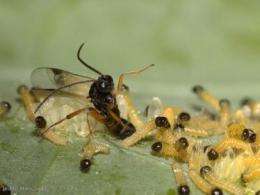
Two parasitic wasp species show similar memory consolidation patterns in response to rewards of different quality, providing evidence that the reward value affects the type of memory that is consolidated. The full results are reported Aug. 22 in the open access journal PLOS ONE.

The researchers, led by Marjolein Kruidhof of the Netherlands Institute of Ecology, tested how wasps store scents associated with situations of low reward (egg-laying into a inferior-quality host species that lays single eggs) versus high reward (egg-laying into a superior-quality host species that lays egg clusters) in their brain.

They found that both behaved similarly, retaining memory for the scent associated with the high reward scenario to a greater extent compared to the low reward scenario.

They write that this behavior makes sense given the energetic cost of consolidating shorter-lasting memory forms into long-term, consolidated memories, which may only be advantageous if the benefit is sufficiently high.

Explore further: Insects learn faster when they are rewarded with nectar

More information: Kruidhof HM, Pashalidou FG, Fatouros NE, Figueroa IA, Vet LEM, et al. (2012) Reward Value Determines Memory Consolidation in Parasitic Wasps. PLoS ONE 7(8): e39615. doi:10.1371/journal.pone.0039615

Related Stories

Insects learn faster when they are rewarded with nectar

Aug 01, 2012

Butterflies learn faster when a flower is rewarding than when it is not, and females have the edge over males when it comes to speed of learning with rewards. These are the findings of a new study, by Dr. Ikuo Kandori and ...

Ant queens lay more eggs as they age

Apr 11, 2012

Ant queens get better at laying eggs as they get older, researchers report in the Apr. 11 issue of the open access journal PLoS ONE. Furthermore, this high egg-laying rate did not shorten the queens' life spans, as would ...

Wood ant queen has no egg-laying monopoly

Jun 28, 2007

The reproductive monopoly of the ant queen is not as strong as is often thought. Dr. Heikki Helanterä and Prof. Lotta Sundström, biologists working at the University of Helsinki, Finland, investigated worker ovary development ...

Recommended for you

City-life changes blackbird personalities, study shows

just added

The origins of a young animal might have a significant impact on its behavior later on in life. Researchers at the Max Planck Institute for Ornithology in Radolfzell, Germany, have been able to demonstrate ...

Origins of 'The Hoff' crab revealed (w/ Video)

10 minutes ago

The history of a new type of crab, nicknamed 'The Hoff' because of its hairy chest, which lives around hydrothermal vents deep beneath the Southern Ocean and Indian Ocean, has been revealed for the first ...

Personality test finds some mouse lemurs shy, others bold

5 hours ago

Anyone who has ever owned a pet will tell you that it has a unique personality. Yet only in the last 10 years has the study of animal personality started to gain ground with behavioral ecologists, said Jennifer ...

Lonely bees make better guests

12 hours ago

Solitary bees are twice as likely to pollinate the flowers they visit as their more sociable counterparts, according to a new study.

User comments : 0

More news stories

Origins of 'The Hoff' crab revealed (w/ Video)

The history of a new type of crab, nicknamed 'The Hoff' because of its hairy chest, which lives around hydrothermal vents deep beneath the Southern Ocean and Indian Ocean, has been revealed for the first ...