Mars scientist explains why NASA chose Gale Crater for new rover
Aug 02, 2012
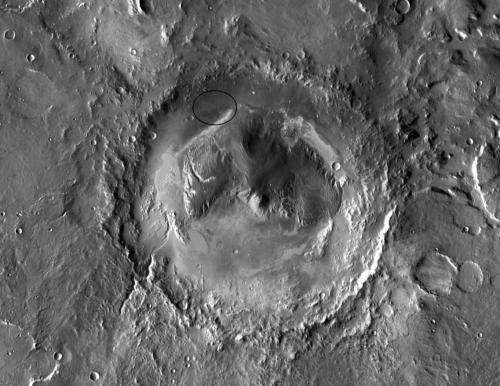
NASA's Mars Science Laboratory rover is set to land within the ellipse on the floor of Gale Crater on Mars. Gale is 96 miles (154 kilometers) in diameter and holds a layered mountain rising about 3 miles (5 km) above the crater floor. Photo by: NASA/JPL-Caltech/Arizona State University

NASA chose Gale Crater as a landing site for its Mars Science Laboratory rover because the giant crater probably had conditions that may have once hosted life. The bottom layers near the crater floor "have minerals in them that form in water," says Philip Christensen, Regents' Professor of Geological Sciences in ASU's School of Earth and Space Exploration.

These minerals include clays, sulfates, and gypsum, he says, and they can give scientists valuable clues about the habitability of early Mars.

Says Christensen, "The current thought is that when this crater first formed some 3.5 to 4 billion years ago, maybe in the bottom of it there was a standing lake, maybe there was groundwater." In any case, he says, there was enough water to make sediments that are full of aqueous minerals. These are good places to look for evidence of Mars' , past or present.

Christensen's comments appear in an interview given to science reporter Pete Spotts for the Christian Science Monitor (Aug. 1, 2012). They provide background on NASA's decision to send the rover to Gale.

Dubbed Curiosity, the rover is scheduled to land on Aug. 5, at 10:31 p.m. Arizona time. The size of a Mini-Cooper car, the one-ton nuclear-powered rover is the biggest, heaviest, and most sophisticated spacecraft ever sent to Mars.

Explore further: NASA's STEREO detects a CME from the sun

add to favorites email to friend print save as pdf

Related Stories

Daybreak at Gale crater

Aug 25, 2011

This computer-generated images depicts part of Mars at the boundary between darkness and daylight, with an area including Gale Crater, beginning to catch morning light.

Mojave Desert tests prepare for NASA Mars Roving

May 14, 2012

(Phys.org) -- Team members of NASA's Mars Science Laboratory mission took a test rover to Dumont Dunes in California's Mojave Desert this week to improve knowledge of the best way to operate a similar rover, ...

3Q: The next Mars rover's destination

Jul 25, 2011

When the next-generation Mars rover, dubbed Curiosity, touches down on martian soil next summer, its cameras will likely capture a scene similar to what the first explorers of the Grand Canyon witnessed: towe ...

Recommended for you

Mars rover Opportunity examines clay clues in rock

16 hours ago

(Phys.org) —NASA's senior Mars rover, Opportunity, is driving to a new study area after a dramatic finish to 20 months on "Cape York" with examination of a rock intensely altered by water.

NASA's STEREO detects a CME from the sun

May 17, 2013

On 5:24 a.m. EDT on May 17, 2013, the sun erupted with an Earth-directed coronal mass ejection or CME, a solar phenomenon that can send billions of tons of solar particles into space that can reach Earth ...

Nine-year-old Mars rover passes 40-year-old record

May 17, 2013

While Apollo 17 astronauts Eugene Cernan and Harrison Schmitt visited Earth's moon for three days in December 1972, they drove their mission's Lunar Roving Vehicle 19.3 nautical miles (22.210 statute miles ...

Bright explosion on the Moon

May 17, 2013

For the past 8 years, NASA astronomers have been monitoring the Moon for signs of explosions caused by meteoroids hitting the lunar surface. "Lunar meteor showers" have turned out to be more common than anyone ...

User comments : 2

Adjust slider to filter visible comments by rank

Display comments: newest first

deatopmg
1 / 5 (1) Aug 03, 2012
Hale crater may have been a far more interesting choice.
Deathclock
not rated yet Aug 28, 2012
Hale crater may have been a far more interesting choice.


I'm sure you know better than the scientists at NASA who studied these alternatives for months if not years before making this choice...

Some people are completely out of touch with reality, or drastically overestimate themselves.

More news stories

Galaxy's Ring of Fire

Johnny Cash may have preferred this galaxy's burning ring of fire to the one he sang about falling into in his popular song. The "starburst ring" seen at center in red and yellow hues is not the product of ...

Alaska volcano shoots ash 15,000 feet into the air

(AP)—One of Alaska's most restless volcanoes has shot an ash cloud 15,000 feet into the air in an ongoing eruption that has drawn attention from a nearby community but isn't expected to threaten air traffic.

Chinese, Indian airlines face EU pollution fines

Eight Chinese and two Indian airlines face fines of up to several million euros for not paying for their greenhouse gas emissions during flights within the bloc, the European Commission said on Friday.

Morocco to harness the wind in energy hunt

Morocco is ploughing ahead with a programme to boost wind energy production, particularly in the southern Tarfaya region, where Africa's largest wind farm is set to open in 2014.

US seizes Bitcoin operator accounts

US authorities seized the accounts of a Bitcoin digital currency exchange operator, claiming it was functioning as an "unlicensed money service business," court documents showed Friday.