Independent control of ionic and electronic conductivity research
Aug 15, 2012 by Anne M Stark
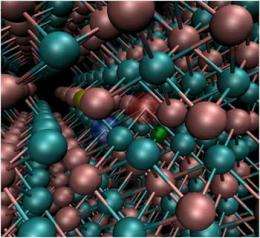
Atomic structure of co-dopant complex in thallium bromide that binds charged vacancies and reduces their mobility, allowing selective control over ionic conductivity without affecting electronic conductivity. 

(Phys.org) -- Lawrence Livermore National Laboratory researchers have discovered a new method to control the conductivity of materials that could eventually apply to fuel cells, batteries and gas sensors.

Postdoc Cedric Rocha-Leão, working with Condensed Matter and Division's Vince Lordi, has found a new method to independently control ionic and electronic conductivities in certain solids.

The method, which uses tailored acceptor-donor co-doping to bind charged native vacancies and selectively modulate ionic but not electronic conductivity, was developed by using first-principles materials simulations.

The computational materials design approach allowed quantitative screening of dopants to find those most effective for a particular application. Their recent work focused on optimizing conduction in thallium bromide for high-resolution room-temperature gamma radiation detectors, for which high electronic conductivity and low ionic conductivity are required.

Achieving simultaneous control of ionic and electronic conductivity in materials is one of the great challenges in solid state ionics. Since these properties are intertwined, optimizing one often results in degrading the other.

But the new limits ionic current without impacting the electronic properties for a general class of materials, based on co-doping with oppositely charged ions.

The research appears in the June 15 edition of Physical Review Letters.

Explore further: Atomic-scale investigations solve key puzzle of LED efficiency

Related Stories

Scientists demonstrate novel ionic liquid batteries

Apr 15, 2011

(PhysOrg.com) -- Scientists at the NRL Materials Science and Technology Division are providing solid evidence that there is a new route towards developing novel, lightweight energy storage devices. By moving ...

Scientists use nanocrystals as dopants

Jan 23, 2007

U.S. scientists discovered that nanocrystals can mimic atoms in solid-state devices by altering their electrical properties, thereby acting as dopants.

Ionic Liquid's Makeup Measurably Non-Uniform at the Nanoscale

Nov 10, 2009

(PhysOrg.com) -- Researchers at Texas Tech University, Queen's University in Belfast, Ireland, the University of Rome and the National Research Council in Italy recently made a discovery about the non-uniform chemical compositions ...

Recommended for you

Promising doped zirconia

May 17, 2013

Materials belonging to the family of dilute magnetic oxides (DMOs)—an oxide-based variant of the dilute magnetic semiconductors—are good candidates for spintronics applications. This is the object of ...

Nanocrystals grow from liquid interface

May 17, 2013

An international collaboration of scientists has discovered a unique crystalizing behavior at the interface between two immiscible liquids that could aid in sustainable energy development.

User comments : 1

Adjust slider to filter visible comments by rank

Display comments: newest first

gmurphy
not rated yet Aug 15, 2012
This insight was forged from first-principles materials simulations, in other words, a computer model. Strange how little controversy there is over the use of computer models in fields of study other than climate science, although, if you think about it, it's not that surprising at all.

More news stories

Galaxies fed by funnels of fuel

(Phys.org) —Computer simulations of galaxies growing over billions of years have revealed a likely scenario for how they feed: a cosmic version of swirly straws.

Google eyes emerging markets networks

Google has become deeply involved in a series of projects to build and operate wireless networks in emerging markets including sub-Saharan Africa and Southeast Asia, a report said Friday.

Facial-recognition technology proves its mettle

(Phys.org) —In a study that evaluated some of the latest in automatic facial recognition technology, researchers at Michigan State University were able to quickly identify one of the Boston Marathon bombing ...