Green tea compound shows promise for tackling cancer
Aug 22, 2012
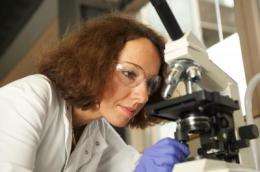
This is Dr. Christine Dufes. Credit: University of Strathclyde

A compound found in green tea could be a weapon in treatments for tackling cancer, according to newly-published research at the University of Strathclyde in Glasgow, Scotland.

The extract, known as epigallocatechin gallate, has been known to have preventative anti-cancer properties but fails to reach tumours when delivered by conventional intravenous administration.

However, in initial laboratory tests at the Universities of Strathclyde and Glasgow, researchers used an approach which allowed the treatment to be delivered specifically to the tumours after intravenous administration. Nearly two-thirds of the tumours it was delivered to either shrank or disappeared within one month and the treatment displayed no side effects to normal tissues.

The tests are thought to be the first time that this type of treatment has made cancerous tumours shrink or vanish.

In the tests, on two different types of , 40% of both types of tumour vanished, while 30% of one and 20% of another shrank. A further 10% of one of the types were stabilised.

The researchers encapsulated the in that also carried transferrin, a which transports iron through the blood. for transferrin are found in large amounts in many cancers.

Dr Christine Dufès, a senior lecturer at the Strathclyde Institute of Pharmacy and Biomedical Sciences, led the research. She said: "These are very encouraging results which we hope could pave the way for new and effective cancer treatments.

"When we used our method, the extract reduced the size of many of the tumours every day, in some cases removing them altogether. By contrast, the extract had no effect at all when it was delivered by other means, as every one of these tumours continued to grow.

"This research could open doors to new treatments for what is still one of the biggest killer diseases in many countries."

The research paper has been published in the journal Nanomedicine. Imaging equipment used in the research was funded by a grant from the Wellcome Trust.

Explore further: How nanotechnology could keep your heart healthy

Related Stories

Scientists develop new drug to outflank cancer resistance

Dec 11, 2007

A new drug has shown promising results against breast and prostate cancer cells and tumours that are resistant to conventional hormone-based treatments, according to research published in the British Journal of ...

Inhaler treatment for lung cancer

Oct 11, 2011

Lung cancer patients could receive safer and more efficient treatment through a system being developed by researchers at the University of Strathclyde in Glasgow.

Socking it to cancer

Aug 02, 2006

An Australian research team has identified a gene that could be used to stop tumours growing by blocking their blood supply.

Recommended for you

How nanotechnology could keep your heart healthy

May 17, 2013

Since the heart is such a delicate and critical organ, clinicians usually opt not to intervene with the dead cells that remain after a heart attack or cardiac disease. "But we think that all heart attacks deserve some kind ...

User comments : 2

Adjust slider to filter visible comments by rank

Display comments: newest first

Tangent2
1 / 5 (1) Aug 22, 2012
The Asians have been proclaiming the health/cancer benefits for years, this is nothing new. "Modern" medicine is slowly catching up.
kochevnik
5 / 5 (1) Aug 22, 2012
I wonder if transferrin encapsulation could work as a generalized tumor delivery strategy?

More news stories

Kinks and curves at the nanoscale

One of the basic principles of nanotechnology is that when you make things extremely small—one nanometer is about five atoms wide, 100,000 times smaller than the diameter of a human hair—they are going ...

Catching graphene butterflies

Writing in Nature, a large international team led Dr Roman Gorbachev from The University of Manchester shows that, when graphene placed on top of insulating boron nitride, or 'white graphene', the electr ...

Honeybees trained in Croatia to find land mines

(AP)—Mirjana Filipovic is still haunted by the land mine blast that killed her boyfriend and blew off her left leg while on a fishing trip nearly a decade ago. It happened in a field that was supposedly ...

Mice, gerbils perish in Russia space flight

A number of mice and eight gerbils sent into space in a Russian capsule destined to find out how well organisms can withstand extended flights perished during their journey, scientists said Sunday as the ...