An effect occurring for rotating objects at the speed of light has surprising relevance to everyday applications
Aug 10, 2012
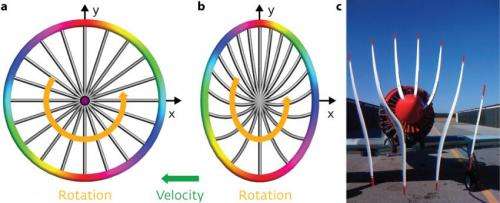
Figure 1: Relativistic flywheel (a and b): When a round flywheel (a) moves horizontally, close to the speed of light, it appears distorted to an observer (b). The rolling-shutter effect (c): CMOS camera chips are continuously read out from left to right of the image. This can lead to distortions of fast-moving objects that are strikingly similar to the relativistic Hall effect. Reprinted, with permission, from Ref. 1 © 2012 American Physical Society

It is tempting to believe that effects arising from Einstein’s theory of relativity, where objects move at speeds close to the speed of light, arise mainly at very large length scales, for example the movement of planets and stars. However, as Konstantin Bliokh and Franco Nori from the RIKEN Advanced Science Institute have demonstrated, this is not necessarily so. The researchers have shown that a combination of relativistic motions and rotation effects can lead to a rather general phenomenon that occurs for a range of objects, from black holes to small beams of light or electrons.

When an object is moving close to the , relativistic effects occur. For example, to an external observer an object moving very fast appears squeezed in the direction of the object’s motion (Fig. 1). This so-called Lorentz contraction arises from the timing in which light from the fast-moving object arrives at the observer. Bliokh and Nori have now shown that if such an object also rotates at the same time, for example a flywheel, then the rotating motion is also affected. The spokes in the wheel appear distorted in a way that makes them seem denser in one direction than the other. This is a general effect. For electron beams for example, it would appear as if the electrons accumulate mainly on one side. Hence, this effect has been named a relativistic Hall effect, as it is an analog of the usual Hall effect, where moving electrons in a magnetic field accumulate on one side of a material.

The effect on the spokes of a wheel bears a striking similarity to a problem in conventional photography known as the rolling-shutter effect. There, the way a CMOS-based image sensor, in for example a mobile phone camera, is continuously read out from one side to the other causes distortions that look very similar to the spokes of a flywheel. “The rolling shutter effect emulates the relativistic deformations as it introduces a mathematically very similar time delay to an object as the relativistic effects,” explains Bliokh.

Such analogies to photo and video cameras might also point to wider possibilities of observing the relativistic Hall effect in real-world systems that are mathematically identical to relativistic motions. But it is applicable to truly relativistic systems as well. “The relativistic Hall effect can play a role in astrophysical systems involving rotating black holes or vortex-like beams of light,” says Nori.

Explore further: Hall effect at the speed of light: How can you demonstrate relativistic effects with your mobile phone?

More information: Bliokh, K.Y. & Nori, F. Relativistic Hall effect. Physical Review Letters 108, 120403 (2012). prl.aps.org/abstract/PRL/v108/i12/e120403

add to favorites email to friend print save as pdf

Related Stories

Emerging from the vortex

Feb 17, 2012

Whether a car or a ball, the forces acting on a body moving in a straight line are very different to those acting on one moving in tight curves. This maxim also holds true at microscopic scales. As such, a ...

Mass is energy

Nov 21, 2011

Some say that the reason you can't travel faster than light is that your mass will increase as your speed approaches light speed – so, regardless of how much energy your star drive can generate, you reach ...

Car batteries powered by relativity

Jan 14, 2011

(PhysOrg.com) -- French physicist Gaston Plante invented the lead-acid battery in 1859 – almost 50 years before Einstein developed his theories of relativity. Now scientists have found that the lead-acid ...

Photonics: Beam me up

May 24, 2012

'Tractor beams' of light that pull objects towards them are no longer science fiction. Haifeng Wang at the A*STAR Data Storage Institute and co-workers have now demonstrated how a tractor beam can in fact be realized on a ...

Recommended for you

Breakthrough calls time on bootleg booze

18 hours ago

(Phys.org) —Using a laser, the St Andrews scientists can now carry out detailed analysis of a spirit sample no bigger than a teardrop and can even confirm whether it is toxic or not. It's hoped the testing ...

Bringing life into focus

May 17, 2013

Spinning-disk confocal microscopy is an optical imaging technique that can be used to generate detailed three-dimensional fluorescence images of living cells and their contents. Although a powerful tool for ...

World's smallest droplet

May 17, 2013

(Phys.org) —Physicists may have created the smallest drops of liquid ever made in the lab. That possibility has been raised by the results of a recent experiment conducted by Vanderbilt physicist Julia Velkovska and her ...

User comments : 4

Adjust slider to filter visible comments by rank

Display comments: newest first

antialias_physorg
5 / 5 (3) Aug 10, 2012
Tektrix
not rated yet Aug 10, 2012
The classic cartoon device that depicts fast-moving vehicles as having forward-tipping ovals for wheels, is an emulation of the same visual effect seen in early photographs made by cameras that used a rolling shutter.
Torbjorn_Larsson_OM
not rated yet Aug 10, 2012
This is a bad article. No one will see a relativistic Lorentz contraction, but a Penrose-Terrell rotation. "Oddly enough, though Einstein published his famous relativity paper in 1905, and Fitzgerald proposed his contraction several years earlier, no one seems to have asked this question until the late '50s. Then Roger Penrose and James Terrell independently discovered that the object will not appear flattened [1,2]. People sometimes say that the object appears rotated, so this effect is called the Penrose-Terrell rotation. Calling it a rotation can be a bit confusing though." [ http://math.ucr.e...ose.html ] Mainly, it is a flow in the vertical directions, a "rotation" in an analytic math sense.

A good example of a local low velocity relativistic effects is magnetism out of electrodynamics.
vacuum-mechanics
1 / 5 (1) Aug 10, 2012
When an object is moving close to the speed of light, relativistic effects occur. For example, to an external observer an object moving very fast appears squeezed in the direction of the objects motion (Fig. 1). This so-called Lorentz contraction arises from the timing in which light from the fast-moving object arrives at the observer.

By the way, talking about length contraction (which was interpreted from the evidence that occurred to the rigid arms of the apparatus in east-west direction) in the well known Michelson Morley experiment, it is interesting why and how such the rigid arms could contract! Me be there would be other interpretation as below.
http://www.vacuum...mid=6=en

More news stories

Lab sets a new record for creating heralded photons

(Phys.org) —Entanglement, by general consensus of physicists, is the weirdest part of quantum science. To say that two particles, A and B, are entangled means that they are actually two parts of an inseparable ...

Competition in the quantum world

Innsbruck physicists led by Rainer Blatt and Peter Zoller experimentally gained a deep insight into the nature of quantum mechanical phase transitions. They are the first scientists that simulated the competition ...

Breakthrough calls time on bootleg booze

(Phys.org) —Using a laser, the St Andrews scientists can now carry out detailed analysis of a spirit sample no bigger than a teardrop and can even confirm whether it is toxic or not. It's hoped the testing ...

New principle may help explain why nature is quantum

Like small children, scientists are always asking the question 'why?'. One question they've yet to answer is why nature picked quantum physics, in all its weird glory, as a sensible way to behave. Researchers ...

New immune system discovered

(Medical Xpress)—A research team, led by Jeremy Barr, a biology post-doctoral fellow, unveils a new immune system that protects humans and animals from infection.

Protein study suggests drug side effects are inevitable

A new study of both computer-created and natural proteins suggests that the number of unique pockets – sites where small molecule pharmaceutical compounds can bind to proteins – is surprisingly small, meaning drug side ...