Dawn Engineers Assess Reaction Wheel
Aug 14, 2012
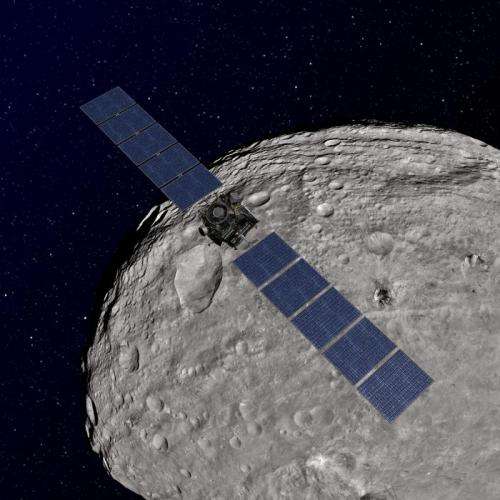
This artist's concept shows NASA's Dawn spacecraft orbiting the giant asteroid Vesta. The depiction of Vesta is based on images obtained by Dawn's framing cameras. Image credit: NASA/JPL-Caltech

Engineers working on NASA's Dawn spacecraft are assessing the status of a reaction wheel -- part of a system that helps the spacecraft point precisely -- after onboard software powered it off on Aug. 8. Dawn's mission is to study the geology and geochemistry of the giant asteroid Vesta and dwarf planet Ceres, the two most massive objects in the main asteroid belt. Dawn is now using its thrusters to point at Earth for communications. The rest of the spacecraft is otherwise healthy.

During a planned communications pass on Aug. 9, the team learned that the reaction wheel had been powered off. Telemetry data from the spacecraft suggest the wheel developed excessive friction, similar to the experience with another Dawn reaction wheel in June 2010. The Dawn team demonstrated during the cruise to Vesta in 2011 that, if necessary, they could complete the cruise to Ceres without the use of reaction wheels.

The spacecraft has been orbiting Vesta since July 15, 2011. Dawn concluded its primary science observations of Vesta on July 25, 2012, and has been spiraling slowly away from the giant asteroid using its ion propulsion system. Ion thrusting was halted to accommodate the reaction wheel investigation, which may briefly delay the escape from Vesta.

"The Vesta mission has been spectacularly successful, and we are looking forward to the exciting Ceres mission ahead of us," said Robert Mase, Dawn project manager, of NASA's Jet Propulsion Laboratory, Pasadena, Calif.

Explore further: Mice, gerbils perish in Russia space flight

add to favorites email to friend print save as pdf

Related Stories

Engineers Assess Dawn's Reaction Wheel

Jun 30, 2010

(PhysOrg.com) -- Engineers are studying the reaction wheels on NASA's Dawn spacecraft after automatic sensors detected excess friction building up in one of them and powered it off early on the morning of ...

Dawn gets extra time to explore Vesta

Apr 19, 2012

(Phys.org) -- NASA's Dawn mission has received official confirmation that 40 extra days have been added to its exploration of the giant asteroid Vesta, the second most massive object in the main asteroid belt. ...

Dawn Glides Into New Year

Nov 21, 2008

(PhysOrg.com) -- NASA's Dawn spacecraft shut down its ion propulsion system today as scheduled. The spacecraft is now gliding toward a Mars flyby in February of next year.

Dawn beams back asteroid science data

Aug 12, 2011

(PhysOrg.com) -- The Dawn spacecraft has completed a graceful spiral into the first of four planned science orbits during the spacecraft's yearlong visit to Vesta. The spacecraft started taking detailed observations ...

Recommended for you

Mice, gerbils perish in Russia space flight

13 hours ago

A number of mice and eight gerbils sent into space in a Russian capsule destined to find out how well organisms can withstand extended flights perished during their journey, scientists said Sunday as the ...

Mars rover Opportunity examines clay clues in rock

May 18, 2013

(Phys.org) —NASA's senior Mars rover, Opportunity, is driving to a new study area after a dramatic finish to 20 months on "Cape York" with examination of a rock intensely altered by water.

NASA's STEREO detects a CME from the sun

May 17, 2013

On 5:24 a.m. EDT on May 17, 2013, the sun erupted with an Earth-directed coronal mass ejection or CME, a solar phenomenon that can send billions of tons of solar particles into space that can reach Earth ...

Nine-year-old Mars rover passes 40-year-old record

May 17, 2013

While Apollo 17 astronauts Eugene Cernan and Harrison Schmitt visited Earth's moon for three days in December 1972, they drove their mission's Lunar Roving Vehicle 19.3 nautical miles (22.210 statute miles ...

Bright explosion on the Moon

May 17, 2013

For the past 8 years, NASA astronomers have been monitoring the Moon for signs of explosions caused by meteoroids hitting the lunar surface. "Lunar meteor showers" have turned out to be more common than anyone ...

User comments : 0

More news stories

Heat-related deaths in Manhattan projected to rise

Residents of Manhattan will not just sweat harder from rising temperatures in the future, says a new study; many may die. Researchers say deaths linked to warming climate may rise some 20 percent by the 2020s, ...

Mice, gerbils perish in Russia space flight

A number of mice and eight gerbils sent into space in a Russian capsule destined to find out how well organisms can withstand extended flights perished during their journey, scientists said Sunday as the ...

Kinks and curves at the nanoscale

One of the basic principles of nanotechnology is that when you make things extremely small—one nanometer is about five atoms wide, 100,000 times smaller than the diameter of a human hair—they are going ...

Honeybees trained in Croatia to find land mines

(AP)—Mirjana Filipovic is still haunted by the land mine blast that killed her boyfriend and blew off her left leg while on a fishing trip nearly a decade ago. It happened in a field that was supposedly ...