Cooler waters help diminish Isaac's punch
Aug 29, 2012 by Alan Buis
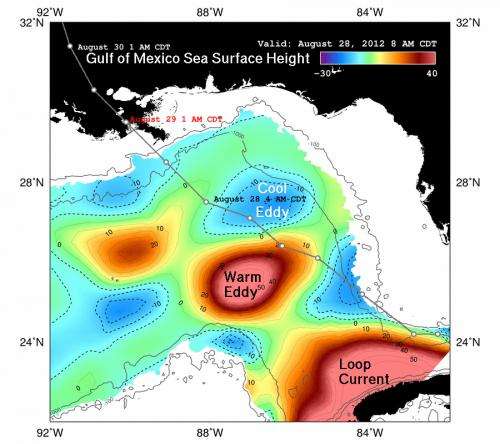
Color-enhanced image of sea surface heights in the Gulf of Mexico, showing Hurricane Isaac's path through the Gulf and around its warmest waters. Image credit: LSU Earth Scan Laboratory/U. of Colorado CCAR/NASA-JPL/Caltech

(Phys.org)—Seven years after the powerful Category 3 Hurricane Katrina caused widespread devastation along the Gulf Coast, a Category 1 Hurricane Isaac, with maximum sustained winds of 80 miles per hour (70 knots), is making landfall today in southeast Louisiana. And one of the reasons why Isaac is not Katrina is the path it took across the Gulf of Mexico and the temperature of the ocean below, which helps to fuel hurricanes.

In 2005, 's maximum wind speeds increased dramatically as the storm passed over a warm ocean circulation feature called the Loop Current that is part of the Gulf Stream. The storm evolved quickly from a Category 3 to a Category 5 event on the Saffir-Simpson in a matter of nine hours as it drew heat from the Loop Current. It subsequently dropped in intensity to a Category 3 storm at landfall.

Because the Loop Current and its eddies are warmer, and thus higher in surface elevation, than the surrounding waters, they are easily spotted by satellite altimeter instruments, such as those aboard the NASA/ Jason 1 and Ocean Mission/Jason 2 satellites. Scientists use the latest satellite measurements of sea-surface height from these and other satellite altimeters to create maps showing the location, direction and speed of currents in the Gulf of Mexico.

This color-enhanced image of sea surface heights in the northeastern Gulf, produced using data from available satellite altimeters, including NASA's Jason-1 and Jason-2 satellites, shows Isaac's path through the Gulf. The storm skirted around the Loop Current, then caught the outer edge of a warm eddy before passing directly over a cold eddy. The storm's track away from the Gulf's warmest waters has helped to keep Isaac from intensifying rapidly, as Hurricanes Katrina and Rita did in 2005.

Warm eddies have high heat content and great potential to intensify hurricanes, whereas cold eddies have low heat content and may even cause hurricanes to weaken, as was the case with Hurricane Ivan in 2004.

Explore further: NASA sees Hurricane Isaac affecting the Northern Gulf Coast (w/ Video)

Related Stories

NASA Satellites Keep Watch on Gulf Current Near Spill

May 25, 2010

(PhysOrg.com) -- Scientists and agencies monitoring the oil spill in the Gulf of Mexico are keeping a wary eye on changes in the nearby Loop Current, a warm ocean current that is part of the Gulf Stream.

Researchers make hurricane predictions more accurate

May 24, 2006

The hurricane forecasting model developed by University of Rhode Island and NOAA scientists – the most accurate model used by the National Hurricane Center over the last three years – has been improved ...

Hurricane Igor, unchained, in NASA satellite images

Sep 20, 2010

While its intensity has dropped slightly, massive Hurricane Igor remains a powerful Category Three storm, with maximum sustained wind speeds of 105 knots (115 miles per hour) as it continues on a projected ...

Envisat Images Hurricane Gustav

Sep 05, 2008

The development and path of Hurricane Gustav is shown via a sequence of satellite images acquired by Envisat's Medium Resolution Imaging Spectrometer (MERIS) instrument on 25 August, 28 August, 30 August and ...

Recommended for you

Strong earthquake at exceptional depth

10 hours ago

This morning at 05:45 CEST, the earth trembled beneath the Okhotsk Sea in the Pacific Northwest. The quake, with a magnitude of 8.2, took place at an exceptional depth of 605 kilometers. Because of the great ...

Marine forecasting on the horizon for Indian Ocean Rim

10 hours ago

Nearly all of the member countries of the Indian Ocean Rim Association for Regional Cooperation (IOR-ARC) will attend the week-long workshop to further cooperation and understanding on international ocean ...

Russia evacuates drifting Arctic research station

May 23, 2013

Russia has ordered the urgent evacuation of the 16-strong crew of a drifting Arctic research station after ice floe that hosts the floating laboratory began to disintegrate, officials said Thursday.

User comments : 0

More news stories

Galaxies fed by funnels of fuel

(Phys.org) —Computer simulations of galaxies growing over billions of years have revealed a likely scenario for how they feed: a cosmic version of swirly straws.

Dark, massive asteroid to fly by Earth on May 31

It's 1.7 miles long. Its surface is covered in a sticky black substance similar to the gunk at the bottom of a barbecue. If it impacted Earth it would probably result in global extinction. Good thing it is ...

Source of life running out: water scientists

The majority of people on Earth people will face severe water shortages within a generation or two if pollution and waste continues unabated, scientists warned at a conference in Bonn Friday.

Google eyes emerging markets networks

Google has become deeply involved in a series of projects to build and operate wireless networks in emerging markets including sub-Saharan Africa and Southeast Asia, a report said Friday.

Facial-recognition technology proves its mettle

(Phys.org) —In a study that evaluated some of the latest in automatic facial recognition technology, researchers at Michigan State University were able to quickly identify one of the Boston Marathon bombing ...