Dust from Asia pollutes US, Canada air: study
Aug 02, 2012
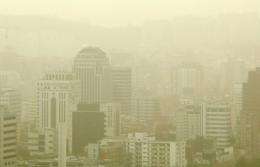
Skyscrapers in downtown Seoul are shrounded by yellow dust storms blowing in from China's Gobi desert in 2006. Dust and aerosol pollution from Asia travels across the ocean and sullies the air in the United States and Canada, possibly worsening the effects of climate change, a study showed Thursday.

Dust and aerosol pollution from Asia travels across the ocean and sullies the air in the United States and Canada, possibly worsening the effects of climate change, a study showed Thursday.

About half of the in North America come from foreign sources, and most are just from naturally occurring dust rather than from burning coal or other fossil fuels, said the research published in the journal Science.

Since could rise as a result of increasingly , drought and desertification brought on by , efforts by North America alone to curb pollution would not be enough, it said.

Instead, all nations must work together to cut back on in the environment, the study urged.

The imported aerosols could be harming the environment by absorbing radiation from the sun, altering cloud formation along with rain and snow patterns, and speeding snow melt in the western US mountains, said the study.

The research was based on data from a US-French environment satellite called CALIPSO that allowed scientists to separate which particles were natural dust and which were pollutant based.

The team included experts at the University of Maryland, NASA Goddard Space Flight Center and Universities Space Research Association in Maryland.

"To mitigate aerosol impacts on regional climate change, actions by a single nation are inadequate. The world must work cooperatively and act synchronically to meet the challenges of global health on a changing planet," said the study.

It also called for more study on how dust itself may affect climate.

"Dust emissions can respond to climate changes, such as changes of wind, precipitation and vegetation. It is thus essential to acquire better understanding of the interactions between dust and climate," the study said.

Researchers noted that their current focus was on foreign dust and aerosols carried into the United States and Canada, but that aerosols emitted and produced in North America certainly affect other regions in much the same way.

Explore further: Desert dust intensifies summer rainfall in U.S. southwest

More information: "Aerosols from Overseas Rival Domestic Emissions over North America," by H. Yu, Science, 2012.

add to favorites email to friend print save as pdf

Related Stories

Probing a link from Sahara dust to climate change

Feb 10, 2012

Qilong Min, Ph.D., Senior Research Associate and Professor with the Atmospheric Sciences Research Center (ASRC) at the University at Albany is developing innovative ways to measure how dust in the Sahara Desert ...

Aerosols -- their part in our rainfall

Feb 12, 2009

Aerosols may have a greater impact on patterns of Australian rainfall and future climate change than previously thought, according to leading atmospheric scientist, CSIRO's Dr. Leon Rotstayn.

Desert dust intensifies summer rainfall in U.S. southwest

May 21, 2012

(Phys.org) -- Dust is more than something to be brushed off the furniture. Scientists at Pacific Northwest National Laboratory found that dust kicked up from the desert floor acts like a heat pump in the atmosphere, ...

Recommended for you

NASA's BARREL mission launches 20 balloons

13 hours ago

(Phys.org) —In Antarctica in January, 2013 – the summer at the South Pole – scientists released 20 balloons, each eight stories tall, into the air to help answer an enduring space weather question: ...

Power of US tornado dwarfs Hiroshima bomb

14 hours ago

Wind, humidity and rainfall combined precisely to create Monday's massive killer tornado in Oklahoma. The awesome amount of energy released dwarfed the power of the atomic bomb that leveled Hiroshima.

Wet weather helped human culture grow (Update)

20 hours ago

We moan about the wet weather all too often but it may have been crucial in the development of human culture from about 70,000 years onwards, according to scientists reporting in Nature Communications today. ...

User comments : 2

Adjust slider to filter visible comments by rank

Display comments: newest first

NotParker
2.6 / 5 (5) Aug 02, 2012
"most are just from naturally occurring dust rather than from burning coal or other fossil fuels"

Vendicar_Decarian
3.7 / 5 (3) Aug 02, 2012
"To mitigate aerosol impacts on regional climate change, actions by a single nation are inadequate. The world must work cooperatively and act synchronically to meet the challenges of global health on a changing planet," said the study.

More news stories

NASA's IRIS mission readies for a new challenge

(Phys.org) —The time draws near. NASA is getting ready to launch a new mission, a mission to observe a largely unexplored region of the solar atmosphere that powers its dynamic million-degree outer atmosphere and drives ...

Eco database to map landscape projects

Environmental projects which map some of the most important benefits we get from nature have been brought together for the first time in an online database, following national survey work by researchers in the University ...

Coral reefs 'ruled by earthquakes and volcanoes'

(Phys.org) —Titanic forces in the Earth's crust explain why the abundance and richness of corals varies dramatically across the vast expanse of the Indian and Pacific Oceans, a world-first study from the ...

Coccoliths thrive despite ocean acidification

Ocean acidification is damaging some marine species while others thrive, say scientists. An international team studied the effect of ocean acidification on plankton in the North Sea over the past forty years, ...