Apollo 11: A giant leap for mankind and Cold War rivalry
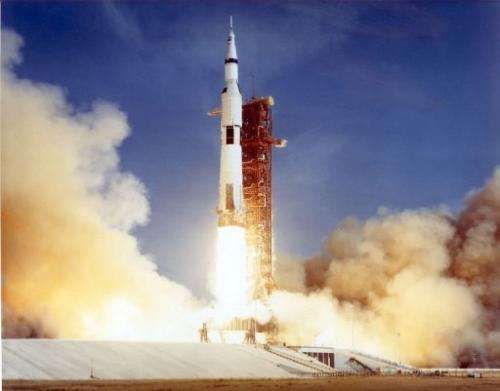
At 9:32 am on July 16, 1969 a 2,900-tonne Saturn V rocket blasted off from the Kennedy Space Center in Florida carrying the Columbia command module and the dreams of a generation.
The mission was Apollo 11, the commander was 38-year-old former navy pilot Neil Armstrong and the destination was the Sea of Tranquility, on the moon.
For the United States, the mission was a Cold War maneuver, a bid to fulfil the vow made by President John F. Kennedy that NASA could overtake the pioneering Russian space program and put a man on the moon.
But for spellbound audiences around the world, it was also an extraordinary and optimistic voyage of discovery and engineering.
The huge rocket carried Columbia and its crew—Armstrong and fellow NASA astronauts Buzz Aldrin and Michael Collins—into Earth's orbit before the third and final booster stage catapulted them toward the moon.
Columbia was docked with the Eagle lunar landing module, and three days later, the combined Apollo 11 craft found itself in orbit around the moon. On July 20, Armstrong and Aldrin uncoupled the Eagle and began their descent.
As they descended, monitored by NASA mission control in Houston and watched by an audience of millions around the world in an unprecedented live broadcast, a computer error in the navigation computer caused two alarms to sound.
The computer recognized it was receiving spurious data and corrected itself, maintaining its descent. Propellant was also sloshing around Eagle's tanks more than had been expected, triggering a premature low-fuel warning.
With co-pilot Aldrin calling out flight data, Armstrong guided the craft, touching down at 2017 GMT in a 300-meter wide crater with only 25 seconds of fuel left. He and Aldrin began to work through their landing checklist.
"We copy you down, Eagle," called out ground commander Charles Duke. Armstrong confirmed his engine was off before responding with the now legendary phrase: "Houston, Tranquility Base here. The Eagle has landed."
The commander, who died on Saturday aged 82, had another now famous remark prepared for the moment more than two hours later when he jumped from a short ladder onto the lunar surface, the first human ever on an alien world.
"That's one small step for (a) man, one giant leap for mankind," he said.
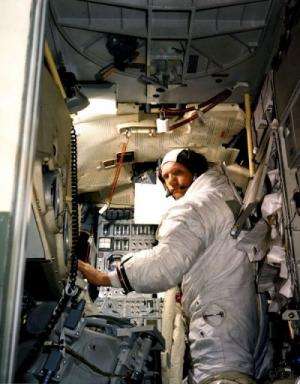
Twenty minutes later, he was joined by Aldrin and the pair spent 21 hours on the moon's rocky and powdery surface, marveling at a view of Earth that no one had seen before, and gathering rocks as samples for study.
The journey home was no less complicated from a technical standpoint, the Eagle lander having to launch itself from the surface and rendezvous with Collins on Columbia before setting off to Earth.
On July 24, the crew capsule ditched in the Pacific Ocean, with the triumphant trio onboard, braced for a heroes' welcome. Left behind them, planted firmly in the lunar dust, the Stars and Stripes symbolized America's victory.
For, if Apollo 11's mission had lasted just eight days, the moonwalk was also the culmination of a wager that had been made eight years earlier, when a young Kennedy had decided to challenge Moscow's lead in the space race.
The Soviet Union had put a satellite into orbit in 1957 and in 1961, Yuri Gagarin became the first man in space. Moscow trumpeted its advance as a sign of Communism's superiority over the Western model of liberal capitalism.
With the Cold War foes locked in a nuclear standoff, the United States could not afford this slight to its technical expertise and economic strength.
"I believe that this nation should commit itself to achieving the goal, before this decade is out, of landing a man on the moon and returning him safely to the Earth," Kennedy declared.
Thanks to NASA, its astronauts and $25 billion—an estimated $115 billion in today's dollars—he got his wish, and around 500 million television viewers around the world saw the star-spangled banner fly on the moon.
In 1970, a few months after the lunar landing, Soviet dissident Andrei Sakharov wrote in an open letter to the Kremlin that America's ability to put a man on the moon proved the superiority of a democracy.
There were six more Apollo missions and 12 more humans have walked on the surface of the Earth's lone mysterious satellite that has fueled dreams and imaginations since the earliest humans walked the planet.
But the last moonwalk was in 1972, and NASA's manned space program has been limited since the space shuttle program was taken out of service last year.
Extra-terrestrial exploration continues, however. Earlier this month, NASA landed the Curiosity rover, an unmanned buggy carrying scientific instruments, in the Gale Crater on Mars.
(c) 2012 AFP


