'Crash test cow' helps prevent farmer death and injury
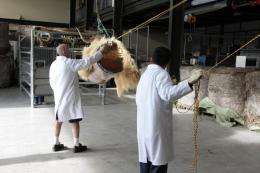
(Phys.org) -- A new type of cattle gate aimed at preventing farmer death and injury has completed rigorous testing and development by the CSIRO. SaferGate, designed by farmer and inventor Edward Evans, has been put to the test by a CSIRO-developed 'crash test cow'.
Hundreds of farmers and cattle handlers are injured in Australia operating cattle gates. According to latest statistics, 211 farmers were 'caught, crushed, jammed, or pinched in or between objects' between 2000 and 2005.1 Gate incidents also account for 0.5 per cent of deaths among agricultural workers in Australia.2
CSIRO's 60 kg test cow, which boasts authentic horns and hide, is designed to simulate the force of a bull or cow charging a cattle gate, used on farms, feedlots, in trucks and abattoirs across Australia.
CSIRO concluded its research last week with a series of simulated crash tests designed to evaluate how SaferGate would perform when charged or kicked by an animal. The tests were conducted by hoisting the cow to a height of five meters before launching it at the gate.
SaferGate is designed by Edward Evans, who had his own leg broken when operating a cattle gate on his farm. Unlike a traditional cattle gate, it swings away from the farmer or operator when a cow charges it, preventing injury or death. This is achieved by a pivot mechanism which splits the gate into two pieces when hit, allowing the part of the gate in front of the operator to fold back on itself and away from them.
In 2011 Mr Evans won the ABC's New Inventors grand final and was awarded testing and evaluation of the SaferGate by CSIRO. CSIRO scientists have improved the original design by adding a magnet on the SaferGate hinge (the magnetic latch), which allows the gate to remain in a steady position – like a traditional gate – until hit. They have also added a handle on top of the gate that makes it easier for workers on horseback to open the gate.
CSIRO's improvements have focused on simplifying the gates operation, optimising safety, and ensuring that all parts and mechanisms on the gate can be easily maintained when exposed to harsh weather conditions.
Research Project Leader Peter Westgate, who led the project, said: "We have never been asked to test the performance of a cattle gate before. Our bread and butter is industrial fire, materials and building testing, but knowing how big an issue safety is for farmers and operators made this project as rewarding as it was challenging.
"What our tests have shown us is that the harder and faster the gate is hit, the better it performs, and even though the tests use a 60 kg 'cow' compared to a real-life 1000 kg cow, the result is the same."
SaferGate inventor and company director Edward Evans said: "With the help of CSIRO, it is great to finally see my vision for SaferGate coming to life. The improvements we have made to the original gate now mean it is even safer and easier operate on foot or on horseback. I hope to see it helping to improve the safety of Australia’s farmers and cattle gate operators very soon."
SaferGate General Manager Mike Agnew said: "We are very pleased with the work that CSIRO has done and we are now focused on taking their designs forward and getting SaferGate manufactured and on the market. We hope to be selling SaferGate in Australia within the next six months."
The company is planning to launch the SaferGate initially in Australia and the United States.
Provided by CSIRO


