Rutgers engineers design cell phone app to reduce distracted driving
Jul 30, 2012 By Carl Blesch
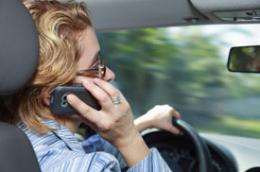
Rutgers engineers have developed an app that senses whether a driver is using a cell phone and takes steps to reduce distractions. Credit: Radu Razvan

(Phys.org) -- Laws that limit cell phone use while driving don’t seem to be curbing accidents blamed on drivers who insist on talking or texting behind the wheel.

This has some engineers and lawmakers wondering if technology can do what threats of fines or jail time are not. Could cell phones automatically become less distracting while their owners are driving?

Rutgers engineers believe they can. They and colleagues at Stevens Institute of Technology have designed and tested a smart phone application that pinpoints where a user is sitting: on the driver’s side or the passenger’s side.

If the latter, the lets the passenger use the phone with no restrictions.

If the former, the app takes several actions that reduce distractions to the driver. For example, it can silently forward incoming calls and texts to message boxes for later retrieval. It could also respond automatically to a caller or texter, saying that the owner is currently driving and will reply later. Or it could offer to put a voice call through if a caller or texter indicates the matter is urgent. For outgoing communication, the app could disable texting and make placing certain calls less difficult, perhaps by offering a short list of frequent contacts shown as large on-screen buttons.

Traffic accidents statistics that account for cell phone use are alarming. The National Highway Traffic Safety Administration estimates that 3,000 fatal traffic accidents nationwide last year were the result of . Studies have found that one in 20 traffic accidents involve a driver talking on a cell phone and that talking even while using a hands-free device carries as great a delay in reaction time as having a blood alcohol concentration of .08, the legal limit.
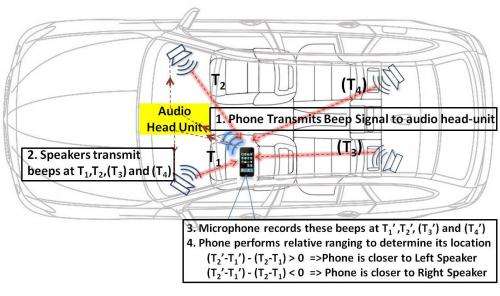
By measuring the amount of time that sound takes to travel from each speaker, the cell phone app can determine whether the phone is on the driver's side or the passenger's side of the car. Credit: Yang et. al., Rutgers University, Stevens Institute of Technology

Earlier suggestions on how technology could fight the problem, such as measuring how fast a cell phone is moving and cutting off conversations above a certain speed, were dismissed as overreaching.

“The trouble was, that would cut you off if you were a passenger in a car or if you were riding on a train,” said Marco Gruteser, associate professor of electrical and computer engineering and a member of the university’s Wireless Information Network Laboratory (WINLAB).

Gruteser and his colleagues devised a way for a cell phone to work with a car’s sound system to distinguish between the driver and passenger. It requires a stereo sound system with Bluetooth connectivity – a capability working its way into the mid-priced car market.

In their lab demonstration, a cell phone generates high-pitched beeps and transmits them to the car stereo over the Bluetooth connection. Beeps come out of left and right speakers at different intervals, and the phone uses its microphone to listen for the beeps it just sent. If beeps from the left speaker arrive fractions of a second faster than beeps from the right speaker, it means the phone is likely in the driver’s hands. A car with four-channel audio can perform the check more accurately, and may one day even be able to distinguish between front- and back-seat phone users.

The concept, while simple, had to prove itself in the cabin of a moving car, where acoustics are far from concert-hall perfect.

“That makes our 90 percent success rate look pretty good,” said Rich Martin, associate professor of computer science in the School of Arts and Sciences, who is also a member of WINLAB. The team wrote its initial app to run on an Android device and plans to develop one for the iPhone. The concept merited a best paper award at last year’s MobiCom, a leading academic and professional conference for mobile computing and wireless networking technology.

The engineers hope their demonstration spurs cell phone makers to pursue commercial development of the concept.

One question remains – would people accept this technology? Or would they perceive it as yet another “nanny state” action?

Drivers would still have to elect to comply, say the developers, who don’t see their technology as an enforcement technique.

”We’re making it easier for people who want to drive less distracted,” said Gruteser. He believes that many people understand the need to not talk and text, but they simply can’t resist the urge to pick up the handset when they hear that familiar ring or text chime. So their ongoing work, in collaboration with WINLAB assistant research professor Janne Lindqvist, focuses on how they can put the burden on people who call or text drivers. One idea is to alert potential callers via social networking that their friend or colleague is driving, and to hold off on placing calls or sending texts until the driver safely reaches his or her destination.

Contributing to the research from Rutgers were Gayathri Chandrasekaran, Tam Vu and Nicolae Cecan; and from Stevens Institute of Technology, Jie Yang, Simon Sidhom, Hongbo Liu and Yingying Chen. The work was funded by the National Science Foundation.

Explore further: Driver cellphone blocking technology could save lives

Related Stories

Driver cellphone blocking technology could save lives

Jul 05, 2012

Researchers in India are developing a new technology that will prevent truck drivers and other road users from using their cell phones while driving. The technology based on RFIDs could also be integrated with police traffic ...

Ford explores call turnoffs for stressed-out drivers

Jun 28, 2012

(Phys.org) -- No calls for you. That is the word from a new technology experiment by Ford, for stressed-out drivers who risk accidents by distractions from incoming calls, playing music, and other vehicle ...

Jaguar Leaps into Luxury of Bluetooth Wireless Technology

Mar 14, 2005

Motorola, Inc. and Jaguar announced the availability of the Jaguar Bluetooth system – a new hands-free in-vehicle communication system using Bluetooth wireless technology – across all Jaguar 2005 model year vehicles. Once a J ...

Recommended for you

Research finds new channels to trigger mobile malware

May 16, 2013

(Phys.org) —Researchers at the University of Alabama at Birmingham (UAB) have uncovered new hard-to-detect methods that criminals may use to trigger mobile device malware that could eventually lead to targeted ...

Fewer Facebook users take a liking to its new Home software

May 16, 2013

It may be too soon to call Facebook Home a flop. But it's clearly not the breakout hit that some expected. One month after its splashy debut, fewer and fewer people are downloading Facebook's new mobile software. It took ...

Google adds player matching to Android

May 15, 2013

Google is adding leaderboards and the ability to match players in online games to its Android operating system for smartphones and tablet computers.

User comments : 6

Adjust slider to filter visible comments by rank

Display comments: newest first

JGHunter
4 / 5 (4) Jul 30, 2012
The drawback is most of the people willing to partake are the ones least likely to be a problem.

I don't see why this has to be a matter of choice. Not driving whilst using the phone is the law anyway, why would this be any more "nanny" than throwing people in prison/giving people a hefty fine for being caught on the phone or causing an accident because of being on the phone? Furthermore, if you make it law to make phones like this, it is no longer down to the people but phone manufacturers. People choose to have phones, just like people choose to have an internet access, or own a gun, that doesn't mean they're allowed to do whatever they wish with these privileges. Likewise, it would not be "nannyish" to apply these technologies as law.
Modernmystic
3 / 5 (2) Jul 30, 2012
Keep the fines, this app will have all kinds of unintended consequences.

Let's say that someone has an extremely important call, one that we all could agree is worth pulling over and answering. It could cost people huge sums of money, or prevent them from saying their last words to a dying relative.

Sorry, but I'll take the fine if it means I'd get to say good bye to my Father for instance...

The world is never going to be a perfect place, no matter how many laws or cell phone apps we make.
A2G
1 / 5 (1) Jul 30, 2012
The law should be are you driving safely, period. I know that I would far rather trust my children's lives with me behind the wheel driving on the freeway while talking on a cell phone before I would let my mother drive them at 40 MPH and not talking. It is about reaction time and overall skill. Some older driver's are very dangerous and should not be driving. Then if I am ticketed by a cop he will call it in while driving at high speed and that is just fine? Just because some people can't walk and chew gum does not mean that the same limitations should apply to all.

The government has gotten out of control and we need to eliminate some laws and not add more. The current cell phone laws are just plain stupid. If you can't drive and talk, don't, but imposing this law on those who can talk and drive safely cost money and wastes a lot of time. IT is already against the law to drive unsafely. Isn't that enough?
88HUX88
5 / 5 (2) Jul 31, 2012
Calls that are considered very important rarely are. Having to say goodbye to your father while you are driving was chosen as an extreme example for its emotive property. What about the 3000 fatalities caused by distracted driving? Some of those dead people were some one else's father. What if you were talking to your father on a really important topic and caused him to die? Talking on the phone while driving is incredibly dangerous. Concentrate on the driving, every driver has the delusion they are safe and others are poor, special pleading means that the law should apply to others. NO, something like this that makes the roads safer and saves lives is a good thing. However good you think you are, you are less good while talking on a phone. The speed limit applies to all, even good drivers like you.
Pattern_chaser
not rated yet Jul 31, 2012
A2G is skilled enough to talk and drive, but others aren't? Hmm. Is this a way to spot the people who should have their phones taken off them before they get into a car? Listen to 88HUX88!!
Msafwan
5 / 5 (1) Jul 31, 2012
A2G is skilled enough to talk and drive, but others aren't? Hmm. Is this a way to spot the people who should have their phones taken off them before they get into a car? Listen to 88HUX88!!

Nobody is immune to attention deficit, that's why people are really serious about not allowing to talk behind the wheel.

If you are in an easy road then probably nothing will happen to you... but if someone suddenly crossed the road or there's a crash infront, then (if you talk behind wheel or drunk) you'll plow right thru them like you didn't see them... that's why talking behind the wheel is taken serious, and when it happen you can't use phone as an excuse because its against the law.

More news stories

Morocco to harness the wind in energy hunt

Morocco is ploughing ahead with a programme to boost wind energy production, particularly in the southern Tarfaya region, where Africa's largest wind farm is set to open in 2014.

US seizes Bitcoin operator accounts

US authorities seized the accounts of a Bitcoin digital currency exchange operator, claiming it was functioning as an "unlicensed money service business," court documents showed Friday.

Galaxy's Ring of Fire

Johnny Cash may have preferred this galaxy's burning ring of fire to the one he sang about falling into in his popular song. The "starburst ring" seen at center in red and yellow hues is not the product of ...

US psychiatry gets makeover in new manual

The latest makeover to a massive psychiatric tome honored by some, reviled by others and even called the "Bible" of mental disorders is being released Saturday with a host of new changes.