Researchers piece together how proteins fold
Jul 26, 2012 By Krishna Ramanujan
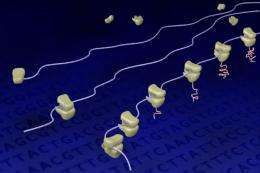
This image shows mRNA (purple) with ribosomes (beige) bearing nascent protein chains (pink) in different stages of folding. (S.B. Qian)

(Phys.org) -- A new method for looking at how proteins fold inside mammal cells could one day lead to better flu vaccines, among other practical applications, say Cornell researchers.

The method, described online in the July 16, allows researchers to take snapshots of the cell's protein-making machinery -- called ribosomes -- in various stages of . The scientists then pieced together the snapshots to reconstruct how proteins fold during their synthesis.

Proteins are made up of long chains of called polypeptides, and folding gives each protein its characteristic structure, which determines its function. Though researchers have used synthetic and purified proteins to study protein folding, this study looks at proteins from their inception, providing a truer picture for how partially synthesized polypeptides can fold in cells.

Proteins fold so quickly -- in -- that it has been a longtime mystery just how fold to create the protein's structure.

"The speed is very fast, so it's very hard to capture certain steps, but our approach can look at protein folding at the same time as it is being synthesized by the ribosomes," said Shu-Bing Qian, assistant professor of nutritional sciences and the corresponding author on the paper. Yan Han, a postdoctoral associate in Qian's lab, is the paper's first author.

In a nutshell, () carries the coding information for proteins from the DNA to ribosomes, which translate those codes into chains of amino acids that make up proteins. Previously, other researchers had developed a technique to localize the exact position of the ribosomes on the mRNA. Qian and colleagues further advanced this technique to selectively enrich only a certain portion of the protein-making machinery, basically taking snapshots of different stages of the process.

"Like a magnifier, we enrich a small pool from the bigger ocean and then paint a picture from early to late stages of the process," Qian said.

In the paper, the researchers also describe applying this technique to better understanding a protein called hemagglutinin (HA), located on the surface of the influenza A virus; HA's structure (folding) allows it to infect the cell.

Flu vaccines are based on antibodies that recognize such proteins as HA. But viruses have high mutation rates to escape antibody detection. Often, flu vaccines lose their effectiveness because surface proteins on the virus mutate. HA, for example, has the highest mutation rate of the flu virus' surface proteins.

The researchers proved that their technique can identify how the folding process changes when HA mutates.

"If people know the folding picture of how a mutation changes, it will be helpful for designing a better vaccine," Qian said.

"Folding is a very fundamental issue in biology," Qian added. "It's been a long-term mystery how the cell achieves this folding successfully, with such speed and with such a great success rate."

Co-authors include researchers at the National Institute of Allergy and Infectious Diseases.

The research was funded by the National Institute of Allergy and Infectious Diseases Division of Intramural Research, National Institutes of Health Grant, Ellison Medical Foundation Grant and U.S. Department of Defense Exploration-Hypothesis Development Award.

Explore further: Protein study suggests drug side effects are inevitable

Related Stories

Researchers Provide Evidence of How Proteins Fold

Sep 01, 2006

Experimental evidence provided by a Cornell researcher and colleagues at the Scripps Research Institute in La Jolla, Calif., support a long-held theory of how and where proteins fold to create their characteristic ...

'Snapshots' Shake Up Views about Proteins

Jun 14, 2006

In 2002, University of Maryland biochemist Victor Muñoz observed something about proteins that challenged the generally accepted theory about how proteins assume their biologically active states – a process called folding. ...

Protein folding made easy

Jun 07, 2011

Protein folding has nothing to do with laundry. It is, in fact, one of the central questions in biochemistry. Protein folding is the continual and universal process whereby the long, coiled strings of amino ...

Unfolding 'nature's origami'

Mar 02, 2009

Sometimes known as "nature's origami", the way that proteins fold is vital to ensuring they function correctly. But researchers at the University of Leeds have discovered this is a 'hit and miss' process, with proteins potentially ...

Recommended for you

New method for producing clean hydrogen

10 hours ago

Duke University engineers have developed a novel method for producing clean hydrogen, which could prove essential to weaning society off of fossil fuels and their environmental implications.

Making ice-cream more nutritious with meat left-overs

17 hours ago

Food industries are now turning meat left-over into high-protein content ingredients for food supplements, or to be added to processed food. But a EU-wide regulation covering them is still lacking.

Non-wetting fabric drains sweat

May 20, 2013

(Phys.org) —Waterproof fabrics that whisk away sweat could be the latest application of microfluidic technology developed by bioengineers at the University of California, Davis.

Protein study suggests drug side effects are inevitable

May 20, 2013

A new study of both computer-created and natural proteins suggests that the number of unique pockets – sites where small molecule pharmaceutical compounds can bind to proteins – is surprisingly small, meaning drug side ...

Attacking MRSA with metals from antibacterial clays

May 17, 2013

In the race to protect society from infectious microbes, the bugs are outrunning us. The need for new therapeutic agents is acute, given the emergence of novel pathogens as well as old foes bearing heightened antibiotic resistance.

User comments : 1

Adjust slider to filter visible comments by rank

Display comments: newest first

HannesAlfven
not rated yet Jul 26, 2012
Re: "Folding is a very fundamental issue in biology," Qian added. "It's been a long-term mystery how the cell achieves this folding successfully, with such speed and with such a great success rate."

This subject is discussed at great length in Gerald Pollack's Cells, Gels and the Engines of Life on page 118. It appears that cooperativity mechanisms involving both polymer and water are basically an essential feature of gel phase transitions. Although the fundamental mechanism has evolved into numerous specific forms, the protein's alternating charged surface (sized perfectly to accept water molecules) seems perfectly suited to theories of structured water within the cell.

It's long-past time to move beyond the polywater debacle, and reconsider the possibility that the structuring of water within the cell does things of importance. When researchers abandon this line of investigation, they abandon an incredibly functional toolkit.

More news stories

New method for producing clean hydrogen

Duke University engineers have developed a novel method for producing clean hydrogen, which could prove essential to weaning society off of fossil fuels and their environmental implications.

Protein study suggests drug side effects are inevitable

A new study of both computer-created and natural proteins suggests that the number of unique pockets – sites where small molecule pharmaceutical compounds can bind to proteins – is surprisingly small, meaning drug side ...

Beautiful 'flowers' self-assemble in a beaker

By simply manipulating chemical gradients in a beaker of fluid, materials scientists at Harvard have found that they can control the growth behavior of crystals to create precisely tailored structures—such ...

Attacking MRSA with metals from antibacterial clays

In the race to protect society from infectious microbes, the bugs are outrunning us. The need for new therapeutic agents is acute, given the emergence of novel pathogens as well as old foes bearing heightened antibiotic resistance.

Encouraging signs for bee biodiversity

Declines in the biodiversity of pollinating insects and wild plants have slowed in recent years, according to a new study. Researchers led by the University of Leeds and the Naturalis Biodiversity Centre in the Netherlands ...

If you can remember it, you can remember it wrong

(Medical Xpress)—Native peoples in regions where cameras are uncommon sometimes react with caution when their picture is taken. The fear that something must have been stolen from them to create the photo ...

B vitamins could delay dementia

(Medical Xpress)—Despite spending billions of dollars on research and development, drug companies have been unable to come up with effective treatments for dementia and Alzheimer's Disease (AD). Now, A. ...