NASA gets a cold stare from Emilia's eye
Jul 10, 2012
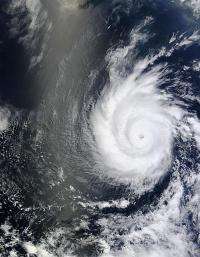
NASA's Terra satellite captured this visible image of Hurricane Emilia following Tropical Storm Daniel in the Eastern Pacific Ocean on July 9, 2012, at 1825 UTC / 2:25 p.m. EDT. Credit: NASA MODIS Rapid Response Team

NASA's Aqua satellite got a cold stare from Emilia. Infrared satellite data revealed that cloud top temperatures around Hurricane Emilia's eye were bitter cold.

The Atmospheric Infrared Sounder (AIRS) instrument that flies onboard NASA's Aqua satellite measured cloud top temperatures in the powerful thunderstorms surrounding Emilia's eye to be colder than -94 Fahrenheit (-70 Celsius). That indicates that they're very high in the troposphere, and very powerful (which would coincide with Emilia being a major hurricane).

NASA's captured a of Hurricane Emilia on July 9, 2012 at 1825 UTC / 2:25 p.m. EDT, and Emilia's eye was clearly visible in the image.

Emilia exploded from a Category 2 hurricane to a Category 4 hurricane on the Saffir-Simpson Scale since yesterday. Today, July 10 at 5 a.m. EDT, Emilia's were near 140 mph (220 kmh). By 11 a.m. EDT, Emilia's maximum sustained winds dropped to 130 mph (215 kmh),still holding to Category 4 hurricane status. Emilia was located about 685 miles (1100 km) south-southwest of the southern tip of Baja California. Emilia is moving at 10 mph (17 kmh) to the west-northwest.

The National Hurricane Center expects Emilia to continue weakening tonight through Thursday, July 12.

Behind Emilia to the east, lies System 98E, a tropical low pressure area that appears to be developing. The National Hurricane Center gives System 98E a 40 percent chance for development over the next couple of days. That means that while Emilia is chasing Tropical Storm Daniel (west of Emilia), there may be another named storm chasing Emilia in the next couple of days.

Explore further: NASA analyzes twin hurricanes in the eastern Pacific

add to favorites email to friend print save as pdf

Related Stories

NASA analyzes twin hurricanes in the eastern Pacific

Jul 09, 2012

There are two hurricanes in the Eastern Pacific today, Daniel and Emilia. NASA's TRMM satellite passed over both storms in pinpointed the intensity of the rainfall within each storm, indicative of their power. ...

Frigid cloud top temperatures show Hurricane Dora's power

Jul 20, 2011

Extremely cold cloud top temperatures in thunderstorms are an indication of the strength they possess, and infrared satellite data from NASA revealed a large area of very cold and powerful thunderstorms around ...

Recommended for you

Strong earthquake at exceptional depth

11 hours ago

This morning at 05:45 CEST, the earth trembled beneath the Okhotsk Sea in the Pacific Northwest. The quake, with a magnitude of 8.2, took place at an exceptional depth of 605 kilometers. Because of the great ...

Marine forecasting on the horizon for Indian Ocean Rim

11 hours ago

Nearly all of the member countries of the Indian Ocean Rim Association for Regional Cooperation (IOR-ARC) will attend the week-long workshop to further cooperation and understanding on international ocean ...

Russia evacuates drifting Arctic research station

May 23, 2013

Russia has ordered the urgent evacuation of the 16-strong crew of a drifting Arctic research station after ice floe that hosts the floating laboratory began to disintegrate, officials said Thursday.

User comments : 0

More news stories

Galaxies fed by funnels of fuel

(Phys.org) —Computer simulations of galaxies growing over billions of years have revealed a likely scenario for how they feed: a cosmic version of swirly straws.

Dark, massive asteroid to fly by Earth on May 31

It's 1.7 miles long. Its surface is covered in a sticky black substance similar to the gunk at the bottom of a barbecue. If it impacted Earth it would probably result in global extinction. Good thing it is ...

Source of life running out: water scientists

The majority of people on Earth people will face severe water shortages within a generation or two if pollution and waste continues unabated, scientists warned at a conference in Bonn Friday.

Google eyes emerging markets networks

Google has become deeply involved in a series of projects to build and operate wireless networks in emerging markets including sub-Saharan Africa and Southeast Asia, a report said Friday.