Methane measurements at low level flight
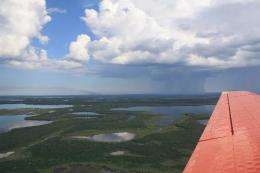
A team of scientists from the Alfred Wegener Institute for Polar and Marine Research in the Helmholtz Association (AWI) and the GFZ German Research Centre for Geosciences has just completed an airborne measurement campaign that allowed for the first time to measure large-scale methane emissions from the extensive Arctic permafrost landscapes. The study area extended from Barrow, the northernmost settlement on the American mainland, across the entire North Slope of Alaska, to the Mackenzie Delta in the Northwest Territories of Canada. The airborne measurements (Airborne Measurement of Methane - AIRMETH) at a flight level of only 30 to 50 meters above ground addresses two major questions: How much methane is emitted from permafrost areas into the atmosphere? Do well known geological point sources, i.e. the leakage of gas along geologic faults, contribute significantly to the total amount or does the microbially produced methane from the upper soil layers dominate?
"First of all, with these measurements we can quantify the current emis-sions and establish baseline data. On this basis, potential future climate-related changes can be determined. In addition, our data will help to better understand the still incompletely explored carbon cycle in the Arctic", said the GFZ scientist Torsten Sachs, head of the campaign.
In order to clarify the exact relationship between older geogenic and younger biogenic methane, isotope analysis would be required. In the Mackenzie Delta, however, the location of some geological sources is well known, so that selective measurements in the immediate surroundings allow conclusions about their contribution to the total emissions. In 2002, the GFZ was already involved here in a scientific drilling program for methane hydrate research. Covered by a 600 meter thick permafrost layer, this region stores unusually highly enriched methane hydrate reservoirs. These are currently considered the world's most significant accumulations under permafrost conditions.
The research aircraft Polar 5 of the Alfred Wegener Institute served as platform for the measurements. The machine of type Basler BT-67 was fitted with a meteorological nose boom, which includes a 5-hole probe to determine the 3D wind vector and temperature and humidity sensors. Via an intake on the roof of the airplane, air was also sucked into the cabin and examined with a fast methane analyser.
An initial screening of the results showed the need for the aircraft for the vast tundra areas: "By using the plane we have measured considerable regional differences in the methane concentration. This finding is new and important: on the one hand because the point measurements on ground stations have not yielded a very detailed and representative picture of the region. On the other hand because it showed that with the airborne measurements, we can close a data gap between the ground measurements and the available satellite data", says atmospheric researcher Dr. Joerg Hartmann from the Alfred Wegener Institute.
In a next step, the data will be analyzed in detail and the detected atmospheric flow processes will be integrated in computer models. The Alfred Wegener Institute is one of the world's leading science institutions in terms of permafrost and atmospheric research. Its scientists work both in the Russian tundra, on Svalbard and in the northern regions of Canada and the United States. As the national research centre for geosciences, the GFZ explores "System Earth" worldwide, with the geological, physical, chemical and biological processes that occur in the Earth's interior and on the surface. Both research institutions are Helmholtz centres.
Provided by Helmholtz Association of German Research Centres


