The more the merrier -- farmers must diversify to survive
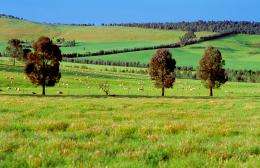
Aside from market fluctuations and changes in commodity prices, climate variability is the greatest threat to the long-term economic viability of dryland farms. In order to counter these uncertainties, many farmers have turned to diversification as a short-term survival strategy, but little research exists on the long-term benefits.
A recent study by CSIRO’s Sustainable Agriculture Flagship in the Lower Murray region in southern Australia set out to confirm whether diversification has any real long-term benefit for farmers. The findings were presented in a paper published recently in Ecological Economics.
The study used advanced simulation, probability theory and soil and climate modelling, including the Agricultural Production Systems Simulator (APSIM), and found that diversification not only helps farmers to hedge their bets against commodity price fluctuations, it can also help protect them from climate variability.
The study’s lead author, CSIRO’s John Kandulu, said diversification could reduce standard deviation by up to 52 per cent of average net returns and increase the probability of breaking even by up to 20 percent.
“Our study area covered 11.8-million hectares and included a range of agricultural practices as well as landscape types and climatic conditions,” Mr. Kandulu said.
“Using historic climate and soil records from 138 different zones over a 116 year period, we were able to apply modelling techniques to compare the performance of a wide range of agricultural enterprise mixes consisting of several different crops and livestock, with that of single-crop agricultural systems,” he said.
The research found diversification should be considered as a long-term strategy to mitigate economic risk from climate variability, a feature of farming that may increase in future in response to climate change.
Mr. Kandulu said the practice of mixed enterprise is not a ‘one size fits all’ solution.
“We found the greatest benefit for diversification can be achieved by those farmers in moderate rainfall areas where there is a mix of grazing and cropping, with limited benefit for those in very high and very low rainfall areas,” he said.
Mr. Kandulu said the results can also be applied to other regions of Australia that have the same soil and climatic conditions. In particular, the central parts of the Eyre Peninsula in South Australia, the Hay and Griffith regions of New South Wales and around Armadale in Western Australia could all reap long-term benefit from diversification.
“The next logical phase for this research is to expand it to a broader scale and include more land types, more soil types and a greater range of climatic conditions, and to assess the impact of diversification under projected future climate conditions,” Mr. Kandulu said.
Provided by CSIRO


.jpg)


