DARPA investments in extreme hypersonics continue
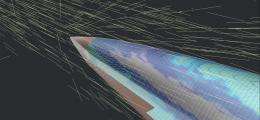
DARPA’s research and development in stealth technology during the 1970s and 1980s led to the world’s most advanced radar-evading aircraft, providing strategic national security advantage to the United States. Today, that strategic advantage is threatened as other nations’ abilities in stealth and counter-stealth improve. Restoring that battle space advantage requires advanced speed, reach and range. Hypersonic technologies have the potential to provide the dominance once afforded by stealth to support a range of varied future national security missions.
Extreme hypersonic flight at Mach 20 (i.e., 20 times the speed of sound)—which would enable DoD to get anywhere in the world in under an hour—is an area of research where significant scientific advancements have eluded researchers for decades. Thanks to programs by DARPA, the Army, and the Air Force in recent years, however, more information has been obtained about this challenging subject.
“DoD’s hypersonic technology efforts have made significant advancements in our technical understanding of several critical areas including aerodynamics; aerothermal effects; and guidance, navigation and control,” said Acting DARPA Director, Kaigham J. Gabriel. “but additional unknowns exist.”
Tackling remaining unknowns for DoD hypersonics efforts is the focus of the new DARPA Integrated Hypersonics (IH) program. “History is rife with examples of different designs for ‘flying vehicles’ and approaches to the traditional commercial flight we all take for granted today,” explained Gabriel. “For an entirely new type of flight—extreme hypersonic—diverse solutions, approaches and perspectives informed by the knowledge gained from DoD’s previous efforts are critical to achieving our goals.”
To encourage this diversity, DARPA will host a Proposers’ Day on August 14, 2012, to detail the technical areas for which proposals are sought through an upcoming competitive broad agency announcement.
“We do not yet have a complete hypersonic system solution,” said Gregory Hulcher, director of Strategic Warfare, Office of the Under Secretary of Defense for Acquisition, Technology and Logistics. “Programs like Integrated Hypersonics will leverage previous investments in this field and continue to reduce risk, inform development, and advance capabilities.”
The IH program expands hypersonic technology research to include five primary technical areas: thermal protection system and hot structures; aerodynamics; guidance, navigation, and control (GNC); range/instrumentation; and propulsion.
At Mach 20, vehicles flying inside the atmosphere experience intense heat, exceeding 3,500 degrees Fahrenheit, which is hotter than a blast furnace capable of melting steel, as well as extreme pressure on the aeroshell. The thermal protection materials and hot structures technology area aims to advance understanding of high-temperature material characteristics to withstand both high thermal and structural loads. Another goal is to optimize structural designs and manufacturing processes to enable faster production of high-mach aeroshells.
The aerodynamics technology area focuses on future vehicle designs for different missions and addresses the effects of adding vertical and horizontal stabilizers or other control surfaces for enhanced aero-control of the vehicle. Aerodynamics seeks technology solutions to ensure the vehicle effectively manages energy to be able to glide to its destination. Desired technical advances in the GNC technology area include advances in software to enable the vehicle to make real-time, in-flight adjustments to changing parameters, such as high-altitude wind gusts, to stay on an optimal flight trajectory.
The range/instrumentation area seeks advanced technologies to embed data measurement sensors into the structure that can withstand the thermal and structural loads to provide real-time thermal and structural parameters, such as temperature, heat transfer, and how the aeroshell skin recedes due to heat. Embedding instrumentation that can provide real-time air data measurements on the vehicle during flight is also desired. Unlike subsonic aircraft that have external probes measuring air density, temperature and pressure of surrounding air, vehicles traveling Mach 20 can’t take external probe measurements. Vehicle concepts that make use of new collection and measurement assets are also being sought.
The propulsion technology area is developing a single, integrated launch vehicle designed to precisely insert a hypersonic glide vehicle into its desired trajectory, rather than adapting a booster designed for space missions. The propulsion area also addresses integrated rocket propulsion technology onboard vehicles to enable a vehicle to give itself an in-flight rocket boost to extend its glide range.
“By broadening the scope of research and engaging a larger community in our efforts, we have the opportunity to usher in a new area of flight more rapidly and, in doing so, develop a new national security capability far beyond previous initiatives,” explained Air Force Maj. Christopher Schulz, DARPA program manager, who holds a doctorate in aerospace engineering.
The IH program is designed to address technical challenges and improve understanding of long-range hypersonic flight through an initial full-scale baseline test of an existing hypersonic test vehicle, followed by a series of subscale flight tests, innovative ground-based testing, expanded modeling and simulation, and advanced analytic methods, culminating in a test flight of a full-scale hypersonic X-plane (HX) in 2016. HX is envisioned as a recoverable next-generation configuration augmented with a rocket-based propulsion capability that will enable and reduce risk for highly maneuverable, long-range hypersonic platforms.
More information regarding the August 14 Proposers’ Day is available here.
Provided by DARPA


