Cell research: enzyme questions important principle of evolution
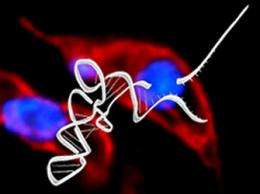
In evolutionary processes, it is the simple, economical solutions that prevail over the complex and laborious ones. A team of researchers led by Walter Rossmanith from the MedUni Vienna has now investigated the key enzyme, “ribonuclease P”, which is found in every living organism. The surprising result is that the principle of evolutionary economy does not appear to apply to this enzyme.
Enzymes are hugely important for living things. From digestion to the reproduction of genetic information, they control and accelerate the majority of biochemical reactions. Reason enough for a team of researchers led by Walter Rossmanith from the Centre for Anatomy & Cell Biology at the MedUni Vienna, together with researchers from the University of Marburg (Germany) and Vienna’s Max F. Perutz Laboratories, to take a closer look at the evolution of enzymes.
The enzyme “ribonuclease P” was used to investigate the importance of molecular complexity compared to simple solutions to the same problem. Or in other words, why is one enzyme only made up of one component, whereas others are made up of many?
In Trypanosoma brucei, the pathogen that causes sleeping sickness, the researchers found an organism that has a ribonuclease P made of just one protein. In all of the other higher cells investigated so far, such as baker’s yeast or humans, this same molecule has a more complex structure. Says Rossmanith, who initiated and led the study: “Of course, it is very interesting to know why the same enzyme is so complex in some organisms when there is a simple form available.”
Surprisingly, the researchers were able to easily replace the complex enzyme from baker’s yeast with the simple one from Trypanosoma brucei. “We now want to continue comparing the two forms of the enzyme in order to understand what the possible evolutionary advantage of the complex enzyme is. After all, this actually contradicts the tendency towards economy in evolutionary processes,” says Rossmanith. The results of the study were published in the renowned international journal “Cell Reports”.
The “ribonuclease P” enzyme is responsible for a key step in the production of certain RNAs (transfer RNAs – tRNAs) in the cells of all living things, from simple bacteria to humans. In all of the higher cells investigated so far, “ribonuclease P” is itself made up of RNA and at least ten proteins, with the RNA being the most important component. In the pathogen responsible for sleeping sickness, “ribonuclease P”, on the other hand, is made up of just one protein. Cells need tRNAs for the synthesis of proteins that keep them alive.
More information:
“Nuclear RNase P of Trypanosoma brucei: A Single Protein in Place of the Multicomponent RNA-Protein Complex” Andreas Taschner, Christoph Weber, Aurélie Buzet, Roland K. Hartmann, Andreas Hartig, Walter Rossmanith.
Cell Reports, July 2012, doi: 10.1016/j.celrep.2012.05.021
Journal information: Cell Reports
Provided by Medical University of Vienna


