Bats hang out in the burbs
Jul 31, 2012 By Bob Beale
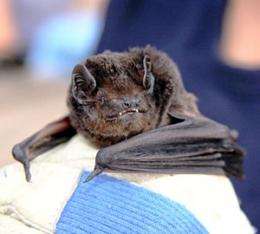
Only Gould's wattled bat can tolerate inner-city life. Credit: Tracy Morris

The greatest diversity of small insect-eating microbats in the Sydney region is not in the national parks that ring the city but in its western suburbs, according to a new study.

The key difference between the two habitats is the richer soils of those suburbs, reflecting the of Sydney’s early settlers for fertile farmland and water resources over the drier, sandy soils where the parks were later established.

The three-year study, led by Caragh Threlfall – dubbed in the media as “Batgirl” for her doctoral research – also found that in the more densely settled inner suburbs most microbats are absent.

Dr. Threlfall, now a research fellow at the University of Melbourne, and colleagues have published the results of their study in the journal PLOS One.

They found that only one of Sydney’s 20 or so species of microbats – Gould’s wattled bat – can routinely tolerate life in the highly urbanized inner city, while the less-developed of Penrith, Blacktown, Liverpool and Cabramatta were the most attractive to them. Bushy areas around creeks and rivers were especially attractive to them.

“We found that insect biomass was at least 10 times greater within suburban landscapes in bushland and backyards located on the most fertile soils than in the nutrient-poor sandy landscapes,” says Dr. Threlfall.

‘‘Urban restoration efforts should focus on creeklines and bushland reserves in areas of good soils, to benefit both insects and the bats that depend on them to survive.’’

While some species were found to have adapted to roosting in man-made structures, such as sheds and drains, most still depend on old tree hollows for refuge and breeding. Even though offer more roosting trees and caves, the insect life is richer in the better but more urbanised soils.

The study involved recording and analysing bat calls at 113 sites representing a wide variety of land-use types with 60 kilometers of the CBD, as well as nocturnal insect trapping.

Explore further: Navy dolphins discover rare old torpedo off Calif. coast near Coronado

add to favorites email to friend print save as pdf

Related Stories

Big trees boost city life

Feb 03, 2012

(PhysOrg.com) -- New research from The Australian National University has revealed for the first time the role large trees play in sustaining biodiversity and bird life in urban environments.

Ladybirds - wolves in sheep's clothing

Jun 24, 2011

(PhysOrg.com) -- CSIRO research has revealed that the tremendous diversity of ladybird beetle species is linked to their ability to produce larvae which, with impunity, poach members of 'herds' of tiny, soft-bodied ...

Three new bat species discovered in Indochina

Sep 05, 2011

Three new bat species have been discovered after an international team of scientists from the Hungarian Natural History Museum (HNHM) and Fauna & Flora International (FFI) embarked on a study in southern Indochina.

Key to controlling deadly viruses in bat community

Feb 15, 2011

CSIRO research into how bats can host some of the world’s deadliest viruses without suffering any ill-effects themselves will lead to improved strategies for controlling the spread of bat-borne diseases.

Scientist exposes threat to backyard bird diversity

Oct 29, 2007

A leading environmental scientist from the University of Western Sydney has revealed that parrots commonly thought of as native to Sydney, are in fact invaders from inland areas of Australia, and their growing presence is ...

Bush rats fight back

Nov 10, 2009

(PhysOrg.com) -- Sydney's native bush rats were unintended victims of a campaign to exterminate foreign black rats during a plague epidemic in 1900, according to new research by scientists who plan to reintroduce ...

Recommended for you

Scientists take a new look at an ancient crop

18 hours ago

Though the price makes you wince, you might just buy that bottle of your favorite olive oil anyway. Perhaps it's exactly what you want for the salad dressing you're making tonight and for your special stir-fry ...

Bittersweet: Bait-averse cockroaches shudder at sugar

May 23, 2013

Sugar isn't always sweet to German cockroaches, especially to the ones that avoid roach baits. In a study published May 24 in the journal Science, North Carolina State University entomologists show the ne ...

White tiger mystery solved

May 23, 2013

White tigers today are only seen in zoos, but they belong in nature, say researchers reporting new evidence about what makes those tigers white. Their spectacular white coats are produced by a single change ...

User comments : 0

More news stories

EU bans three pesticides harmful to bees

The European Commission said Friday that it will ban for two years beginning in December pesticides blamed for killing the bees that pollinate food and fruit crops.

Galaxies fed by funnels of fuel

(Phys.org) —Computer simulations of galaxies growing over billions of years have revealed a likely scenario for how they feed: a cosmic version of swirly straws.