Britons spend less time talking on mobiles: study
Jul 18, 2012
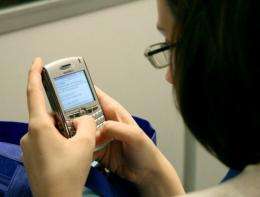
A woman texts on her mobile phone. The amount of time that Britons spend talking on their mobile phones has dropped for the first time -- by one billion minutes, a new Ofcom report revealed on Wednesday.

The amount of time that Britons spend talking on their mobile phones has dropped for the first time -- by one billion minutes, a new Ofcom report revealed on Wednesday.

Britons spent 125 billion minutes talking on their mobile phones in 2010, compared to 124 billion last year, the 's Communications Market Report showed.

Instead, text messaging has become the most popular form of daily communication between British adults, the figures revealed, with the average Briton sending 200 texts a month -- more than double the figure from 2008.

More than half of UK adults (58%) reported using texts at least once a day to communicate with their family and friends, whereas the figure for mobile phone calls was 47%.

Face-to-face conversations were the second most popular form of daily contact for British adults at 49%.

The figure for social networks such as or was 33%, making them the least popular form of daily contact covered by the study.

However use of social networks was increasing, with the report showing that British adults spent 3.3 hours a month social networking on a PC or laptop in 2011, up from 3.1 hours in 2010.

Despite the popularity of text messages, the overwhelming majority of said they would prefer to see their loved ones in person (67%) or speak on the phone (10%).

However the trend looks set to continue. Some 90% of 16 to 24-year-olds said they use text messaging at least once a day to communicate with friends and family, followed by (74%) and mobile phone calls (67%).

The figure for face-to-face contact among that demographic was 63%, making it the least popular form of communication for that age group -- though it was still higher than among adults.

"New forms of communications are emerging which don't require us to talk to each other - especially among younger ," James Thickett, Ofcom's director of research said.

"This trend is set to continue as technology advances and we move further into the digital age."

The report also showed that ownership of tablets such as Apple's iPad and Samsung's Galaxy Tab has shot up from 2% of UK households in 2011 to 11% in the first quarter this year.

Explore further: UK study: Calls place modest fifth in phone time use

add to favorites email to friend print save as pdf

Related Stories

Britons addicted to their 'CrackBerries': study

Aug 04, 2011

Many Britons are welded to their smartphones 24 hours a day and refuse to turn them off in cinemas and theatres, according to a study Thursday showing how the devices are changing social behaviour.

Study: Internet use leads to more diverse networks

Nov 04, 2009

(AP) -- A new study confirms what your 130 Facebook friends and scores of Twitter followers may have already told you: The Internet and mobile phones are not linked to social isolation.

Inexpensive fun fuels text messaging growth

Jan 31, 2007

Fun technology coupled with economical pricing fuel young adults' burgeoning use of text messaging, according to new research conducted by the DeGroote School of Business at McMaster University.

UK study: Calls place modest fifth in phone time use

Jul 01, 2012

(Phys.org) -- Remember when a phone used to be a phone? Not a camera, restaurant finder, music player, social networking check-in, or mini game diversion? A new survey makes it official. Engaging in phone ...

Reports of e-mail's death have been greatly exaggerated

Oct 14, 2010

All the ballyhoo that social networking sites such as Twitter and Facebook are diminishing our need for e-mail can be best summarized by paraphrasing Mark Twain: Reports of e-mail's death have been greatly exaggerated.

Recommended for you

Google launches Internet-beaming balloons

Jun 15, 2013

Wrinkled and skinny at first, the translucent, jellyfish-shaped balloons that Google released this week from a frozen field in the heart of New Zealand's South Island hardened into shiny pumpkins as they ...

Obama acts to free up spectrum to ease crunch

Jun 14, 2013

US President Barack Obama moved Friday to free up more broadcast spectrum used by federal agencies to help meet the surging demand from smartphones and other mobile devices.

US prosecutors want smartphone 'kill switch'

Jun 14, 2013

U.S. law enforcement officials are demanding the creation of a "kill switch" that would render smartphones inoperable after they are stolen, New York's top prosecutor said in a clear warning to the world's ...

User comments : 0

More news stories

Mozilla lab wants scientists to step out of analog age

(Phys.org) —Talk about big ideas. Not satisfied to rest on laurels of having brought forth the open source browser Firefox, Mozilla—defined by some as a global project, by others as one of the key open-source ...

3D printing tiny batteries

(Phys.org) —3D printing can now be used to print lithium-ion microbatteries the size of a grain of sand. The printed microbatteries could supply electricity to tiny devices in fields from medicine to communications, ...