All washed up and somewhere to go
Jul 23, 2012 By Cheryl Dybas
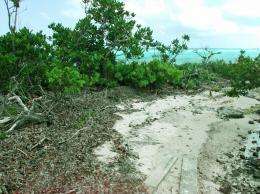
The "wrack line" on beaches: an ecological bridge between land and sea. Credit: David Spiller

(Phys.org) -- Wrack, it's called--the tangled mass of seaweed found on beaches around the world. It washes in with the high tide and lingers long after the waters recede.

Beach-goers in summer barely notice it, other than to call it a nuisance. They step across piles of it to get to the water, finding the little but a hindrance.

They might want to take a second look, says ecologist David Spiller of the University of California, Davis (UC-Davis), currently on leave at the National Science Foundation (NSF) as a program director in the Division of Environmental Biology.

"Seaweed provides an important connection between two ecosystems," he says, "that of the sea and that of the land."

Ecologists generally studied habitats with the idea that what happens there stays there--or at least stays within certain boundaries. They assumed that most interactions occur within one habitat, rather than across two or more.

But that thinking has gone out to sea.

Spiller and colleagues conducted a study of the effects of "deposition events" on seaweed species inhabiting tropical islands in the Bahamas. In this case, the researchers looked at seaweed transported from one location to another by hurricanes and other major storms.

They added seaweed to six shoreline plots and removed seaweed from six other plots over a three-month-period.  All plots were monitored for 12 months after the initial change.

Spiller found that washed-up seaweed is in fact a resource "subsidy" that's consumed by flies and small amphipods such as beach fleas, which in turn are eaten by and predatory arthropods like spiders.
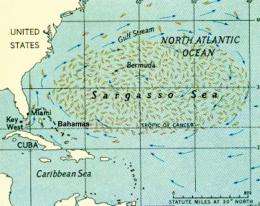
Much of the floating seaweed off the Bahamas is sargassum, named for the Sargasso Sea. Credit: bermudatriangle.org

Seaweed also decomposes directly into the soil, providing nutrients to plants. In the study, the growth rate of land-based plants near seaweed-subsidized plots was 70 percent higher than in non-seaweed-subsidized plots.

In subsidized plots, the density of lizards also increased rapidly, averaging 63 percent higher than in non-subsidized plots. In addition, lizards shifted their diets to marine-based prey.

When clumps of seaweed appeared on the scene, they attracted marine amphipods that reproduce rapidly. Lizards then went from land-based vegetation to seaweed to feast on the treasure trove.

The addition of seaweed also led to an increase in insect damage to plants living along the beach. When lizards moved to seaweed from land-based vegetation, their usual prey--plant-eating insects--were free to go on a spree, decimating plant leaves as they munched.

"What we saw may be called a 'fertilization effect' in which seaweed adds nutrients to plants, increasing their growth rate," says Spiller, "and a 'predator-diet-shift effect' in which lizards shift from eating land-based prey to consuming small, marine detritivores that breed in seaweed."
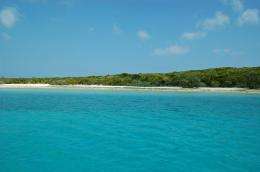
The deep blue sea: its seaweed is a treasure trove for species in the ocean and on land. Credit: David Spiller

Spiller and colleagues published the results in the journal Ecology. Co-authors of the paper are Jonah Piovia-Scott, Amber Wright, Louie Yang and Thomas Schoener of UC-Davis, Gaku Takimoto of Toho University in Japan, and Tomoya Iwata of the University of Yamanashi in Japan.

Understanding how various factors influence species interactions in food webs is a central goal of current ecological research, say the scientists.

In a follow-up study published in the journal Science, the biologists looked at the effect of another predator, ants, on plant-eating insects on the same islands. The ants chow down on the insects, giving plants a breather.

A combination of ants and lizards has a strong positive effect--on plants. But insects aren't as lucky.

Predatory ants on islands in the Bahamas are nocturnal; lizards go about their business by day. In a world with both ants and lizards, plant-eating insects are hit from both sides.

But when seaweed is added to the mix, the effect disappears. Like the lizards, the ants head for the beach to dine on small creatures breeding in shoreline seaweed. 

Damage to land-based plants then increases as there are more of the plant-eating insects.

"Ecosystems are clearly very complicated networks of interactions," says Spiller.

Seaweed "wrack" is likely to increase with more frequent storms as a result of global warming, as well as from increased nutrient run-off that fuels seaweed growth--and via a reduction in seaweed-eating fish caused by overfishing.

"We all need to take a closer look," says Spiller, "at that line of seaweed on the sand."

Explore further: Climate change may have little impact on tropical lizards

Related Stories

Island-scale study reveals climate-change effects

Jan 31, 2011

(PhysOrg.com) -- A large-scale UC Davis experiment with ants, lizards and seaweed on a dozen Caribbean islands shows that predicting the effects of environmental change on complex natural ecosystems requires a large laboratory.

Seaweed records show impact of ocean warming

Oct 27, 2011

As the planet continues to warm, it appears that seaweeds may be in especially hot water. New findings reported online on October 27 in Current Biology, a Cell Press publication, based on herbarium records collected in Aus ...

Recommended for you

Climate change may have little impact on tropical lizards

May 17, 2013

A new Dartmouth College study finds human-caused climate change may have little impact on many species of tropical lizards, contradicting a host of recent studies that predict their widespread extinction in a rapidly warming ...

Wetlands: value to locals matters most

May 17, 2013

A new way of valuing ecosystem services, incorporating the local perspective, is the driving force behind a project assessing aquatic ecosystems in highland areas of Asia

Symbolic saviour of an endangered species

May 16, 2013

In 2006 Berlin Zoo saw the birth of their first polar bear cub in 33 years. A retired circus polar bear gave birth to two cubs at the zoo. One of them died soon after, but Knut survived. At only a month old he became the ...

User comments : 8

Adjust slider to filter visible comments by rank

Display comments: newest first

danlgarmstrong
5 / 5 (2) Jul 23, 2012
Too much seaweed? What can that huge amount of biomass in the Sargasso Sea be used for? Biodiesel perhaps? Animal fodder? Wonder why we are not harvesting it.

...Anyone remember that Japanese oil tanker that was modified to 'skim' oil during the gulf oil leak a couple years ago? It could probably be used to fill up a HUGE cargo of seaweed. Might not be as profitable as a bellyfull of oil, but seeing as the seaweed is free for the taking, maybe it could be. And while I am thinking about it, why cant they use that tanker to scoop up all that plastic floating around? Then change that plastic back into oil. Might burn a lot of fuel collecting it up, maybe use sails to help reduce that cost...hmmm - thin film solar arrays on the sails?...
danlgarmstrong
5 / 5 (1) Jul 23, 2012
Just did a quick search on seaweed biodiesel and came across this:
http://biofuelsch...-biofuel

excerpt:
Seaweed is seen as an appealing option for biofuel because, unlike corn and sugar cane, it does not use arable land and so does not compete with crops grown for food.
Less than three percent of the worlds coastal waters can produce enough seaweed to replace some 60 billion gallons of fossil fuel, according to background information in the article.
At peak production, seaweed could produce 19,000 liters per hectare annually, about twice the level of ethanol productivity from sugarcane and five times higher than the ethanol productivity from corn.
danlgarmstrong
5 / 5 (1) Jul 23, 2012
OK - plenty of people have the same idea about using the Sargasso Sea for biodiesel. Google turns up 653,000 results on "Sargasso Sea Biodiesel". Y'know - I think the day is soon coming where Middle East politics won't make us worry about the supply of energy anymore.
danlgarmstrong
5 / 5 (1) Jul 23, 2012
I guess the big problem with using Sargasso seaweed is - of course - environmental concerns. The seaweed supports an awful lot of other life, turtles, eels and innumerable species of fish. They've established boundaries for a bio-preserve, but still harvesting outside of those boundaries will cause a lot of 'collateral damage'. A valid concern, I wonder if there is a good way to do green, ethical harvesting of that resource.
danlgarmstrong
5 / 5 (1) Jul 23, 2012
BTW - interesting study of the effects of seaweed 'wrack' on the beaches. All good stuff to know. All grist for the computer models that should be used to figure out sustainable living on our world.
PussyCat_Eyes
2.5 / 5 (2) Jul 23, 2012
Seaweed is also great for people with an iodine deficiency. Seaweed salad with a little vinaigrette and croutons is delicious. Wash the seaweed thoroughly to get rid of any bugs, then boil it for a few minutes and let it cool down. I've tried it when I was in California on vacation. It's a different taste...a little bit like collards but not quite.
Jimee
not rated yet Jul 23, 2012
Perhaps it might be better to proceed slowly. Overuse of anything is not helpful, and the sea is under devastating attack already. Let's get our biodiesel from the food crops we save when we decrease our population.
pres68y
not rated yet Jul 24, 2012
Good idea Jimee... send me your death certificate 1st and I'll do my part. :-)

More news stories

Honeybees trained in Croatia to find land mines

(AP)—Mirjana Filipovic is still haunted by the land mine blast that killed her boyfriend and blew off her left leg while on a fishing trip nearly a decade ago. It happened in a field that was supposedly ...

Heat-related deaths in Manhattan projected to rise

Residents of Manhattan will not just sweat harder from rising temperatures in the future, says a new study; many may die. Researchers say deaths linked to warming climate may rise some 20 percent by the 2020s, ...

Kinks and curves at the nanoscale

One of the basic principles of nanotechnology is that when you make things extremely small—one nanometer is about five atoms wide, 100,000 times smaller than the diameter of a human hair—they are going ...