South Korean paper hit by major cyber attack
Jun 11, 2012
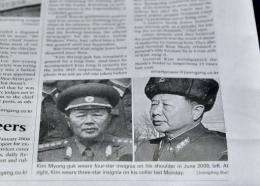
A reproduction of a page of South Korean newspaper JoongAng Daily created in Seoul in 2010 shows a story of North Korean General Kim Myong-Guk released in 2009 and 2010. The conservative South Korean newspaper said Monday it had been the victim of a major cyber attack, less than a week after North Korea threatened the paper and other Seoul media over their reports.

A conservative South Korean newspaper said Monday it had been the victim of a major cyber attack, less than a week after North Korea threatened the paper and other Seoul media over their reports.

Police are investigating Pyongyang's possible involvement in the hacking of the Internet news site and database server at the JoongAng Ilbo and sister paper the Korea JoongAng Daily, the Daily reported.

The English-language Daily said both papers lost the databases for articles and photos. The editing system that moves copy was also destroyed, disrupting production, by the cyber attack Saturday evening.

The paper, in a news report, said the connection to the site www.joongang.co.kr was cut off. A photo of a white cat and the statement "Hacked by IsOne" was posted instead.

It said a message suggested that more media sites would be hacked on two days, the 19th and the 29th, although the month was not specified.

North Korea's military on June 4 threatened attacks on the Seoul offices of South Korean including JoongAng Ilbo, for their critical coverage of a mass children's event in Pyongyang.

The military general staff listed the coordinates of some of the offices and said missile units and other forces had already targeted the buildings.

It did not mention a possible cyber-attack, although Seoul says its neighbour carried out several such attacks in the past.

"We have never seen a strong attack like this before," the paper quoted Jong Seok-Hwa, chief investigator of the national police force's Cyber Terror Response Center, as saying.

"We will find out the origin of the hacking and take necessary measures."

Unidentified officers were quoted as saying they are investigating possible North Korean involvement. Police and the newspaper could not immediately be reached for comment.

The Korea JoongAng Daily said the hacker connected to the website by typing in a domain address used only by employees.

It said the two papers are using a temporary server, and plan to normalise production as soon as possible by backing up lost data and installing a new operating system.

Seoul says Pyongyang has an elite team of hackers.

It accused the North of staging cyber-attacks on websites of South Korean government agencies and financial institutions in July 2009 and March 2011.

In May 2011 the South said a North Korean paralysed operations at one of its largest banks. Pyongyang says Seoul invented the charges.

Last month Seoul accused Pyongyang of jamming the GPS systems of hundreds of civilian aircraft and ships in South Korea between April 28 and May 13. The North rejected the South's accusations as "sheer fabrication".

Explore further: S. Korea military accuses North of stealing secrets

add to favorites email to friend print save as pdf

Related Stories

N. Korea blasts South over game site hacking claims

Aug 14, 2011

North Korea on Sunday lashed out at South Korea for accusing Pyongyang of hacking Seoul online game sites and stealing prize money, rejecting the allegations as an "unacceptable provocation."

S. Korean held for selling N. Korean malware

Jun 04, 2012

A South Korean has been arrested and accused of distributing illegal computer game programmes infected with malignant codes developed by North Korea, police said Monday.

2,700 hacking attempts on S.Korea military in year

Sep 28, 2011

South Korea's military has seen more than 2,700 attempts to hack into its websites over the past year, a lawmaker said Wednesday, amid growing concern over North Korea's cyber warfare capability.

Cyber attack on Seoul's Unification Ministry

Aug 09, 2011

The South Korean ministry which handles relations with North Korea has been targeted by hackers in the latest of a series of online attacks on government and corporate websites, an official said Tuesday.

Recommended for you

Review: Google music plan solid, serendipitous

15 hours ago

Google's new music service offers a lot of eye candy to go with the tunes. The song selection of around 18 million tracks is comparable to popular services such as Spotify and Rhapsody, and a myriad of playlists ...

Facebook joins Web freedom group

May 22, 2013

Facebook on Wednesday became a full member of the Global Network Initiative, a non-governmental organization promoting Internet freedom and privacy rights.

Big Data—for better or worse

May 22, 2013

A full 90% of all the data in the world has been generated over the last two years. The internet companies are awash with data that can be grouped and utilised. Is this a good thing?

User comments : 0

More news stories

Solar Kettle allows for boiling water off the grid

(Phys.org) —A company called Contemporary Energy has unveiled a new device it calls the Solar Kettle. It looks very much like a normal coffee thermos, but has flaps on one side that open to allow for collecting ...

Google Drive sports new view and scan enhancements

(Phys.org) —Google Drive has a new look and functions. The makeover in Google Drive features scanning and interface enhancements that put the user into "card" mode. The enhancements make it easy for the ...

Hormone replacement therapy—clarity at last

The British Menopause Society and Women's Health Concern have today released updated guidelines on Hormone Replacement Therapy (HRT) to provide clarity around the role of HRT, the benefits and the risks. The new guidelines ...

Controlling mood through the motions of mitochondria

(Medical Xpress)—Regulating the distribution of power in neurons is done by a system that makes the national electric grid look simple by comparison. Each neuron has several thousand mitochondria confined ...

A hidden population of exotic neutron stars

(Phys.org) —Magnetars – the dense remains of dead stars that erupt sporadically with bursts of high-energy radiation - are some of the most extreme objects known in the Universe. A major campaign using ...