Silkmoth inspires novel explosive detector
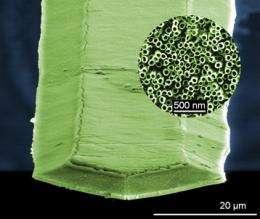
Imitating the antennas of the silkmoth, Bombyx mori, to design a system for detecting explosives with unparalleled performance is the feat achieved by a French research team. Made up of a silicon microcantilever bearing nearly 500,000 aligned titanium dioxide nanotubes, this device is capable of detecting concentrations of trinitrotoluene (TNT) of around 800 ppq (i.e. 800 molecules of explosive per 1015 molecules of air), thereby improving one thousand-fold the detection limit attainable until now. This innovative concept could also be used to detect drugs, toxic agents and traces of organic pollutants. This work is published on 29 May 2012 in the journal Angewandte Chemie.
The efficient detection of explosives such as trinitrotoluene (TNT) represents a difficult challenge in terms of security. Indeed, these compounds have very low volatility and it takes extremely sensitive sensors to detect them at a distance. Current systems detect concentrations of around 1 ppb (one molecule per 109 molecules of air), but this level of performance can be insufficient to ensure airport security for example. Yet, numerous animals have a sense of smell that can go well below this limit including, for example, the silkmoth (Bombyx mori), capable of reacting to the capture of just a few pheromone molecules. Its antennas are composed of strands of around one millimeter in length, bearing a large of number of sensilla, micrometric sized organs directly connected to the sensory neurons. It is this structure that the researchers sought to imitate.
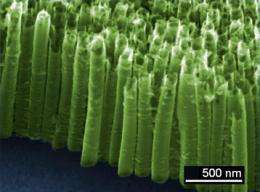
The system that they have developed comprises a 200-micron long and 30-micron wide silicon microcantilever. This support has been nanostructured with around 500,000 vertically aligned titanium dioxide nanotubes. The role of these nanostructures is to multiply the surface area of the microcantilever by a factor of around one hundred and to proportionally increase the chances of capturing the molecules being searched for. By making the microcantilever vibrate, it is possible to determine whether the ambient air contains traces of TNT and if these molecules have been captured by the device. In fact, the microcantilever has a particular resonance frequency that is modified in a specific manner when it absorbs molecules of explosive.
To test the performance of this device, the researchers released very small quantities of TNT in a controlled manner. In this way, there were able to establish that the sensitivity of the device was 800 ppq (800 molecules per million billion molecules (1015)). No current device is able to detect such low concentrations of explosives. These performance levels are similar to those of trained sniffer dogs.
Research and development work is still necessary before an easy-to-use device based on these nanostructured levers can be obtained. One of the next steps is to design a device capable of specifically recognizing the type of explosive absorbed. The scientists already hope to adapt these microcantilevers to the detection of other explosives, such as pentrite, which could pose security problems in Europe. Furthermore, this method could also be used to detect various drugs which, like explosives, have very low volatility. In environmental terms, this bio-inspired device could make it possible to measure infinitesimal traces of pollutants such as volatile organic compounds, which have become a major health issue.
More information: Bio-Inspired Nanostructured Sensor for the Detection of Ultralow Concentrations of Explosives. D. Spitzer, et al. Angewandte Chemie. 29 May 2012.
Journal information: Angewandte Chemie
Provided by CNRS


